
1) Though Several CMs Oppose, and Others Are Uneasy, Council Appears Likely to Forward Lee’s Strong Mayor Proposal to November Ballot
Despite several CMs vocally opposing Mayor Barbara Lee’s “strong mayor” ballot measure, and others appearing uneasy about it, the Council’s majority appears to be ready to send the initiative to the ballot. But one increasingly possible way that could happen is alongside a competitor ballot measure for a Council/Manager form of government that’s much more common in municipalities throughout California.
Council uneasiness with Lee’s proposal began to emerge at the Rules meeting where it was introduced several weeks ago. That body of 4 CMs has the power to put the brakes on initiatives in committee, as it has done for at least two CM-sponsored ballot measures this year*, but the Rules members referred the issue to full council. At Tuesday’s meeting, the first of two Council meeting readings required before passage, CMs Noel Gallo, Janani Ramachandran, and Zack Unger, all clearly said they did not support a strong mayor form of government. And while both CM Carroll Fife and CM Ken Houston said they are unsupportive of the Mayor’s proposal, they did support putting it before voters as one of two choices—the other being, the Council/Manager form of government.
Taken to their logical conclusion, the potentially negative votes would have been enough to either scuttle the legislation or put Lee in the awkward position of having to consider a tie-breaking vote on her own strong-mayor legislation Tuesday. But only Unger, Ramachandran and Gallo voted no at Tuesday’s meeting, the remaining CMs, who range from supportive to equivocal at least entertain the idea of further discussion.
Mayor and Council on the Dais in Rare Real Time Public Debate
The charter reform issue has put the Mayor and Council in a public debate rarely seen at council meetings, where the Mayor usually only appears briefly for tie-breaking votes and the state of the City address. Lee has likely already appeared before Council more times than any Mayor in memory in a single year, thanks to the requirements of the ballot measure process. Lee and her chief of staff, Preston Kilgore, have participated with rare directness in back and forth conversations with Council members on the dais.
In framing her presentation at the start of the meeting, Lee said that her proposal aims to answer three direct questions she often hears from the public: "Who is responsible when something goes wrong? Who has the authority to act? And who should voters hold accountable at the ballot box?"
Lee said the "strong mayor" proposal is the best answer to all those questions and also asked CMs to refrain from adding amendments to the ballot measure before forwarding it to voters.
Objectively, "Strong Mayor" Does Reduce Council Powers
Objectively, Lee’s proposal would reduce the Council’s power in meaningful ways. Council would have significantly reduced ability to influence the Mayor’s budget through amendment processes. And the Mayor’s line item budget and legislative vetoes would mean that the Mayor and only two allies on Council would have the final word on most decision-making, from policy to budget.
Other changes to Council would be more subtle. The CM role pays far better than a living wage, and it's rare for a CM to hold both the council job and another, but the new rules would bar that regardless while standardizing pay in a PEC-governed process. Two changes would give the Council some agency amid the reductions: Council would have a “confirmation” role over several key departmental head hires; and “Section 218” reform would remove some of the onerous hazards in Council communications with the City Administrator’s Office and Department heads.
CM Zac Unger, who started the Council discussion, framed that last as a pyrrhic consolation prize, given that the Council would lose its ability to affect legislation and budgeting.
“When the charter commission interviewed me, I told them that the main thing I wanted, as council member, was the greater ability to perform constituent services. What they brought me back was a plan that reduced my ability to perform constituent services. …this proposal diminishes the already minimal power that we have as council members. Under this new plan, the Mayor, who will now directly control the City Administrator, and would also be able to control budgeting and legislation with just a minority of the council. I will say that again, instead of a majority of the council making decisions under a strong mayor, a minority of the council can make those decisions,” Unger said, referring to the 6 votes that would be required to over-ride a Mayoral veto. That structure would give a handful of CMs inordinate power at the Council.
Unger added that despite the loss of power, Council members would become little more than targets of criticism for any administration’s failure.
“Council members under strong mayor would continue to be the face of futility, even greater futility than we already are, and will essentially become shields for all of the failures of the administration. If council members lose primacy on budgeting, lose primacy on legislation, lose even more juice on constituent services, then what is a council member even for?” Unger argued.
CM Janani Ramachandran was also direct but more circumscribed in her opposition to the plan. After praising Lee for making the move to begin addressing the issues of governance, Ramachandran nevertheless said she would respectfully disagree.
“When it comes to the issue of service delivery of core constituent service delivery, my personal belief is that the council manager system would be better to be able to do that...I am grateful that this conversation has begun, and I think we have a ways to go to get something on the ballot. So today I will not be supporting this proposal.”
An unusually cogent CM Noel Gallo also said he believed the Council working as one with the Mayor, and directing a City Administrator was the best way for charter reform.
“I am a strong supporter of a city council, city manager type of government, to deliver the service to the city and have control of budgeting, but most of all, be able to have the cooperation from the city manager and our city public works directors, and so forth, and have the mayor sit at every meeting, as we work together to move this city forward,” Gallo said. Gallo noted that the council/manager form of government was typical among 97% of the area’s jurisdictions.
CM Fife shared the concerns about giving up Council power, and giving too much power to an executive, but she said she preferred to put both models before voters and let them choose.
“I'm deeply concerned about giving away some of our powers in order to get things done in the city of Oakland. If we're going to place charter reform on the ballot, I think it's important that we give people options, because there are other options in the state of California that are working, and I think that [putting both] a council manager model and a strong mayor model would allow people to choose from multiple options, and that would be the ideal opportunity to have things for people to choose from. We know democracy is not simple, but it's the system that we've all committed to, and as such, we need to empower voters by placing options on the ballot," Fife said.
Houston’s opposition to the Strong Mayor system was more difficult to parse, but he largely agreed with Fife about putting both proposals on the ballot and allowing the public to choose.
Wang supports Lee’s proposal, but wants to add amendments that would give the City confirmation power over a larger number of department heads. Jenkins made few comments, but voted along with the majority to address the ballot measure again at the next meeting.
Brown, who had initially partnered with Unger to bring about a competitor council/manager proposal, implied that the newest iteration of Lee’s charter reform had satisfied her concerns. An initial draft of Lee’s legislation had done away with Brown’s seat as at-large council representative of the entire city, but that was removed several weeks ago. Brown also says that Section 218 changes actually respond to many of the concerns shared by her colleagues. It’s not clear if Brown supports putting both models on the ballot, however.
It’s also unclear that in their opposition, Unger, Ramachandran and Gallo would also support such a move. As it is, the likelihood of the measure going before voters is high, but the exact way that could happen is still unknown.
2) Wang Unable to Get Support for Delaying Measure NN Spending Plan
In an often emotional series of arguments Tuesday, CM Charlene Wang failed to move the majority of Council members to pause on a proposed Measure NN "community violence reduction" plan. CMs voted to accept the plan, which is required to be passed before the end of the fiscal year, 5 to 3.
A requirement of Measure NN is the establishment of a resident’s oversight commission and their creation of a plan. The community violence reduction plan must be adopted by Council prior to the expenditure of Measure NN funds in the coming fiscal year. Council can’t amend the plan, but can decline it and send the commission back for another draft. But the plan is only a high-level values statement that sets priorities and outlines certain strategies. Council will allocate funding in its budgeting process, according to the amounts set by the measure. The Oakland Public Safety Planning And Oversight Commission [OPSPOC] has been working on the plan, which highlights goals and priorities to inform the pre-set allocations, not line item expenditures, since September.
Wang's opposition to the plan has been hard to gauge. Initially, Wang said she wanted to continue the plan until votes are tallied on Measure E, a parcel tax measure for police, fire and other services, which now looks likely to fail. But later, Wang added more complaints about the plan. Wang said that the 911 spending portion was not sufficiently articulated. A majority of the Council, led by CM Rowena Brown, CM Janani Ramachandran and CM Carroll Fife, who made the substitute motion to accept the plan, noted that ultimately, Council has the burden to focus on priorities with direction from the plan. Those CMs also praised the commission for their work.
"At the end of day there are strategies, there are recommendations, but the amount of money that goes to OPD, OFD, and Violence Prevention is set in stone," Ramachandran said.
"As far as the dollar amount, it's not going to change, it's already in stone..." Brown agreed.
CMs Kevin Jenkins and Ken Houston supported Wang’s move.
Wang increasingly turned to different arguments, including that she believed OPD aren’t working hard enough to recruit new officers.
"Actually the component of the spending that I have the most concerns around is actually the OPD spending...this is where I think this is our role to push the department, especially I will say, when it comes to things like recruitment and retention. Because I'll give an example. I was reflecting on the conversation that we had in public safety, on some of the recruitment conversations that we had, and the OPD recruiter, their major recommendation is they needed a website. And I'm sorry, in reflection, they don't need a website. We can get a student from Laney College to design a website for, like, you know, 10k a pop." Wang said.
At another point, Wang grew emotional.
"Are people out there getting the services they deserve? They're not...and we heard it from our communities, mucho violencia," Wang said, switching to Spanish, "I mean it. I don't get emotional often."
CMs voted five to three to accept the plan, with Wang, Houston and Jenkins voting no.
3) Privacy Advisory Commission Forwards Expansion of Flock Authorized Search Parameters with Little Discussion
In a deliberation that lasted half an hour, including OPD’s presentation by Lt. Gabriel Urquiza, Oakland’s Privacy Advisory Commission [PAC] approved and forwarded a significant expansion of authorized search rationales to search OPD’s Flock license plate database. The lack of substantive questions by the PAC left many questions unanswered, but at times, Urquiza appeared to imply that OPD would be officially adopting a standardized set of terms created as a national boilerplate by Flock, not OPD. Urquiza also implied that the terms are already in use by OPD, despite not being included in the use policy.
The action item was placed on the agenda as a review of a revised use policy in the context of a required ALPR 2025 annual report. With unanimous PAC approval, the use policy with the added terms will now go to Council with a recommendation from the PAC to approve it as is.
The current Flock use policy includes a brief and general list of search uses, mostly focused on serious crimes and safety concerns, “missing or at-risk persons, witness locates, burglaries, grand theft, violent crime investigation, and in response to any subpoena, warrant, or other court order”.
The amended use policy submitted to the PAC on Thursday, and now on its way to Council, greatly expands the list in a detailed attachment.
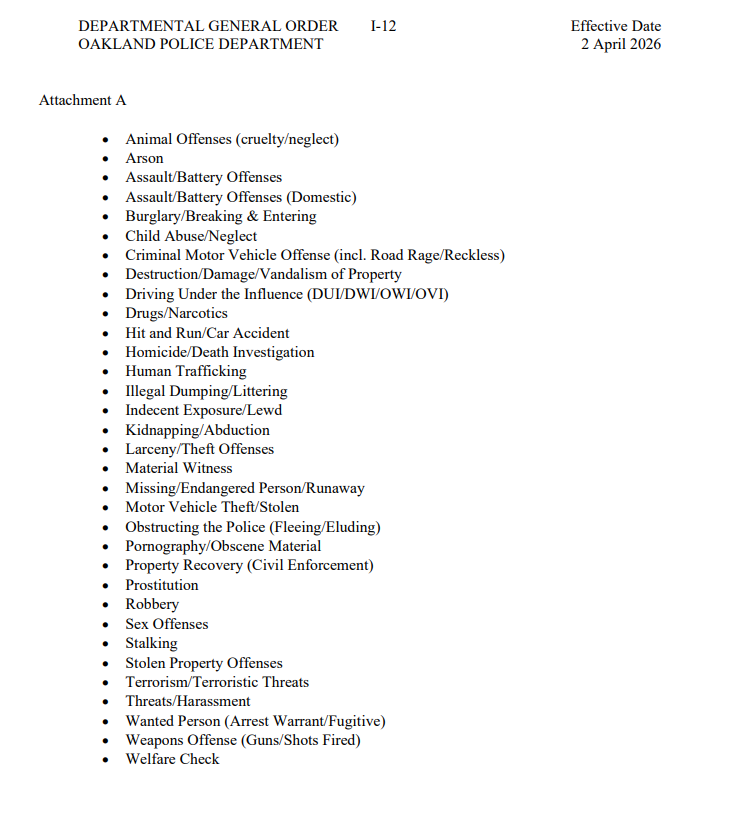
The new list includes low-level crimes, such as drugs/narcotics possession, littering, vandalism. The list also expands non-criminal rationales, including, apparently, welfare checks, the possession of pornography and property recovery.
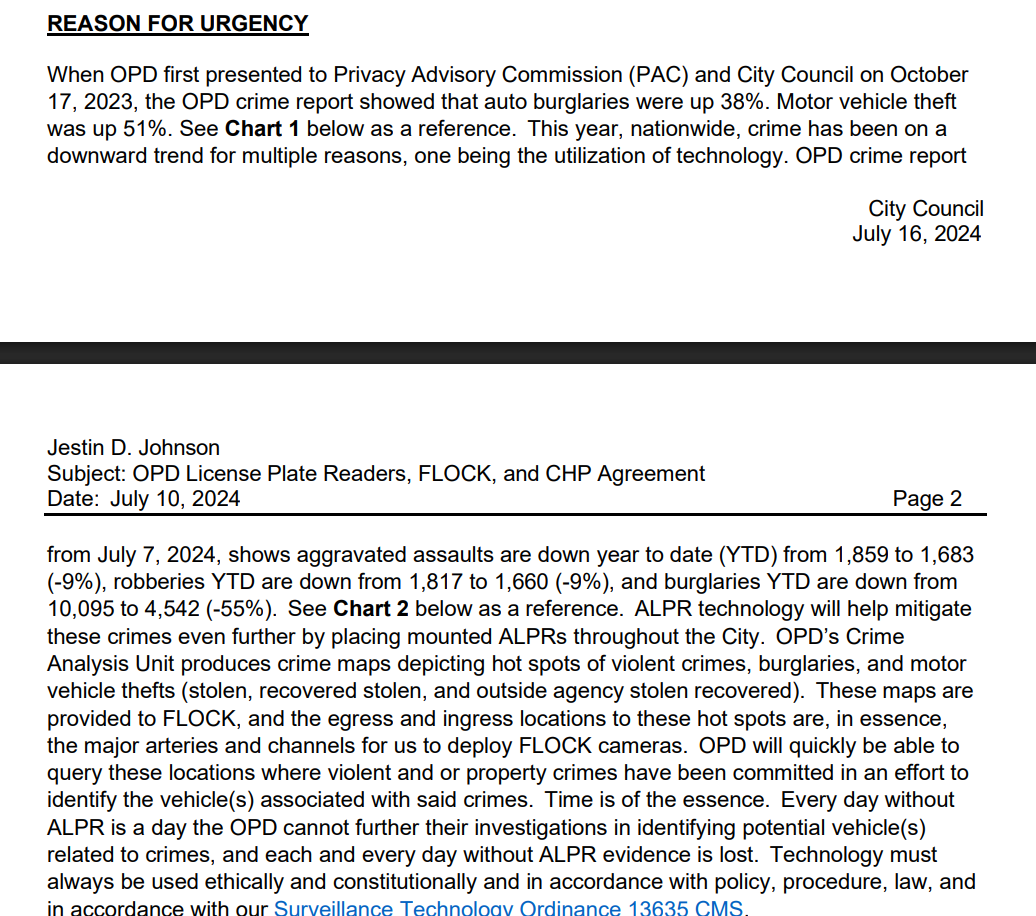
In presentations to Council, OPD has argued that Flock was necessary to stop Oakland's car theft and more serious violent crimes such as carjacking and homicide, but did not give the impression that vehicles would be tracked for issues like simple drug use, now apparently included in the new list.
Some of the general terms are hard to parse and were not given adequate explanation by Urquiza or follow up by Commissioners—its not clear if property recovery refers to civilian or police asset forfeiture, for example.
At one point, Urquiza appeared to suggest that Flock created the terms as a universal "pull down list", but also appeared to suggest that OPD is already using the list it presented, and that it was the inspiration for Flock's pull-down list.
"Since we implemented our standardized drop down list Flock implemented their own, which is now used throughout the system, which kind of emulated what we had already done, and we have changed those search reasons to be standardized with the reasons that are in Flock," Urquiza said.
But Urquiza was unable to explain the logic behind some of the terms when asked.
Urquiza, for example, said that one troubling line item “terrorism/terroristic threats” is just the penal code terminology for “criminal terroristic threats” that constitutes serious threats of violence, not a more widely understood concept of terrorism.
"For something like terrorist threats, that's a California penal code definition, and that's talking more about like if someone says that they're going to shoot somebody, that would be a terroristic threat. We're not talking about terrorism as kind of, what we think about it as a society," Urquiza said.
But the term terrorism does not appear in the California penal code 422 from which the term "terroristic threats" was originally derived, leaving questions about why it is included. Chair Henry Gage asked Urquiza why the term "terrorist" is used at all, given that it does not appear in 422. Urquiza replied that it was there to emulate more boilerplate language in use in criminal investigations throughout the country and the Uniform Crime Reporting definitions [the term also does not appear in the UCR]. Gage did not return to the question.
Other terms appear to conflate types of crimes, like illegal dumping/littering, two distinct crimes with very different penalties. “Reasonable suspicion” is the minimum metric required to perform the searches, a very broad criteria subject to interpretation. It also brings up questions of under what guidelines non-criminal criteria, such as welfare checks and material witness, will be searched.
The Oakland Observer has emailed a request to OPD for more detailed information about each use description.
The PAC’s focus was light throughout the deliberation and very little explanatory information about the new approved uses was revealed. Though Lt. Urquiza was asked about potential inappropriate use of the search parameters, he responded that pronounced unusual search activity by officers and other agencies could be flagged, for example. During the same discussion, Urquiza admitted that OPD is relegated to statistical sampling in their use audits, focusing only on 500 random search actions at a time, and does not have that level of oversight over searches.
Most of the PAC discussion centered around the participation of DPW and City Attorney in asking OPD to retrieve license plate information involved in illegal dumping civil investigations. Another focus was whether to limit the expansion, particularly around illegal dumping, to a pilot program, but the Commission decided to allow the entire year of use policy before annual review instead.
* CM Houston's Police Commission ballot measure and Wang's RETT ballot measure. Houston pulled his legislation, noting he was certain it would not have votes to pass committee. The committee held Wang's ballot measure, where it faces an uncertain future.
Comments ()