1) Low Key Introduction of Lee’s “Strong Mayor” Ballot Measure at Rules Leaves Few Clues About How CMs will Vote
Mayor Barbara Lee officially introduced her “strong mayor” ballot measure proposal for deliberation and scheduling at Rules, Thursday. But the occasion was strangely muted, with a small crowd of residents in attendance, no tv cameras and very little debate among CMs. The Chambers were about half-filled, less than one would expect for the introduction of policy that will vastly increase the powers of a Mayor facing re-election. No local TV media was present and a quick search for local coverage shows the introduction of the item sparked no reporting. The occasion was also the observed one year anniversary of Lee's term.
In her presentation, Lee said her “strong mayor’ proposal will “clarify roles and responsibilities of elected officials, strengthening financial management systems, and improving accountability and transparency”. In Lee’s structure, the Mayor will become the head of the City government with the ability to line-veto budgets and veto other Council legislation, similar to San Francisco’s structure. Lee argues her vision would preserve Council powers, but the fact that Council would have a significantly downgraded legislation-making power and approval of the budget is indisputable.
About 28 residents spoke on the matter, and much of the commentary was supportive—a product of turnout by Faith in Action East Bay, which supports Lee’s initiative. Though fewer in number, veterans of director-level roles at both Oakland and other cities, continue to support either the council/manager structure or a hybrid of it but seem to agree a change is necessary. Notable was Mark Sawicky, who under Schaaf led Oakland’s Economic and Workforce Development department for half a decade—Sawicky said that Oakland is more like the 97% of Oakland cities that have a council/manager system and would not benefit more from a “strong mayor” system. Another notable supporter of the “strong mayor” idea, Frank Blackwell, a former Oakland City Administrator, also agreed that a council/city manager form is effective but said the "strong mayor" system is preferable.
After a lengthy presentation and speakers, Council had few questions and only brief statements and seemed eager to put the matter before the entire Council—which the four Rules members unanimously voted to do for a June 2 meeting. But the few statements, such as they were, were significant. CM Janani Ramachandran went on record as unsupportive of Lee’s proposal.
“I've been looking at the issue of charter reform, thinking of other cities, and I'm glad that a study has happened, but as the mayor said, reasonable minds can disagree without resorting to character attacks, and that's what I'm doing today. I'm respectfully disagreeing, and would rather we move towards the council manager system,” Ramachandran said.
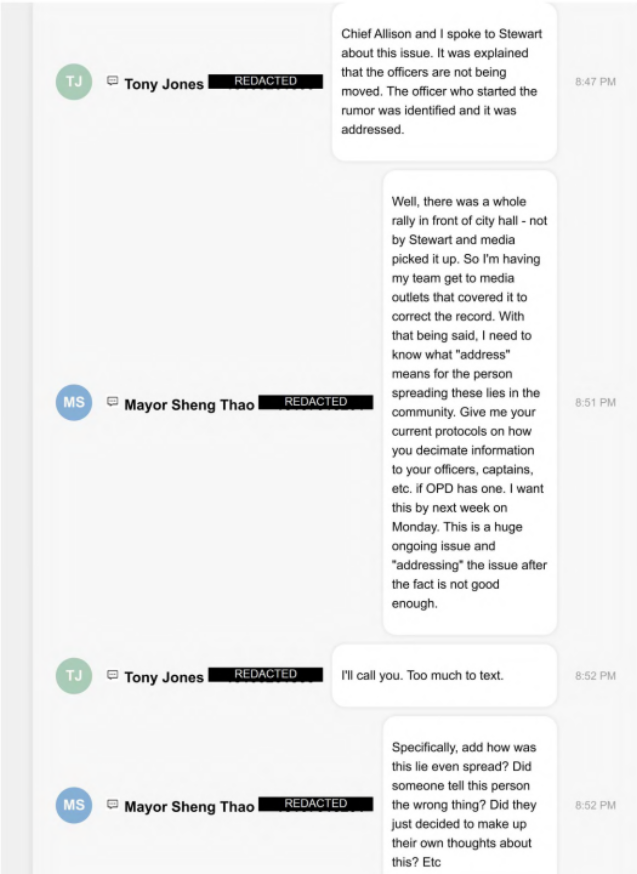
Fife, for her part, acknowledged that the current system is faulty, but remains unconvinced that the structures being debated have true accountability without more work. Fife noted as an example, a messaging thread between former Mayor Sheng Thao and a police administrator, Tony Jones, in which the latter admitted that a police officer had spread a falsehood that were then utilized for an anti-Thao protest in 2023. Fife asked who would be responsible for holding OPD accountable under the “strong mayor” system.
“In the [Jestin Johnson] texts that were published, I saw an affirmation from the Oakland Police Department that they were aware that the police were spreading misinformation about crime in the City of Oakland. I want to know how in a strong mayor model that will be addressed,” Fife said.
Lee responded that the Mayor and Police Commission would continue to have oversight roles but didn't dwell on the issue of governance over the scandal-prone OPD.
CM Ken Houston also said he was not supportive of a strong mayor system. Houston said he trusts Lee, but not the Mayors to come and preferred the Council/Manager system.
“I know my mayor right now, and I'm gonna say my mayor—because she is my mayor—is competent to make these things happen. But I want to be able to, as council… hire and fire the City Administrator…and I do feel that a strong manager, strong counsel is the way,” Houston said.
CM Gallo was in the chambers to ask Council to agendize Becker Board’s re-structuring [see below], but did not speak on the Mayor’s proposal–and two other key Council votes necessary to send the ballot measure to voters in November, Charlene Wang and Zac Unger, did not appear to have attended the meeting. It’s possible that a majority of CMs would still vote to put the proposal before voters, despite not supporting the structure.
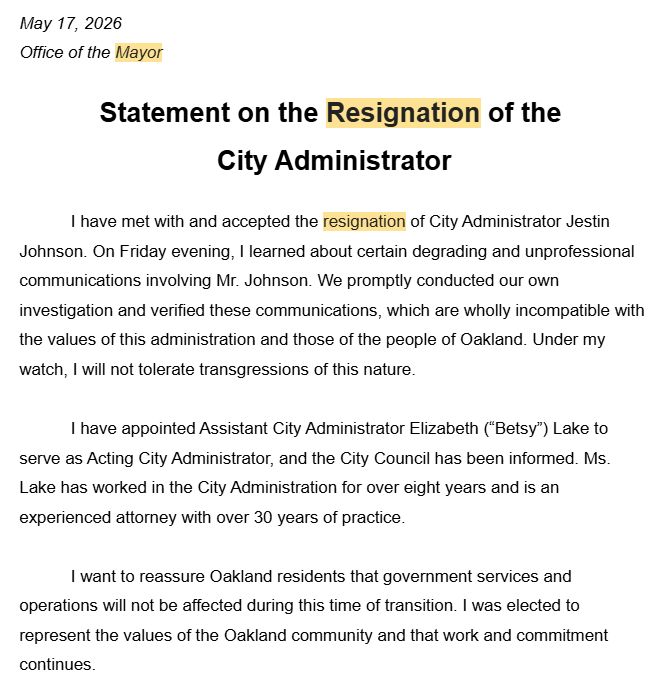
Despite the introduction, changes are still being added to the legislation, and it has evolved from its last iteration—Lee’s previous model did away with the at-large council seat, but now that section has been deleted. The core elements of the "strong mayor" structure remain—Oakland’s mayor would have broad powers to pass legislation and veto Council legislation. It's unclear what would really change in the day to day functioning of the City, as the City Administrator would likely run the city much as it does now. Ironically, the Mayor’s current total control over the City Administrator position was on view just a week ago, as Lee visibly implied she'd directed former City Administrator Jestin Johnson to resign over inappropriate texts uncovered in a public records request.
2) Becker Boards Promised a Stable Revenue Stream to Community Orgs to Win a City-Wide Billboard Contract in 2023—Now Becker is in a Hurry to Walk Back Those Commitments
CM Noel Gallo was in chambers, Thursday, but not to talk about Lee's “strong mayor” proposal. Rather Gallo was seeking to introduce legislation that would significantly alter a once-celebrated billboard agreement for Becker Boards that promised yearly derivative income both to the City and to a stable of local non-profit service organizations. In the original agreement terms approved by Council in 2023, Becker would pay a yearly flat rate to the City of $250K and another flat rate to 5 non-profits of $100K each. Becker marshalled the non-profit community organizations to lobby CMs at several meetings on the agreement, and the organizations’ support clearly had an influence on the City Council’s decision.
Nema Link speaking to Council on behalf of his own company, had community backers stand, all wearing green shirts. Community groups will receive direct revenue from the deal, includes Native American Health Ctr, Clinica de la Raza, Asian Health Ctr. Not much doubt it will pass. pic.twitter.com/g4cPGvfdag
— Jaime Omar Yassin (@hyphy_republic) June 6, 2023
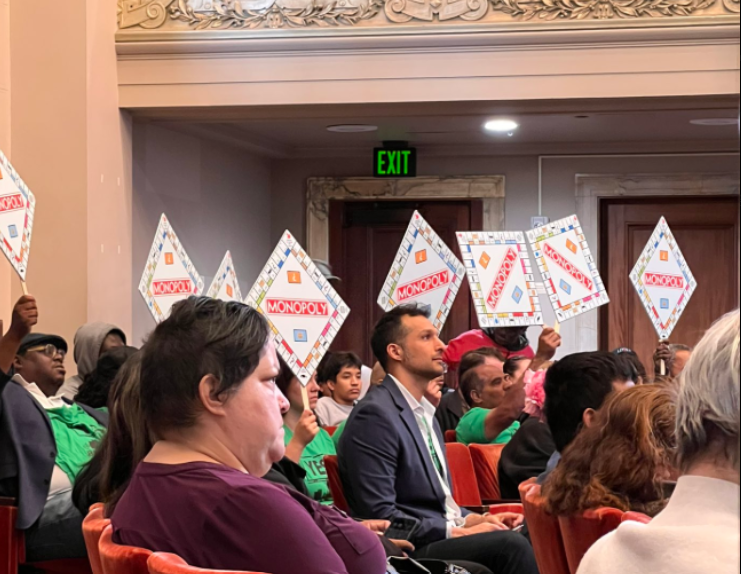
Becker brought many of the same orgs and their supporters when it came back for a second billboard agreement, which only included free advertising space on Becker billboards. But Becker's argument for getting the new contract was substantially linked to the community-investing first one.
To financially secure the first deal, Becker partnered with competitor Outfront/Foster Interstate [OFI], which already owned some billboards in Oakland, so that both could edge out Clear Channel Outdoor, another billboard operator. The partnership of Becker and OFI won similar, but separate, agreements with the City for the removal of existing billboards and replacement with new, digital billboards, along with promising yearly community grants.
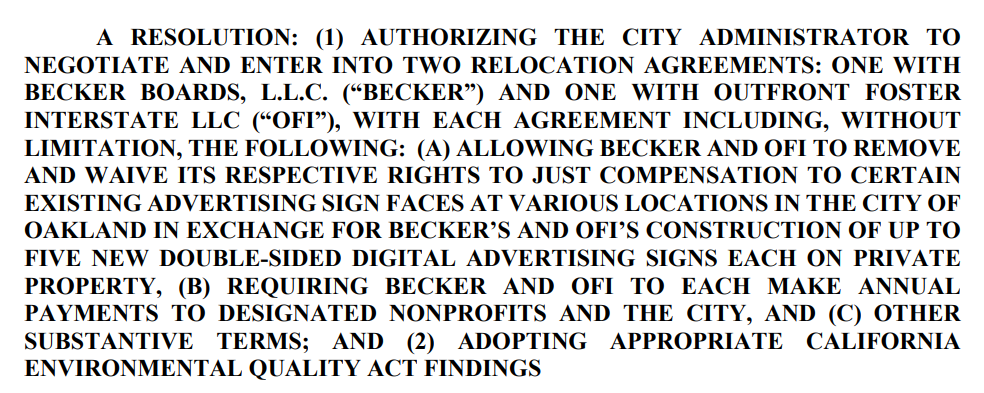
Now Becker's lobbyist, principals and Gallo argue that its 2023 and 2025 agreements will collapse, depriving the City of expected revenue, if Becker isn't allowed to change the payment structure to the community organizations.
OFI Central to 2023 Contest to Beat Out Clear Channel, Then Left Behind for Future Deals
Essentially, OFI provided added financial capacity Becker would not have been able to muster on its own to break into Oakland’s market. OFI was not a party to the second contract, but rather appeared to be competing for it. The City Attorney confirmed during deliberations that no competitive process was required or considered, so OFI, like Clear Channel before it, was relegated to making its arguments at the podium during public comment. Significantly, the City's own Economic and Workforce Development Department [EWD] argued that the Clear Channel agreement would be more stable and lucrative for the city over the next decades, and from those profits, the City could make more money and still give those same groups grants. But a very compelling argument for the Becker/OFI deal was the dedicated static yearly community grants from both Becker and OFI, which would not waver with budgetary considerations. A chief selling point of the 2023 contract was that it would be a decades-long independent and immutable revenue stream for service non-profits often beholden to the City’s budget priorities for needed grants.
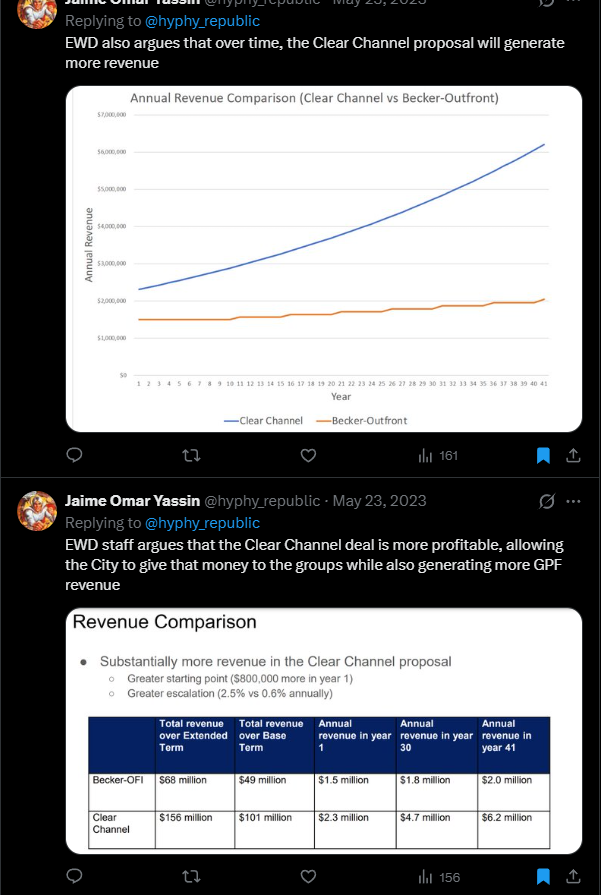
Gallo one of the proponents speaking first, he says that his motivation for the deal is that some revenue would go directly to community groups directly and not to GPF "where we don't know where it goes" [smh]
— Jaime Omar Yassin (@hyphy_republic) May 23, 2023
Now Becker wants to rewrite the original 2023 contract so that the City and the non-profit partners would split 20% of Becker’s revenue. Details are currently sparse because there is no accompanying legislation for Becker’s proposal. But, per the title of the legislation, the City would be guaranteed the original minimum payment in the fixed payment plan, $250K, regardless of the percentage amount. But Becker’s non-profit partners would have no guaranteed fixed income and derive 10% of the revenue yearly.
Gallo came to the Rules meeting Thursday to make the argument for a "Rule 24" urgency motion to speed the legislation to the June 2 Council meeting, with no intermediary Committee hearing. Though Gallo's rationale was difficult to follow, the statement in the agenda claims that without the change, Council would be deprived of a previously budgeted $2.375 MM from the second Becker deal already budgeted in 2026-27.
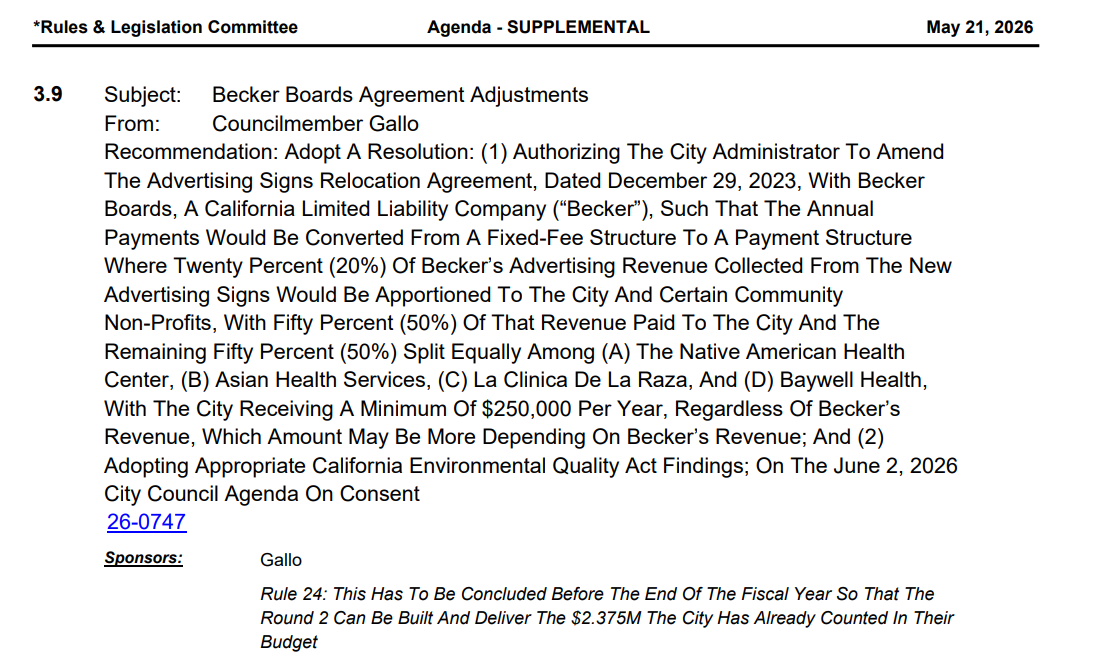
Things became complicated when the City Attorney made it clear the public would still need to be notified via published newspapers with 17 days notice before the meeting. If the deal were to be altered before the end of the fiscal year, it would potentially change the amount of funds the non profit organizations had counted on receiving from this fiscal year’s billboard revenue, which appears to be Becker's goal. Gallo’s comments were especially bewildering, as he suggested no “substantive” discussion was needed for the change, despite also indicating that both of Becker’s billboard plans would collapse without the changes.
“There are just some small financial adjustments that guarantee the city's share in the shorter term and increase in the long term, so there is no substantive policy discussion needed. If these adjustments don't happen, the current billboards would not be market viable, which means the second round won't be built. If the first round goes down, all the community advertising and the community in the city benefits would end, so we're asking to place this on consent or non-consent at the next meeting,” Gallo said.
During public comment, one of the company’s principals and its primary lobbyist to the City, Nema Link, seemed to clarify that the organizations should expect less money, but downplayed the impact of the change and called the proposed revenue decrease, “breathing room.”
“It's a little dip in the short term, and a lot more money for the community groups in the city, in the long run,” Link said, of the proposal that would fundamentally change the way the community groups key to the agreement would receive funding.
During public comment, Becker’s lobbyist, Isaac Kos-Read also suggested Becker is in troubled revenue waters and that Becker's 2025 deal would collapse without the changes to the community-facing grants in the 2023 grant.
“My client is seeking some reasonable adjustments to the agreements that will allow them to weather the current challenging market and ensure more money long term for the city and community, while guaranteeing the short term payments to the city. We'll also increase competition in the market and ensure that we can continue providing these community benefits,” Kos-Read said.
Kos-Read argued that OFI is a duopoly billboard operator “fighting” the more enlightened Becker, despite the fact that Becker had achieved its previous agreement and edged out Clear Channel Outdoor only with the partnership of OFI.
The meeting did turn into a quasi-battle of lobbyist narratives during public comment, as OFI appears to see the moment as a way to win back concessions lost to Becker. OFI’s lobbyist, Jason Overman, argued that the company has had no problems honoring its deal to the same community groups that Becker now wants to back away from. Becker's requested changes would only affect its community deal, not OFI's.
“The only guarantee [is] going to the city and a 10% share of whatever is left for the Native American Health Center, Asian Health Services, La Clinica de la Raza, Baywell Health and Movement Strategy Center, that could mean just mere pennies for these groups…this is not a routine agreement, it is a major retreat of the 2023 agreement,” Overman said.
Overman also suggested that Becker seeks to limit the number of billboards it is required to take down and that the new contract would “claw back” payment commitments already made to community groups. Though the latter can’t be confirmed as there is no proposed agreement as yet to review, it does appear that changing the flat payment to percentage in the midst of a fiscal year would likely result in less money than the organizations would have expected this year per the current contract.
OFI also opposed the granting of Becker's second contract in 2025 and was clearly in competition for it. But OFI has been relegated to making its arguments in public comment because, as noted, the City isn't required to put out the contracts for competitive bidding. In December, an OFI proposal for an additional 5 billboard deal was brought before Council by CMs Charlene Wang and Noel Gallo, but was shelved and hasn't been seen since.
Eventually, by the end of the meeting, the CAO and Clerk confirmed that if the legislation were to be handed into City Administrator’s office by the coming week, the timeline would line up for a June 16 Council meeting. The item was scheduled to non-consent at that meeting, and despite the fact that the item can now go both to committee and Council under that timeline, it is skipping committee completely. As of this writing there is no written documentation in the legislative packet.
Comments ()