
1) Fife Takes Solo Stand Against Cellebrite and Peregrine, but Council Votes Up Contracts for Both
CM Carroll Fife took a lone stand against two controversial proposed OPD contracts Tuesday night, as nearly two dozen residents voiced similar concerns about the contractors, Cellebrite and Peregrine. Though the two technology platforms perform distinct tasks, they are both owned and run by problematic companies tied to fascist discourse and Israel’s genocidal war against Palestinians, respectively. Fife and CM Janani Ramachandran, who did not speak on the contract, voted no on Cellebrite. Fife was the sole no vote on Peregrine.
Despite claims that the technology is vital, OPD’s own practices for about a decade of Cellebrite’s proprietary Universal Forensic Extraction Device [UFED] suggest it was largely considered ancillary until recently. OPD has had a Cellebrite device and platform for over a decade, since 2014, but its own disinterest in the technology for almost the entirety of that period meant it was only used to copy cellphone contents with permission of the owner—mostly either from officers in routine checks of their city-issued phones, or members of the public under conditional release from incarceration. The latter meant that the technology had a disparate impact on Black and Brown residents, as noted in its first ever annual use report in late 2023*.
OPD either was not aware or was not concerned about the fact that, as a surveillance technology, the Cellebrite device and platform required a use policy and annual reporting under Oakland's surveillance law—and it wasn’t until after former Privacy Advisory Commission [PAC] Chair Brian Hofer sued the City to force compliance with its own law that OPD drafted one for approval. It’s arguable, given that the technology languished in OPD's inventory without much use, that OPD’s leadership was literally reminded it had the tool by Hofer’s suit.
Following the PAC and Council approval of the use policy, OPD purchased a new Cellebrite device under its then existing contract. Per the OPD's own report, police have only been using Cellebrite to crack cellphones for about a year and a half and there are no metrics that show it is an effective crime fighting tool. OPD's testimony to effectiveness is by their own admission anecdotal. The current contract represented about a 50% increase in the funding amount to about $140K.
Peregrine is the New “Google for Cops” to Replace the Current "Google for Cops", But Its Founder Has a Troubling Pedigree
OPD currently uses a proprietary database search platform created by Shotspotter called CrimeTracer, but argues it is increasingly outmoded and can’t be secured against searches from federal agencies. The platform OPD would like to switch to, Peregrine, was co-founded by a principal in Palantir, Nick Noone, who oversaw Palantir product sales to US Special Operations Command in the Iraq theater of war for half a decade. Peregrine has been associated with AI profiling and community opposition has nixed contracts in other cities, like Durham, North Carolina.
Both systems are described as “google for law enforcement”, but it’s not clear what data is amassed, from what databases and for what ends. OPD argues that usage of CrimeTracer can't be audited or tracked and is open to federal searches. But despite renewed concerns about federal surveillance, has never agendized the issue publicly, leaving residents in the dark about potential surveillance from ICE and other federal authorities. Alameda County is also considering a Peregrine contract.
During deliberation on the two contracts, taken separately, Fife echoed many of the criticisms from the public about both Cellebrite and Peregrine. The primary focus of the evening was on Cellebrite, although Fife was also the lone voice opposing Peregrine on the grounds of promoting troubling actors through their tech platforms.
In particular, Fife noted that Cellebrite was created by the members of an Israeli military unit, who’d pioneered the technology to blackmail Palestinians to inform on one another. Fife also noted that Cellebrite first became a go-to platform for other authoritarian regimes, who used it against journalists and activists. And with all this troubling history, OPD could not provide concrete data of the usefulness of the device.
"[Cellebrite's] CEO admitted that most of the employees come from [IDF] Unit 8200 which is a military intelligence warfare unit that is used to undermine civil rights and torture people...and used to out non-heterosexual individuals...cracking people's phones in order to coerce them into becoming informants...why can't we show, after the use of over 10 years of data ...Cellebrite directly helped us solve this many crimes in the City of Oakland," Fife said.
Interestingly, OPD’s representative who has shepherded the technology through its entire approval process, from the PAC to Committees, acknowledged the problems with the “optics” of the technology in his presentation, but argued that there were no alternatives.
Fife suggested that OPD step away from Cellebrite and enter into a true procurement process, where a UFED can be transparently evaluated against competitors. Fife noted that OPD has continued its practice of pressuring Council to bypass city procurement law, which requires an open bidding process, by arriving with desired contracts in “urgency” mode and claims that other technologies were tested to unsatisfactory results, but with no paper trail.
Fife, for example, noted that Cellebrite competitors like Grayscale, exist, although Zhou argued that the platform [presumed to be Grayscale] isn’t as effective. Later in his presentation Zhou admitted that OPD had not tested the other platform thoroughly, noting that it only used a competitor "for a week" of testing that usually lasts 30 days before bringing the Cellebrite contract. Zhou didn't explain why OPD waited until a week before the Cellebrite contract to test another device, or why it did not follow the procurement process.
CM Charlene Wang, one of OPD's most dependable allies on Council and Public Safety Chair, argued similarly that despite being a disturbing company, western democracies have also contracted with Cellebrite.
"It is undeniable that Cellebrite has been used by authoritarian regimes to surveil activists and journalists without consent. I don't want to downplay that... it is heinous, it is anti-democratic. But what's also not being told is that it is also widely used in democratic nations known for being at the forefront of human rights to investigate violent organized crime and human trafficking. These countries include Sweden*, Denmark, Norway, Finland and New Zealand, which rank at the very top of worldwide rankings for human rights and freedom...and because this technology is so widely used, both domestically, in the United States and internationally, we're not going to make a dent in Cellebrite's financials by not signing $140,000 contract with them, and what we will do is undermine our own ability to solve violent crimes," Wang said.
The British Journal of Criminology seemed to echo the chasm between Fife and Wang's positions in a 2025 paper, arguing that as troubling actors like Cellebrite become more common due to the pressure of supposed policing ubiquity, the contracts have embedded “moral taint” in local policing, mainstreaming problematic companies to the exclusion of alternatives or effective pressure to improve human rights records.
"In most instances, Police organizations (in democratic and non-democratic countries alike) are major consumers of such technology. Local, state and federal-level Police organizations have an opportunity to demonstrate moral leadership in this area by immediately withdrawing support and introducing stricter new standards of who they purchase from. Withdrawing their financial support to companies such as Cellebrite can create new market incentives for tech companies to consider who they do business with and discourage the selling to governments known to engage in widespread human rights abuses. Technology companies should not be able to contribute to egregious human rights abuses by selling to authoritarian regimes while simultaneously maintaining lucrative contracts with Police organizations that espouse support for human rights. Improved standards are urgently needed to address the increasing interconnections between Police organizations and external technology companies and to ensure that Police procurement practices align with the fundamental principles of human rights and ethical conduct."
2) Houston Pulls Police Commission-Weakening Ballot Measure Immediately After Introducing it
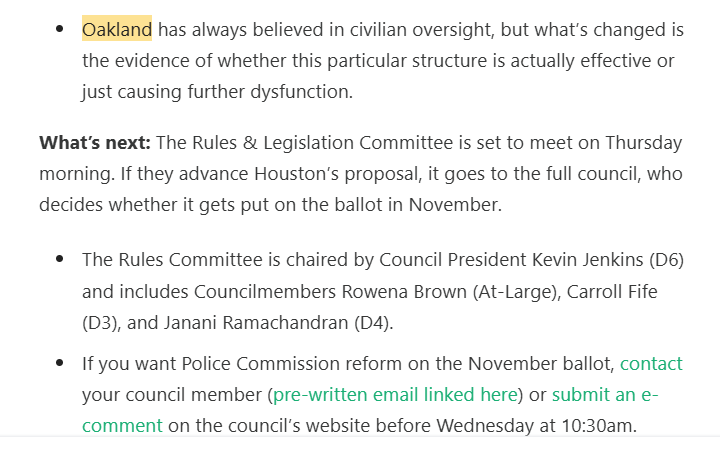
Despite weeks of news coverage about the potential for a Police Commission weakening ballot measure to be on November’s ballot, the measure’s author pulled the legislation as he was presenting it at Thursday's Rules Committee meeting. CM Ken Houston asked for the ballot measure instead to be placed on a “pending, no date specific” list, which is often a graveyard for city legislation. Given the extended steps required for a city-sponsored measure to reach the ballot, including an affirmative vote at Rules, separate hearings at two full council meetings, and processing to the ballot which all must occur 88 days before the election, it appears far from likely that the measure will make it before voters this year.
An Off the Cuff Idea that Grew Legs
Houston’s withdrawal continues the impulsive arc of his ballot measure idea, belied by Empower Oakland’s recent campaign and push poll** meant to give the proposal the appearance of a sober effort to reform the OPC.
According to Houston’s own comments, he created the legislation overnight several weeks ago after a presentation of the OPC audit by Oakland’s City Auditor at the Public Safety Committee. The Auditor, Michael C. Houston, noted the obvious—the OPC has struggled because while being quasi-independent, it depends on the City for its budget. As such, the Auditor recommends increasing the budgets of the bodies to strengthen oversight and independence in the report.
Though the Auditor also found inconsistencies between the Charter and the City’s enabling ordinance, most of those are due to the fact that after Measure S1 passed in 2020, adding the independent Office of the Inspector General [OIG] and other changes, the Council failed to pass a new “enabling” ordinance that specifies pattern and practice for the charter mandated structure. The Auditor recommended solving the inconsistencies between the Charter and code in the simplest way, by reintroducing legislation that was ultimately sidelined in 2024 that would have updated the enabling ordinance. That legislation was pulled as it was entering its second reading and never returned, as this publication has reported.
But despite the Auditor’s analysis and recommendations, CM Ken Houston appeared to perceive the Auditor's recommendations as a mandate to change the Charter. Houston said he would begin writing and introducing a charter-changing ballot measure to remove key components of independence from the Commission. Less than 48 hours later, Houston introduced for Rules deliberation his ballot measure, which was then scheduled to be discussed at this last Thursday’s meeting.
As Rationales Faltered, Houston Withdrew the Legislation Before Finishing His Presentation
Houston’s office argues that the proposed changes would in fact help the Police Commission, a body that voters overwhelmingly approved twice by well over a ⅔ margin after two decades of failures by Oakland’s City Council and Mayor to effectively oversee the OPD. [Houston is not a member of the Rules Committee].
Explanations from Houston’s office seemed guided by an idiosyncratic reading of independence—and often relied on a faulty understanding of the body and its agencies’ roles and limits under the Charter. Houston [and his staffer, who co-presented the legislation] claimed the Selection Panel [SP] is dysfunctional, but the basis for the argument is that the Council had denied the SP’s appointments—a move that even the East Bay Times attributed to political pressure.
Houston also argued that giving the role of appointing Commissioners to the Council would give the Commission a broader popular mandate, because the government officials “are civilians elected by the people to provide oversight”—an idea at odds with the original argument for Measure LL and independent police oversight.
In service of moving the hiring of OIG to the City Auditor's penumbra, Houston and his staff argued that the OPC has a conflict with the OIG because it must also audit the Police Commission. But that isn't accurate—the OIG audits the Community Police Review Agency [CPRA], which is under the OPC, not the OPC. Houston also caused some confusion when he argued that the Auditor’s only role would be to appoint the Inspector General, leaving unexplained how the OIG’s performance would be evaluated, and if needed, the appointment terminated.
As Houston wound down his presentation, he suddenly reversed course and declared he would pull the scheduling item and shift it to the “pending, no date specific” list. Houston explained that he didn’t believe he had the votes to move forward on the legislation at Rules “for certain political reasons”. Chair Kevin Jenkins, for his part, missed the meeting, although he had been expected to be present via teleconferencing. The remaining calculus required at least two members of the Committee to vote for the legislation. But Jenkins’ no-show appeared to catch Houston, who asked if Jenkins had logged on to Zoom as he began his presentation, off-guard.
Although neither CMs Janani Ramachandran nor Rowena Brown commented on Houston's proposal, Fife spoke vehemently against it's current structure. Fife said Houston's arguments seemed “contradictory to not only the Auditor’s report, but also to the intent of the item itself”. Fife asked Houston directly why the Council should move a ballot measure when the Auditor had recommended giving the current OPC more resources and moving an existing legislative resolution instead.
“[the auditor] mentions what the body needs in order to strengthen the independence, and he recommends that the city attorney's office should provide an independent analysis of the resources needed, including staffing to support the requirements of the police oversight agencies, the Commission, the Community Police Review Agency and the Office of Inspector General. The Auditor also said that in conjunction with relevant stakeholders, including the Police Commission, the CPRA and the Office of Inspector General, the council should develop and adopt revisions to the Municipal Code…I stated that I would bring forward those revisions to resolve the conflicts between the muni-code and the Charter...so I want to understand why we are proposing to move against what the elected City Auditor recommends for independence?”
Houston appeared to struggle with the response before suggesting that City Attorney Ryan Richardson would be able to answer the questions.
Despite significant organizing by Empower Oakland and Montclair-based organizer Rajni Mandal, only one person besides Mandal spoke in favor of Houston’s proposal—Rules is perhaps the most critical step in the journey of the measure from agenda to ballot. About a dozen residents, many members of the Coalition for Police Accountability, an organization with an outsized role in getting the OPC on the ballot a decade ago, spoke against Houston’s proposal.
Rashidah Grinage, one of the primary movers of the police commission, noted that at the time the ballot measures establishing and expanding the OPC came before residents, no organization or agency had the temerity to argue against them.
"There's a reason why there was no 'no' argument on the 2016 ballot measure called Measure LL, nobody submitted a 'no' argument. There was no 'no' argument on the 2020, ballot called Measure S1 What does that mean? It means nobody in the city, not the City Council, not the Police Department, not the OPOA, not a community organization, could find a reason to urge residents of Oakland to vote no. What does that say? And what's different now? So now we have 10 years of experience, and we have an auditor's report, and we can see that things are not perfect, but we also have a mechanism for dealing with the issues that have been identified, and that method is the ordinance, the enabling legislation...[a new ordinance] was brought to the council in 2024, it had one reading, and it was dropped. So the responsibility is to look there," Grinage said, echoing Fife's position.
Millie Cleveland directly challenged Houston's motivations, and suggested the time was ill-spent with so many other pressing issues facing the City's policing regimen.
"Can we just cut to the chase about what Councilman Houston's resolution is really about? Whose interest does it serve? Do you want a police department that functions in a way that protects the constitutional rights of its residents, or don't you? Do you want a police commission with community input on who should be on the Commission, or don't you? Do you want the community to have a built in way to have a say on the criteria for their police chief, like through a civilian police commission, or not? Do you want the commissioners appointments divorced from political influence. Or do you want to set the conditions for corruption or not? It's time to pick your side...When are you going to have a hearing on police overtime and have someone other than the police talk? When are you going to direct the City Administrator to focus on recommendations from the City Auditor? Why aren't you asking the community what they would like to address in the OPOA negotiations. Why isn't there GPS in the patrol cars? Why hasn't that been activated?" Cleveland said.
Jose Dorado, a Commissioner from the inaugural body also spoke out against Houston’s proposal.
And the Inspector General, Zurvohn Maloof, presented a point by point rebuttal to Houston's idea to transfer the OIG to the City Auditor's penumbra. Maloof said Houston's idea would rob the police commission of its authority and intended independence; weaken public-facing community input required at OPC meetings; and most importantly, Houston's idea would produce a conflict with auditing standards. In effect, the City Auditor would be conflicted in auditing the OIG's role, though the Auditor is required to do so.
Zirhvan Maloof, the Inspector General, went point by point why the proposal to move OIG to Auditor is flawed pic.twitter.com/jJFhyoF4v0
— The Oakland Observer (@Oak_Observer) May 7, 2026
As Houston withdrew his proposal, he said he would leave it to a citizen signature gathering effort to put the proposal on the ballot, though it’s not clear if that was a long-standing goal, or if it was an off the cuff comment, as Houston’s decision to withdraw also appears to have been a decision made in the moment, per his own commentary. Later he claimed he had put the item on pending to give City Attorney Ryan Richardson an opportunity to comment, apparently at a later meeting. An as yet formalized citizen’s signature gathering effort also seems unlikely to get to the November ballot on the current timeline.
*In its new use policy, OPD committed to forego using Cellebrite to crack the phones of individuals on conditional release, but also asked to be exempted from tracking demographic outcomes for that same reason.
** As CM Fife noted, Swedish agencies appear to be transitioning from Cellebrite to a Swedish proprietary UFED company and suggested that OPD test that company. The company, MSAB, has recently begun contracting with US government agencies . Given that Cellebrite sued MSAB for uncompetitive practices, it's likely a viable competitor.
**In the run up to the Rules Committee hearing, Empower Oakland published the results of an online poll from a paid a third party that it claims shows public support for an OPC-changing ballot measure. But the results are tainted by the fact that the company, apparently at the direction of Empower Oakland, grossly mischaracterized the powers and composition of the Commission.
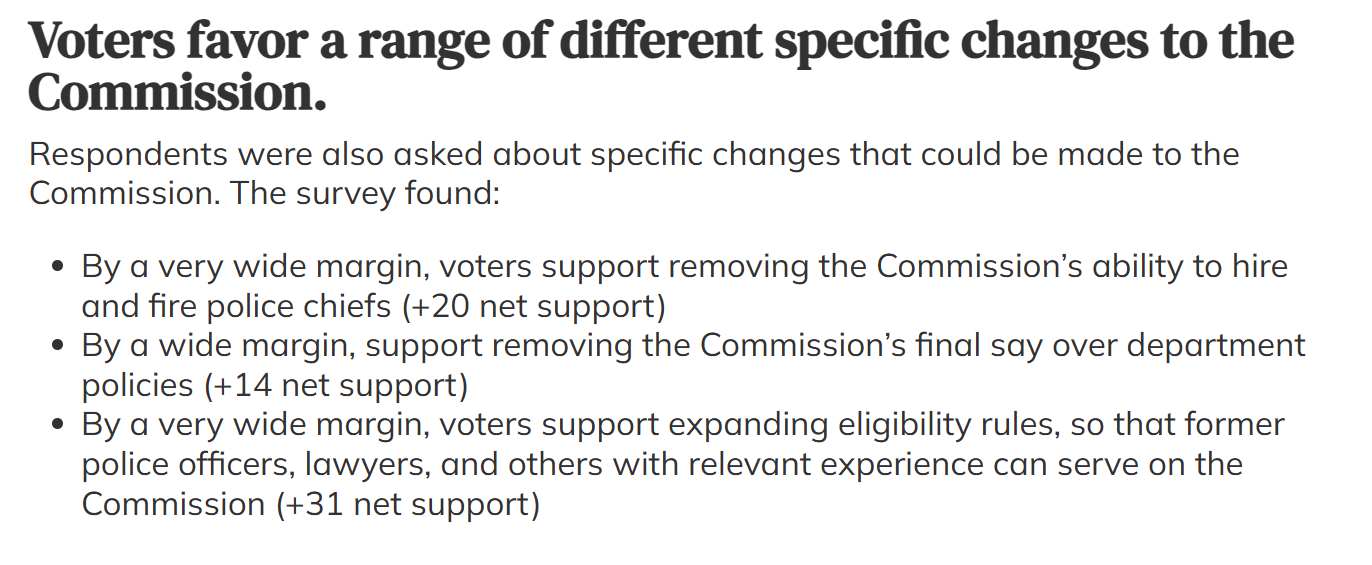
For example, respondents were told the OPC does not allow lawyers on the body, despite nearly every iteration of the Commission containing at least one lawyer. Two Commission rolls have now had judges as Commissioners and the first OPC body contained three practicing attorneys, one of who went on to become the City Attorney of Antioch.
The poll also told respondents that the Commission hires the Police Chief and that it has final say over OPD policy, both of which are untrue. Though the Commission carries out a community-invested candidate selection process, the Mayor makes the decision to hire the Chief and can decline to hire any of the slate presented by Commissioners. What the Commission does do is invite the public into a process of conversation on the hire, and contracts an executive search firm in reaching out to candidates, much as the City would.
Finally, when the Commission and OPD differ on policy decisions, the proposal is forwarded to the City Council, which then votes on passage, per the Charter. Only policies that are mutually agreed on by the OPD and the OPC are integrated into OPD policy without Council approval. Some OPD policies are not under the purview of the Commission and are not required to come before the Commission at all, although the OPD sometimes does share the process with the Commission. For almost the entire existence of the Commission, the City Attorney and the OPD believed the pursuit policy to be under the sole discretion of the OPD, for example. Three OPD changes to the pursuit policy occurred without any participation of the OPC after its establishment. Richardson’s office was the first to opine that the OPC has a role in determining pursuit policy.
Comments ()