1) Valedictory Tone as Orrick Lays Out Exit Path from Court Oversight by September, with Pledges and Concerns on Accountability
At what could be one of the last Case Management Conferences for Oakland's Negotiated Settlement Agreement [NSA] Thursday, the parties and even Judge William Orrick took on a largely congratulatory and retrospective tone. Just a few minutes into the conference, Orrick revealed that Oakland could be in its last months of the settlement structure for Delphine Allen, also known as the "Riders" case, that’s had Oakland’s Police under court oversight for over twenty years.
Orrick observed the long journey to compliance and the constant work on-going compliance will take and highlighted work that still needs to be done after recent reversals on discipline disparity and IAD response and thoroughness. Orrick then proposed a near-future exit strategy for court oversight.
“The goal of the NSA as signed in 2003 was to direct OPD to the path of constitutional policing. This is not something that OPD could achieve for a moment in time and have achieved victory. This is a goal that will and must exist as long as Oakland has a police force. This is the first time in 23 years that OPD has achieved each of the 51 tasks in the NSA. No one can say mission accomplished, but I do congratulate the city and OPD on getting this far,” Orrick said.
Orrick’s structure, agreed to by both plaintiff and city, requires the City to provide evidence of sustained compliance in previously completed tasks at the next case management conference on September 29. Orrick also says he wants to see the number of police misconduct lawsuits filed against OPD and the City in state and federal court and the annual amount of settlements for each year from 2000 to the present.
While offering kudos and farewell to court oversight, plaintiff’s counsel Jim Chanin said he remains troubled about what the OPD has referred to as an anomalous disparity in sustained internal discipline cases for officers in 2024. Chanin said that while the 2025 review did not show the same level of disparate outcomes, he was disturbed at the lack of explanation of the 2024 differences for Black and Latino officers.
“Why are 47% of the Black officers and 24% of the Hispanic officers sustained in complaints of internal origin in 2024 but not a single white officer was sustained for cases which had an internal origin?...the department failed to consider that there might be, and probably is, a double standard where white officers commit major infractions or even misconduct, and are not brought up on charges, while Black officers are. I have tried and tried to understand how the sustained rate can be so racially disparate, and I can come up with no other explanation but the one I have just offered,” Chanin said.
John Burris echoed the concern and said he is also worried about nascent signs that OPD is already slipping back into previous patterns.
“Well, I think the efforts are being made, positive efforts on the data [on disparity of discipline] that's there…sustainability is about the future, and whether the mechanisms are in place for that to occur, and so it'd be good to look back on the profiling stop data collection…and whether or not African Americans are being stopped at a rate that is unsupported by intelligent policing,....whether or not there are in fact issues related to increases in use of force cases. There seems some uptick in that, that is somewhat alarming to me…” Burris said. But Burris also acknowledged the historic penultimate moment, where emergence from court oversight is likely.
“...what we have done here is substantial and I don't want to belabor the point, because 25 years is enough to belabor anything…what we have tried to do here is to pave the way for the next generation of people, and I hope that when this is done, whatever it is, that we've done exactly that, and I thank the court for it,” Burris said in closing.
The concerns about back-sliding were evident in most comments by the parties. Mayor Barbara Lee referred to the coming expected exit from oversight as a single milestone in an ongoing set of challenges.
“This forward progress belongs to the entire city…. let us be very clear, compliance is a milestone, and I know this very clearly. It's not a finish line. We know that being in compliance for the first time does not mean that our work is done. We're here to prove to this court and to every resident of Oakland that these changes are not a snapshot in time. If something unfortunate occurs. We will acknowledge the facts and be 100% transparent to ensure this progress is permanent and self-sustaining,” Lee said.
The court monitor and the Community Police Review Agency [CPRA] received spare congratulations, but its arguable the current moment only came about with their copious help. The structures were put in place after the two revealed major scandals—neither of which were mentioned in the congratulatory statements. The cases of Michael Chung and Phong Tran are less than two years old—the far more egregious latter case involved over a decade of alleged bribes and extortion that has reversed at least two murder convictions and led to resentencing in others. Those scandals scuttled OPD’s emergence from the sustainability period in the short term.
The discipline from the Tran case ranged from suspension to termination involving almost the entire OPD leadership, and would have likely led to the termination of Leronne Armstrong, had he still been Chief by the time the IAD malfeasance was unearthed by the CPRA and the Monitor. In the aftermath, the Court ordered OPD to restructure its Internal Affairs Department and put it directly under then Chief Floyd Mitchell. But shortly thereafter, Mitchell, who visibly chafed under the order, left OPD. His departure often appears as a negative outline in the praise for the current achievements, in which only his replacement, Chief Beere is mentioned in the yeoman labor of getting the last three tasks under compliance. Almost all of the credit for the completion of the last tasks is given to, and falls under, Lee's administration and her Interim Chief, James Beere and Constitutional Policing Administrator, Michelle Phillips.
The release from oversight also comes as transparency and civilian oversight are under attack by various stakeholders, which has brought concerns from other local organizations. OPD has removed some modes of transparency, shielding its radio transmissions from regular view and withholding video of recent police shootings. The Oakland Police Commission’s Chair, Ricardo Garcia Acosta who also had laudatory words for the emergence from court oversight, is on hold over status after a City Council process with well-defined links to the Oakland Police Officers Association denied his reappointment. The OPC and the CPRA will be the successors of the court in independent oversight, but on Monday, the Mayor will debut a budget in which the CPRA is one of few departments that will, again, receive budget cuts. The budget, a ballot measure to fund police, and a process to appoint new Commission members will all take place in the interim between Thursday and the next CSM in September,
2) CM’s Wrestle with Wang Ballot Measure to Tax Foreclosed Property Sales as Issues with Complicated Ballot Placement, Low Revenues and Politically Charged Issue Arise
At Rules Thursday, CM Wang introduced a complicated set of ballot measures that would change existing rules around Real Estate Transfer Tax [RETT] to include the sale proceeds of foreclosed properties. Currently, foreclosed property sales are not taxed on RETT. Wang’s structure would exclude inter-family transfers, but not corporate ones. Wang said that the foreclosure tax break encourages private equity, which can pay cash and exclude smaller property investors, to buy up distressed homes and turn them into rental properties. Wang envisions the monies being dedicated to homelessness funding, which would require a second ballot measure on the same ballot to allocate.
But Wang’s idea ran into concerns at the meeting that spanned issues of practicality, legality, finance and ideology. During the deliberation, it became clear that the second ballot measure to earmark the funding would function more as a plebiscite, for example, because RETT cannot be siloed from General Fund spending. And the clerk confirmed that the cost of putting both ballot measures on the November ballot would be up to $1.2 MM. CM Carroll Fife pointed out that the entire structure is fraught with baggage, given the role foreclosures have had in the homelessness crisis to begin with. At one point, Fife asked Wang to consider that she was in a conversation on homelessness, with someone whose entire career has been focused on housing and homelessness. Fife famously supported homeless activists who took over a foreclosed home in the hands of a large property investment company.
Finally, the Bridge Association of Realtors' Kieran Shinoy, zoomed into the meeting ironically arguing that the tax would penalize local companies trying to build real estate empires through purchase of foreclosed properties—a fact that is somewhat odds with Wang’s claim that it is only wall street firms profiting off of flipping foreclosures.
"We still have reservations regarding removal of exemptions for small investors and entities. It's important to understand that not every entity is a large institutional investor or Wall Street—many smaller LLCs are simply local families partnerships with small operators using standard liability structures to acquire and rehabilitate distressed properties," Shinoy said.
The three Rules members suggested continuing the item, and allowing Wang and the City Administrator and City Attorney to bring in more information. The vote was the second in a month in which a Wang policy platform failed to convince fellow council members, with both Brown and Fife on that committee.
3) ALCO Adopts Coliseum Term Sheet with AASEG With Direction to Sell Arena to 3rd Party, Fix BOS Missteps in A’s Deal
A non-binding term sheet adopted unanimously by the ALCO BOS on Thursday will take the County in a new direction on the Coliseum site with AASEG and could fix some of the visible missteps the County made in its rush to sell its Coliseum interest to the A’s LLC, Coliseum Way Partners [CWP].
The new term sheet with the AASEG/Loop LLC, Oakland Acquisition Company [OAC] has the County refunding payments to CWP along with an additional $30 MM the A’s have spent on running the site. The development agreement would then transfer to OAC, and the new deal structure would be a do-over of the CWP deal that left ALCO “on the hook” for environmental concerns in perpetuity, as Supervisor Nate Miley and Interim County Counsel, Andrea Weddle explain in this clip.
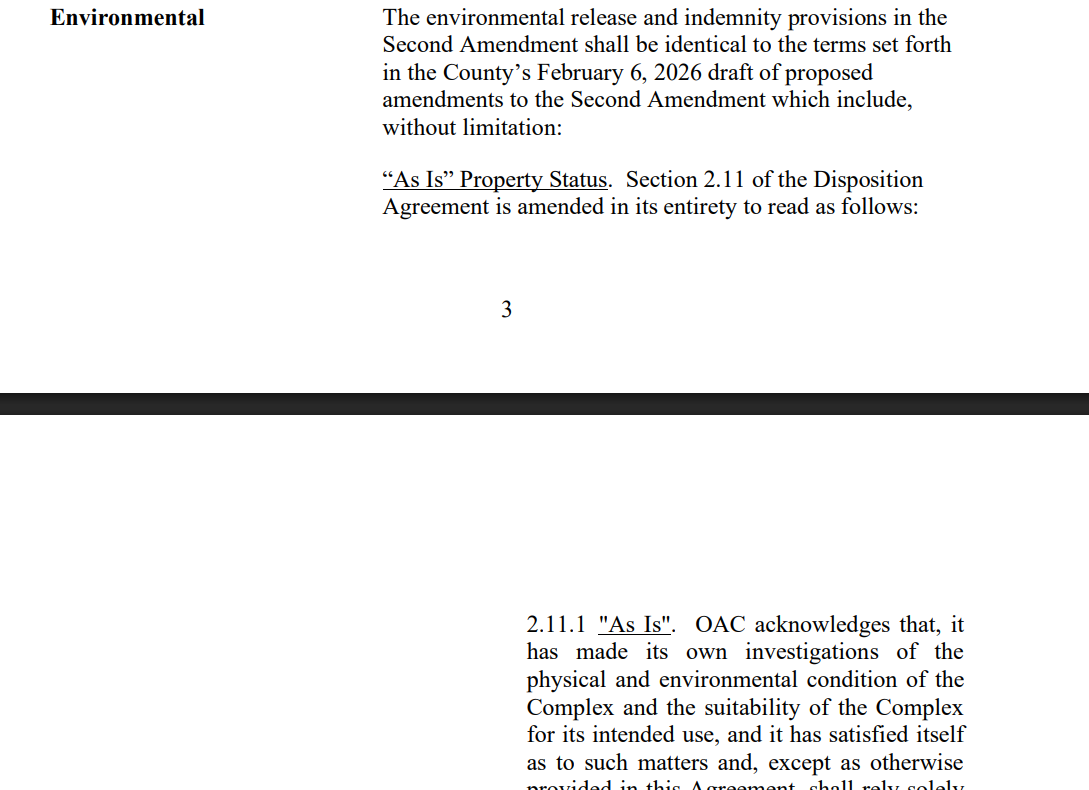
That OAC term sheet would effectively right several of the unsatisfactory terms ALCO inked with CWP. CWP’s deal, which closes in June, left ALCO with sole liability for any environmental issues discovered on the site. That means that in the current deal with CWP, should it complete, for example, ALCO would be responsible for remediating, and paying federal fines for a process that allowed untreated ground water to flow into the Oakland estuary from the Coliseum with no permit or regulatory process. In the new agreement, OAC would assume all environmental liability.
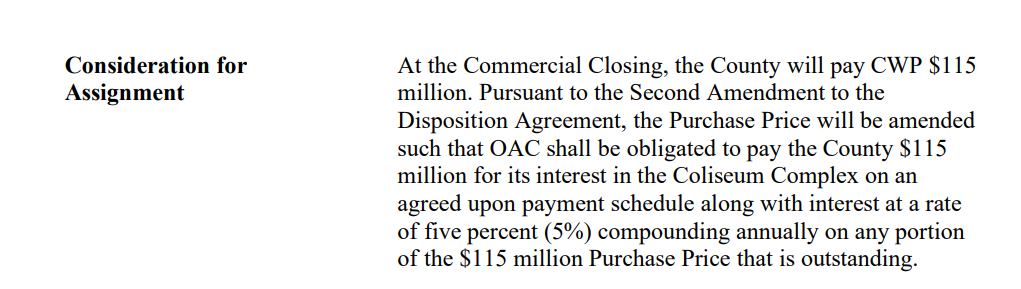
The County would also ultimately receive more revenue from AASEG for the sale than it has with CWP. CWP has paid for the site in installments over several years, but with no interest accrued. AASEG’s deal would have a similar structure, but with 5% interest per payment.
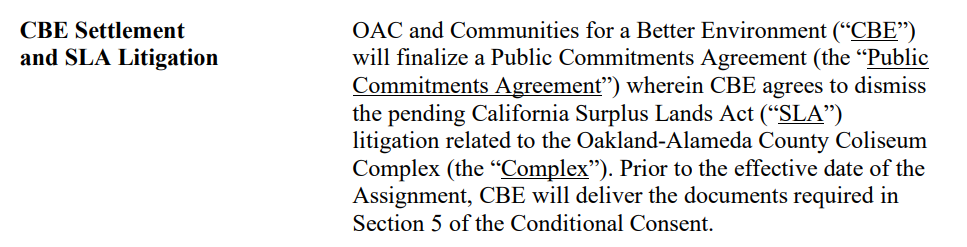
The deal with OAC would also resolve a lawsuit initiated by Communities for a Better Environment [CBE] against the County for not abiding by the state Surplus Lands Act [SLA] requirements. CBE would settle or drop the lawsuit based on AASEG’s deed-embedded requirement to provide 25% affordable housing in any residential project built there. That’s not a minor issue, in fact—there’s a significant chance that CBE would prevail in a lawsuit that could go on for years including appeals, which could invalidate the A’s deal and/or require a hefty fine of tens of millions of dollars. In the meantime, no development could move forward.
The AASEG term sheet now envisions a sale of the Arena to a third party as part of the deal structure—OAC has lined up the sale after significant negotiation and it is embedded in the development planned by the group. At the meeting, AASEG founder Ray Bobbitt described the Arena sale as an “anchor property” for the larger development. The proceeds would be split by the County and, presumably, the City, although Oakland has made no comment about the County deal. The City is in ongoing negotiations with OAC, and will review the deal in an upcoming closed session meeting.
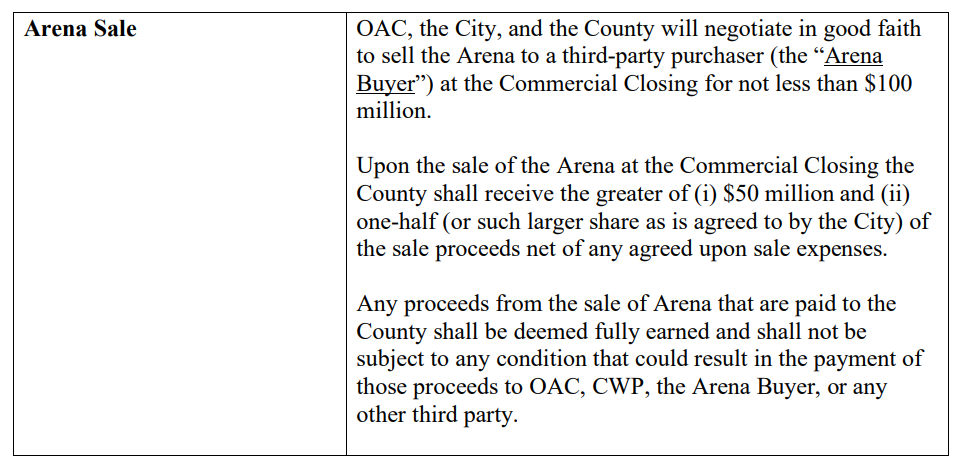
During the deliberation at County, it was revealed that OAC is seeking to “carve out” the Arena from the rest of the site purchase requirements on environmental liability to facilitate the sale. The environmental issues at present affect the Coliseum structure, not the Arena. Despite an impassioned statement from AASEG principal Ray Bobbitt, the Supervisors balked at amending the term sheet with the carve out, however, and moved forward on the term sheet as it had been presented in the agenda—with the apparent acknowledgement that the issue can still be negotiated and that the liability could delay the sale to the third party.
It’s not clear how the structure of the deal would affect the agreement the City last executed with AASEG. Final payments were expected by 2025 in the original deal, but the long slog of negotiations with the county, much of it on how to deal with environmental liability, has delayed the final disposition. In the original city deal, AASEG would have paid the City for its 50% ownership by 2025, but now the closing payment is scheduled for late June 2026 in parallel with the County’s closure in the current deal after defeasement of bonds.
Comments ()