
1) Oakland Divest Coalition Urges Rules Committee to Honor Process and Submit Ethical Investment Policy for Scheduling
The Oakland Divest Coalition has continued its steady pressure to get their ethical investment policy on a scheduling agenda, the first step to having the policy considered by Council. On Thursday, about a dozen members and supporters of the group came to the Rules Committee meeting’s Open Forum and urged the committee to place the item on the agenda for scheduling.
Coalition members suggested that there had been a commitment from Rules members to put the policy on the November 12th Rules agenda, but there now appear to be concerns that the promise will fall through as others have in the recent past. You can see their comments here:
The action is the latest in a series of Rules meeting actions to get the item agendized, now that it has cleared significant hurdles to be considered under Council rules for scheduling. Although Council rules set up a necessary set of requirements for a community-borne legislation to be considered for scheduling, the language is vague about whether it requires the Rules Chair or Admin to agendize the legislation once it has achieved the requirements. The item has been scheduled before, then pulled for unknown reasons. Although Oakland Divest has not commented on this most current process, previous comments and the appearance suggest there is resistance at the Council level to following through.
The Coalition includes labor unions, faith groups and community groups, including the Black Organizing Project, Alameda Labor Council, Beit Tekkun Synagogue, Lighthouse Mosque, Oakland Education Association, several UAW locals, East Bay DSA, Party for Socialism and Liberation and more.
The Coalition’s policy would bar the City of Oakland from investing in companies involved in mass incarceration, weapons proliferation and exploitation and profiting off of military occupations, such as Israel’s occupation of Gaza and the West Bank and Israeli apartheid. The policy would also ban investment in companies that facilitate the transport of goods in such activities.
2) Fife Brings Ordinance for 10.5 Month Data Center Moratorium Extension; Planning and Building Dept Recommends Same Extension in Mandated Report
At Tuesday's Council meeting, CM Carroll Fife, author of the 45 day data center moratorium legislation, will bring a new ordinance proposal to extend the moratorium for another 10.5 months. The extension proposal comes as the Planning and Building Department [PBD] submits its mandated report back on efforts to research and create policy for data centers on the same agenda. As expected, the PBD also recommends that the Council extend the moratorium for another 10.5 months. The recommendation is included in the report required by state law ten days ahead of the end of the 45 day moratorium, which ends in mid-November.
The report has no other findings or recommendations–as PBD Director William Gilchrist told CMs several weeks ago during deliberation for the moratorium, the 35-day window for the report would be barely enough to begin the process of gathering subject matter expertise and resources to create either the regulatory framework—or even an effective ban—for data centers in Oakland. PBD recommends the work proceed through at least another phase of the moratorium.
The state level legislation that allows the moratorium allows two subsequent extensions–the third for up to one one year—each with 7 vote requirement. A more thorough report on the City's progress in researching and developing the regulatory framework will be due 1o days ahead of the October 2027 end of the second phase of the moratorium, should it be passed Tuesday.
3) Lee Uses Current "Weak Mayor" Power for Post-Electoral Administrative Shake-Up
Measure EE, Mayor Barbara Lee’s ‘strong mayor’ ballot measure has received* an impressive super majority of votes—73.9%, nearly matching her close to unanimous electoral outcome in the most recent ballot counts. But in the aftermath of the vote, which won’t go into effect until the results are certified at the county Registrar and by the city Clerk in an open council meeting, some questions about what it actually adds to the Mayor’s powers were almost immediately raised.
As the SF Chronicle and Oaklandside reported late Friday that Human Resources Director Mary Hao and OakDOT Director Josh Rowan had left the City, most likely at the behest of Interim City Administrator Betsy Lake. The news comes from a city wide communique from Lake, welcoming "acting" department heads Megan Weir and Andrea Mariano, and thanking outgoing department heads Rowan and Hao for their service.
Though its unclear how the departures came about, either as termination or requested resignations, they almost certainly appear to be a manifestation of Lee’s will—an ironic juxtaposition with the argument for EE that the City’s current power structure lacks an accountable backstop or clear ultimate authority.
Hao’s departure in particular brings up questions about Lee’s role in a protracted and public civilian workforce contract negotiation, punctuated with several actions by IFPTE and SEIU members. Lee reacted with apparent surprise when confronted by a picket of her State of the City speech, and addressed tv media with a message for workers that she would do everything to ensure a fair contract for them—nearly a year into a process observers and participants alike noted had gone stagnant by mid-year. Lee's administration had already secured a 5 year contract with the Oakland Police Officer's Association [OPOA] that has a controversial "me too" clause which is now poised to add additional raise concessions to the OPD sworn workforce.
The twin 3-year contracts for SEIU and IFPTE came just days ahead of the election, but only after city employees promised a strike directly after it. Hao’s departure was announced just a day after that strike would have begun, bringing questions about why Lee did not use her influence earlier if Hao indeed was an impediment to negotiations. Hao has also had awkward exchanges with CMs in staffing report backs, who questioned why vacant positions went unfilled in the City’s departments. Hao has countered that the departments themselves did not requisition the roles.
Rowan’s departure is less surprising. He was the focus of a sudden public conflict with ACA Betsy Lake earlier this year, as she was being appointed to the role of Interim City Administrator after the forced resignation of former City Administrator Jestin Johnson. A large public records release shortly before the vote for Lake revealed ongoing conflict within city hall between Rowan, Lake and others, including CM Ken Houston. Rowan had initiated several internal and external legal processes and complaints against the city, and issued several workplace demands of the Mayor’s office. Rowan was also outspoken on his own substack, and often took aim at city policies and leadership. In his own public writings, Rowan once referred to a former city council person "still collecting a city paycheck to address a problem she has never solved".
A likewise equally surprising outcome, given opposition on the dais to the strong mayor ballot measure, was the enthusiastic welcoming of the passage by CMs Zac Unger, Houston and Ramachandran, who all voted against the ballot measure prompting Lee to use her mayoral tie-breaker to pass the vote for EE earlier this year.
After a Mayoral news conference welcoming Lee's new mandate, Ramacahndran told an EBT reporter that she doesn't believe the 6 votes necessary to overcome a Mayoral veto is a serious concern, despite the fact that just one missing vote led to the passage of Measure of EE which she strongly opposed several months ago. Likewise, Unger, who briefly attempted to mount a counter-ballot measure for City Manager-Council that died due to lack of Council support, now says he will be the Council liaison to implement the structure.
4) D2 Candidate Adams is Most Competitive Vote Getter Across Oakland Municipal Ballot of Challengers
Meanwhile, an under-reported element in the election is the grassroots performance of the DSA-associated challenger for D2, Nate Adams. Adams garnered the highest proportion of votes of any municipal 2026 challenger—currently at 36% to Charlene Wang's 63.8%. Adams gained slightly more straight votes than Mayoral candidate Brenda Grisham did in her run for Mayor. Grisham famously was considered the leader of the recall of DA Pamela Price and was also a significant voice against Sheng Thao during that recall campaign. But despite a city-wide access to votes, in the latest, and likely close to complete, count, Adams pulled in 4,759 votes to Grisham's 4,702**.
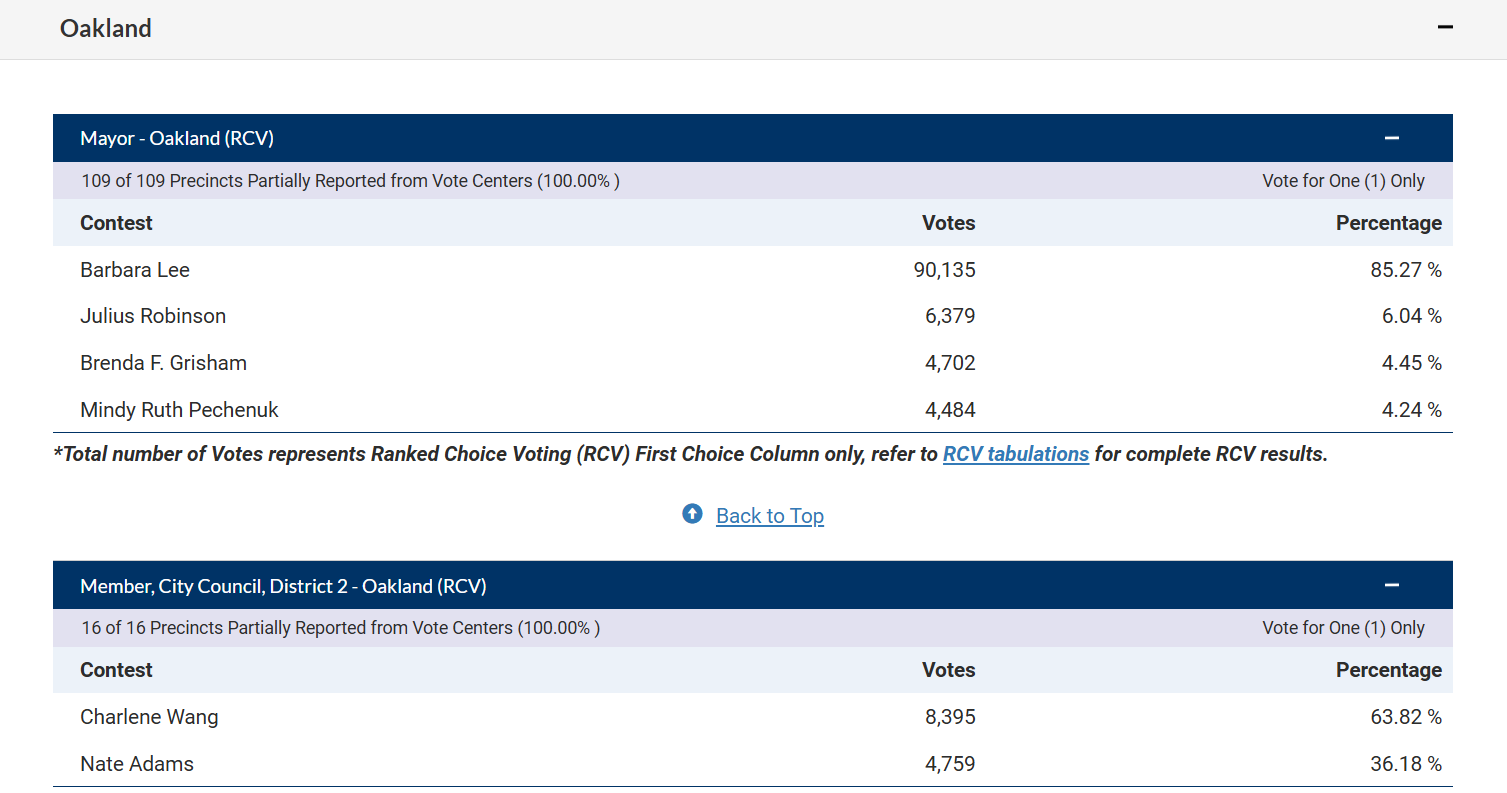
Adams also outraised all of the municipal city seat challengers in the 2026 election, as of the latest campaign finance reports released several weeks ago. Adams raised $51K, all to from his candidate-controlled committee, with no 497 form contributions and no help from independent expenditure committees.
Adams told this publication that he was excited to be part of the process of building competitive DSA-linked Oakland campaigns of the kind that have been seen in Philadelphia and New York City.
"This is East Bay DSA's first foray into an electoral campaign at this scale in years. We knocked on over 18,000 doors and made 55,000 phone calls. We had 200 volunteers, many of whom developed into emerging movement leaders. Our website, lit, mailers and social media posts were made in-house by a team of coms volunteers. We're only getting started," Adams said.
*It’s unclear if Assistant City Administrator Chuck Baker also named in the shuffle has actually left the city, or merely the interim directorship of the Department of Workforce and Employment Standards.
**Grisham receives 1,678 more votes from Mindy Pechenuk if the additional RCV step is taken. However, the Mayor's race did not go into RCV, and with only two candidates, the D2 race did not either. Thus, comparing like to like here. No school board races were included for comparison. The count is likely close to complete.
Comments ()