
CM Carroll Fife’s legislation to institute a 45 day moratorium on data centers was forwarded to City Council on a unanimous vote of attending members last Tuesday. The vote followed an overwhelmingly supportive public comment from a packed house of data center opponents. Three speakers said they opposed a moratorium and expressed support for data centers—one of them MAGA candidate for Oakland Mayor Mindy Pechenuk, and another, her husband and political collaborator, Gerald Pechenuk.
Fife's moratorium legislation is based on California Government Code section 65858, which allows a California cities and counties to pass a temporary ordinance barring specific kinds of development or uses that “the legislative body, planning commission or the planning department is considering or studying”. The “moratorium” essentially allows a City to prepare a study of a development practice or technological issue before such development or issue is allowed to move forward. The moratorium can often lead to a ban or considerable regulation of the development practice.
The 45 day period, according to the legislation, is an initial one–it can be extended for 10 and a half months, and following that for a year. During the 45 day period, the City must issue a report within 35 days describing ”measures taken to alleviate the condition which led to the adoption of the ordinance”. Importantly, the legislation does not require the 45 day period to result in a final analysis or report, and moratoria are often expected to continue for additional periods.
Each Council vote from the first 45 day moratorium to the one year period requires an unusual nearly unanimous supermajority of 7 Council votes, per the Oakland City Attorney, according to the City's spokesperson Sean Maher. That would mean just two CMs could scuttle the proposed moratorium with a no vote /or could scuttle subsequent extensions. Support for the moratorium appears high—all four committee members expressed support for it, and a fifth sitting in on the meeting as a non-voting member, Rowena Brown, said she was supportive of it as well. Council President Kevin Jenkins was present in chambers during the meeting, but did not speak publicly.
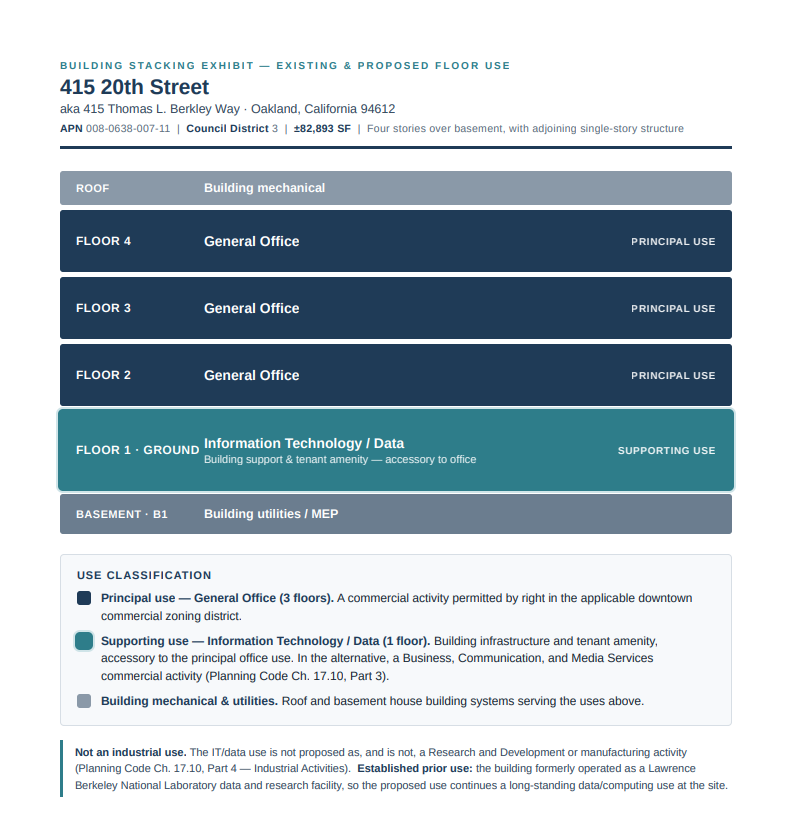
Fife noted that Behring Company, the entity whose broadside media announcement seems to have ignited Oakland data center concerns, has not sought a permit or entered any process with the Planning and Building Department [PBD] about its proposed plans for 415 20th St, as yet. Both she and PBD Director William Gilchrist said that Behring’s actions so far consist of a July 27th dated "letter of determination" requesting guidance on whether or not Behring would need to seek new permits for a new office project there.
Behring claims in the letter that the footprint of a new office complex in the building will be indistinguishable from the previous tenant's activity, Lawrence Livermore Labs. The letter states that the building would operate as a typical office building, and house 1 data center for tenants with higher data needs, and a less-intense data floor for those with basic level needs. The letter contrasts with some bravado on Behring-associated website about the potential development, which states that the power capacity in the Behring project would increase five fold, a claim not present in the letter. The letter is the only document in the City’s accela database pertaining to 415 20th St since a previous project to demolish the building and build a 39-story office building from previous owners fell through.
Oakland has at least one arguable data center, Digital Reality, located in the Jack London Square area. That small data center has applied for a permit to expand its energy usage with generators from 500 KW to a potential 2 MW in late August, far below the standard usage at the former Lawrence Livermore Lab site. Presumably, the moratorium legislation will halt consideration of that expansion, but its unclear at this point.
Fife Welcomes a Supportive Crowd
Fife thanked community members for their engagement and explained that the goal of the moratorium was to ensure the issue of databases could be studied and then regulated.
“We've been doing this work for the last two months,...to give our city staff the time that they need for their due diligence to figure out what needs to be in place in the municipal code and the planning code. Because approval of entitlements before this work occurs could result in new and exacerbated threats to public health, safety, and/or the welfare of the city. I've always stood for development without displacement. I still do to this day, and we are going to work in our best interest to do what our city deserves at this time,” Fife said.
Awkward Deliberation as Wang Seeks to Co-Opt Legislation
Council deliberation on the moratorium was made awkward by CM Charlene Wang’s dogged attempts to add her imprimatur to the legislation via last minute amendments dated several days before the meeting. Fife called the amendments “redundant”, declined to accept them and requested that no other CM add amendments. Wang's late addition of amendments that would see the legislation bear her name along with Fife's occur as she defends her seat in November against a DSA challenger aligned with data center opponents, Nate Adams, who spoke out for a moratorium at a meeting earlier this month.
Wang’s amendments would have directed the PBD to prepare a report to council on Oakland specific potential impacts of data centers, including energy rates, the grid, water rates, water supply, and various forms of pollution and diesel generator use. Wang’s amendments would also require a menu of regulatory options amid a public outreach process included in the report. Wang’s amendments would have also removed a clause that would allow Council to set regulations before the 45-day period is over, an unlikely occurrence. And the final amendment, the most visibly redundant, would have barred any permitting processes from being carried out during the moratorium.
Defending her attempts to add legislation, Wang said she had discussed her amendments with Gilchrist and he had agreed they were helpful.
“Director Gilchrist and I actually worked over the weekend to work out a version of the amendment that works for the staff timelines…but we've [Gilchrist] worked out language that is amenable to the staff and is not going to push any timelines that they're not able to work with,” Wang said.
Fife pushed back against Wang's efforts, noting that the legislation encapsulates all the specificity that Wang was seeking.
“I want to be clear that I've been working on this legislation, and it's the strongest form of legislation that we can push right now. Councilmember Wang, I believe that your additions are redundant…to say you want to study the impacts of energy uses, consumption? No, all of those things are in this legislation…And so, asking [PBD] to come back with a report that state law already requires us to do in 35 days is again redundant…I don't do last-minute amendments unless it's absolutely critical. And as I stated, these are not,” Fife said.
Fife also noted that Wang’s amendment to include community input felt especially ancillary, given that Fife had already held several town halls with constituents.
Despite the name-drop by Wang, Gilchrist declined to support her understanding of the moratoria or their conversation, and appeared to agree that some of Wang’s amendments were redundant, and others unrealistic given time and staffing constraints. Gilchrist said the legislation should not be overly “prescriptive” and noted that it would likely take the entire 45 day period to assemble subject matter expertise and the structure of a study, given staffing constraints. Gilchrist suggested that most of the period would involve setting up the structure and process to analyze data centers in the Oakland context, and provide recommendations that could include, in his own words, up to a ban on the centers.
“We're going to be looking specifically for expertise that can address what the conditions are [in Oakland]...that's not going to to fall on any particular deadline by which we have persons identified…that was one of the reasons why I was concerned that we did not get too prescriptive a report too early...the principal thing is to be able to get the work plan done and that we can then project what the rest of the schedule will be, what the outreach will be, what the technical reviews will be, what the period for findings will be…We're not going to have a consultant identified and ready by 45 days or 35 days. We're not going to have the time to have done that. What we are looking at principally is having a work plan done...I do understand what Councilmember Wang is addressing, but again, we would be bringing a standard of work, irrespective in terms of what that benchmark needs to be, what we need to hit in terms of the 35 days in order to get the consideration for an extension,” Gilchrist said.
Efforts by Wang’s co-chair on the Public Safety Committee, Ken Houston, who also serves on Life Enrichment, gave the conversation around Wang’s amendments a hearing at least twice, but Fife said she would not allow them. Several public speakers also suggested the moratorium be passed with no amendments.
Fife did add amendments herself to have the legislation comply with the Charter and state law, but most were minor, spelling out legal requirements under the state legislation.
About 45 residents spoke at the late afternoon meeting, the vast majority opposing data centers and supporting Fife’s legislation—no speaker spoke in favor of Wang’s amendments and several criticized Wang for other policies she’s backed. Members of the local chapters of DSA and the Party for Socialism and Liberation as well as the local organizing group, Care for Community, spoke during the meeting in significant numbers. Representatives of several environmental/social justice organizations also spoke in favor of a moratorium, including Communities for a Better Environment, Food and Water Watch, Fossil Free California, the Laney College Poor People’s Campaign, the Oakland Freedom Project, and United Native Americans. You can see video of a majority of the comments here.
Major Beneficiary of Data Center Development, ALCO Building Trades, Weighs In
More difficult to parse moratorium support also came from further afield. Andreas Cluver, a Port Commissioner and Secretary of the Alameda County Building Trades, told the committee he supported the moratorium, but indicated that the labor group would support a series of regulations for building infrastructure he termed a “community workforce policy…[to support] working people that are building these data centers.”
A representative of the The Alameda Labor Council, Keith Brown, made some similar comments, but urged Council to urge the administration to agree with city workers on a contract. “There’s dignity in work, so I’m calling for this Council to direct the Administrator to settle a contract with city workers,” Brown said.
The legislation comes back to full Council on October 6.
Comments ()