
1) Amid Wide-Spread Opposition, Council Deadlocks on “Strong Mayor” Ballot Measure, Triggering Lee’s First Mayoral Tie-Breaker
With at least five Council Members lodging opposition to Mayor Barbara Lee's strong mayor proposal, Council nevertheless deadlocked on putting the legislation before voters in November. With a four/four split, it then became the Mayor’s prerogative to break the tie—and she did without hesitation or much comment. It was Lee’s first tie-breaking vote after declining the opportunity twice in her first year as Mayor. The measure is now certain to go before voters in November while Lee herself runs for re-election as Mayor against a slate of opponents that includes at least one MAGA-branded candidate.
The vote and tie-breaker, although dramatic, may not have come as a surprise to many close observers. For weeks the item has existed in a rare area of Council rhetoric that signaled either bare passage, bare failure or tie. A lukewarm reception to the Mayor's proposal and a clear preference for a Council/Manager form of government by a potential Council majority was clear at the Rules meeting where Lee introduced her proposal. Then, again, at the first of two required public hearings before Council.
By the first required Council meeting, sentiments about the proposal had solidified. CMs Zac Unger, Noel Gallo, Janani Ramachandran, Ken Houston and Carroll Fife all made vocal their opposition for a strong mayor proposal and preference for a council/manager system—a voting majority. At that meeting, Unger revealed that he had worked on a competitor Council/Manager ballot measure but had ultimately abandoned it after it became clear that not enough Council members would support placing it on the ballot for passage.*
Lee again gave her presentation for the proposal at the start of the meeting, with push back against some right wing misrepresentations of her position and the process that produced the recommendations for a "strong mayor" form of government. But it's not clear whether it made much of a difference in already cemented views a second time.
Lee defending the process as open, and transparent . Some of the claims in the second recording are questionable, all of those lines are clear, actually, people are misinformed, but they are clear., a very different issue pic.twitter.com/r7SpuIWRkG
— The Oakland Observer (@Oak_Observer) June 16, 2026
Fife reiterated her opinion that the council/manager system is preferable, but added concerns about the potential for a strong mayor system to be abused, and worried that it could be "weaponized" against Lee.
"By allowing a mayor to veto a budget or other legislation and requiring a super majority to override, that is a bit of a usurpation of this body's powers, that's the reality. I will not again stand in the way of allowing the voters to choose, and based on that, that vote in November. I'm just concerned about who comes after Barbara Lee. We're seeing billionaires able to buy elections and to put people in office that they want to run. I had a tech billionaire who put a bunch of money against me in my race, say I'm going to continue to do this in perpetuity, because I believe I deserve a seat at the table, not only to have a seat at the table, but to create it. So, let's be clear about what's happening in Oakland, and this is not about our current mayor, because I have so much respect for you, and I appreciate everything that you've done in terms of the changes that you've brought to the city of Oakland. I'm concerned about what comes next," Fife said.
Though Unger, Gallo and Ramachandran were the only CMs strongly opposed to putting Lee's proposal on the ballot at the start of the process, Houston also became increasingly vocal in his opposition to both the measure and sending it to voters. In between the first and second Council meetings, Houston told the East Bay Times that he'd actually campaign against the measure if it got to the ballot.
In fact, at Tuesday's meeting, Houston tried to persuade Unger to introduce his competitor council/manager proposal and even confirmed with City Attorney Ryan Richardson that there was still a viable timeline to place it before voters in November. Unger declined, saying he left the proposal unfinished after he lost support for it among other CMs—a group that included at least CM Rowena Brown, who at the same meeting said she’d been won over by Lee’s proposal after it had been modified in several areas. Unger declined to disclose who he’d prepared the proposal with, but noted it was within the less than 5 CMs, the limit before violating the Brown Act's prohibitions on non-public conversations among electeds.
Both Houston and strong-mayor supporter CM Charlene Wang included amendment proposals in the agenda packet. But all the CMs both for and against sending the ballot measure to the public were unsupportive of what some CMs characterized as a mash-up of the models.
Houston's amendments in total sought to premise a Mayoral veto on 100% attendance to Council processes on it, as well as giving Council a vote on disciplining or dismissing the City Administrator. The latter amendments strayed too far from the noticed content of the ballot measure legislation for consideration, but the City Attorney opined that the veto amendment was viable. In the end, the central dispute that led to Houston’s no vote on the issue stemmed from Council's denial of that and the other amendments, according to his own commentary.
Wang’s amendment, which would have created a non-binding and discretionary informational “vetting” for certain director level positions under the Mayor’s hiring power, also failed to gain Council support. The fact that Wang's amendment was discretionary and ultimately symbolic were a harder sell for Council members. Fife questioned the amendment's utility. Unger also brought up the possibility that a public “vetting” would expose potential candidates in their current workplaces before their candidacy was a certainty, limiting the candidate pool. Recently, the Oakland Police Commission cited a similar rationale in doing away with a public vetting forum for potential police chiefs—sources confirmed at the time confirmed to this publication that several potential candidates for Chief dropped out in the 2023 process because the forum would have publicly exposed their job hunting.
Ramachandran noted the amendment could ultimately lead to discriminatory processes. Beyond that, several CMs believed that grafting Council amendments on to the Mayor's proposal would send a confused message. Brown said the time to have added amendments was during the engagement process with the Mayor months ago, not the "twelfth hour" before the vote.
Unger said he preferred a ballot decision as a referendum on the public’s preference between the governmental models.
"I believe that the Mayor's office should have the opportunity to write the ballot measure that they want...what I don't want to do is graft a partial strong council system on a strong mayor system. I believe at that point, we wouldn't know what the voters are telling us if they vote it up or down in November...so I am not in support of [Council] amendments," Unger said.
Houston told CMs he would vote no if his amendments were not included, as did Wang.
"Without the added layers of transparency [her own amendments] I cannot be on board," Wang said.
Had Wang made good on her claim as Houston did, the Mayor’s proposal would have failed. But minutes later, albeit after a significant pause, Wang did vote for Lee’s proposal, causing the 4-4 split. In the current charter, the Mayor has discretion about breaking Council ties. The tie was, in fact, Lee’s third tie-breaking opportunity since she took office a little over a year ago. In previous ties, Lee declined to act, which allowed Council to relitigate the issue. But Lee hardly paused before taking the podium and with little ceremony broke the tie on behalf of herself and the ayes. Importantly, the measure passed even though a majority of Council members–5—thoroughly oppose Lee's proposed strong mayor form of government.
The proposal now goes to voters in November, as Lee seeks re-election to office.
2) Rare Consent Item Split as Becker Boards Contract Amendment Passes with Only 5 Votes
In a rare split vote on a Consent Calendar item, Council President Kevin Jenkins, Zac Unger and Carroll Fife all registered their no votes for a Becker Boards contract amendment. Per Council's own Rules of Procedure, the Council Consent calendar is generally meant for non-controversial items that have unanimous Committee support. Those items are rarely discussed on the Consent calendar, and it's rare that even one Council member takes the trouble to log a no vote on a particular item. Three no votes on a Consent item would indicate that the item should not have been heard on Consent in the first place. Its not clear why no Rules Committee member objected to the item being placed as such, nor CM tried to pull it off to Non-Consent.
The new Becker contract means much less funding for organizations that came out in large numbers in 2023 to help Becker win the 30 year contract with the City. At that time, the organizations, which include the Native American Health Center, where proponent Noel Gallo's son Noah is a board member, lauded Becker’s innovative idea to steer a guaranteed pre-set annual revenue to service non profits. That component was used several times as a clear argument for elevating Becker Boards [and Outdoor Foster Interstate's partner proposal] above that of the significantly more profitable Clear Channel proposal.
California cities have a complicated process for billboard companies that seek to regulate and put in control of the City how many billboards are built. Current Oakland and state law require that a company agree to remove existing billboards before it can receive a contract from the City to build new one. That process is now made profitable by the advent of gigantic digital billboards that can cycle through several revenue-generating ads at a time. Becker sought to enter a market controlled by Clear Channel and to a lesser extent Outdoor Foster Interstate [OFI], and ended up partnering its contract with OFI. Both Becker and OFI have the non profit revenue structure, but OFI has maintained its fixed revenue stream. Now it appears Becker has been unable to make the venture profitable and sought the council vote to change the contractual terms of the revenue stream for the non-profits from a fixed amount to a variable percentage. A Becker principal, Nema Link, admitted that Becker is struggling, and that the change would mean a reduction in income for the organizations at least in some non-specified short-term.
Where previous Becker votes have been accompanied by dozens of supporters and principals of the organization in green t-shirts urging Council to vote for the contract, no supporters or representatives of the organizations came to the meeting. Several representatives of ethnic chambers of commerce that get free advertising on the billboards through a second separate Becker agreement, did speak in favor of Becker, however. Andreas Cluver, the Secretary of the Alameda County Building Trades, who praised the deal during public comment in 2023 was present at the meeting to speak on behalf of the "strong mayor" ballot measure, but did not speak on behalf of Becker.
Andreas Cluver Secretary of ALCO Building Trades, supports pic.twitter.com/DfKkfZyAj4
— The Oakland Observer (@Oak_Observer) June 16, 2026
The placement of the Becker contract directly to Council's Consent Calendar by Rules Chair Kevin Jenkins meant that the item would not necessarily receive any particular comment and could be voted in bulk with the rest of the consent agenda. Such an item would normally have gone first to Committee–and indeed, an extended committee process in 2023 had drawn an awkward spotlight on Council Members pushing for the deal. Becker's deal clearly meant less revenue for the city over time. At the Rules meeting where CM Noel Gallo introduced the contract change for scheduling, Rules Chair Jenkins agreed to bypass committee and send the contract amendment to Consent without explanation.
Despite the normal lack of deliberation on Consent items, Fife said that she could not vote for the item as it should have gone to committee, not directly to the Council Consent calendar. Unger also voted no, but without explanation. Jenkins, whose relationship to Link and the company’s lobbyist, Isaac Kos-Read, is a subject of ex-Thao Chief of Staff Leigh Hanson, voted no despite his efforts at helping the item avoid scrutiny. Jenkins said that he did not support reducing any revenue from the contract.
3) CPRA Director Says He Was Not Consulted Ahead of Council Cut to Skelly Project Funding
During Thursday’s meeting of the Oakland Police Commission [OPC], Community Police Review Agency [CPRA] Director, Antonio Lawson responded to issues around staffing and Mayoral and Council budget cuts to the agency. During Council deliberation ahead of the mid-cycle budget amendments, Council President Kevin Jenkins defended cumulative hits to CPRA funding from Mayor and Council—including the cutting of four investigator positions in the Mayor’s budget. Jenkins said he would not support staffing the agency because it has had trouble filling vacancies. On top of the Mayor's cut, which totaled around $715K to CPRA, the Council's budget committee cut another $200K meant for a pilot program to give CPRA more control over the Skelly process. Thus the cut to the CPRA was about 18% of the budget conceived in 2025, likely the biggest cut to any department in the budgeting process.
The Skelly process is a state-mandated option for civil employees in the discipline process to ensure that the process has followed the rules and maintained their rights under the law–but it has for years been controversial specifically at OPD, where it has been an often intentional obstacle in carrying out disciplinary processes.
Lawson said he was troubled by the Council's public process and that it excluded CPRA, while the agency was criticized in open session on misleading claims—though Lawson did not mention Council President Kevin Jenkins by name, he did appear to refer to his comments.
"We weren't given opportunity to speak on [the cuts], because we were never told it was happening...I understand there were rumors to say that this was being done because CPRA was not hiring staff. We specifically hired someone for this position in February to come on as project manager to oversee administration [of the project]...we had a project manager who's on board since February, so, contrary to what's been discussed, we were prepared and ready to move forward on that issue," Lawson said.
Lawson also correctly framed CPRA’s vacancy issues as endemic to the City’s workforce, not a specific CPRA problem. As Lawson noted, the City has about a 25% total vacancy rate, and the HR department has a vacancy rate of 44% [Lawson said 40, but this was an undercount].
"First off, we've hired 2 complaint investigators [level 2] and one [level 3], a project manager, a deputy director—and you should understand the city is 25% vacant at all the positions, and HR has a 40% vacancy rate.”
According to the City’s most recent report to the Finance Committee in March, the Police Commission, and its agencies have the third highest vacancy rate at the City, but several factors lead to this being an incomplete representation, as noted by Human Resources representative at the Finance meeting. The departments with the highest vacancy numbers are those with the largest staffing levels, led by OFD, OakDOT and the OPD.
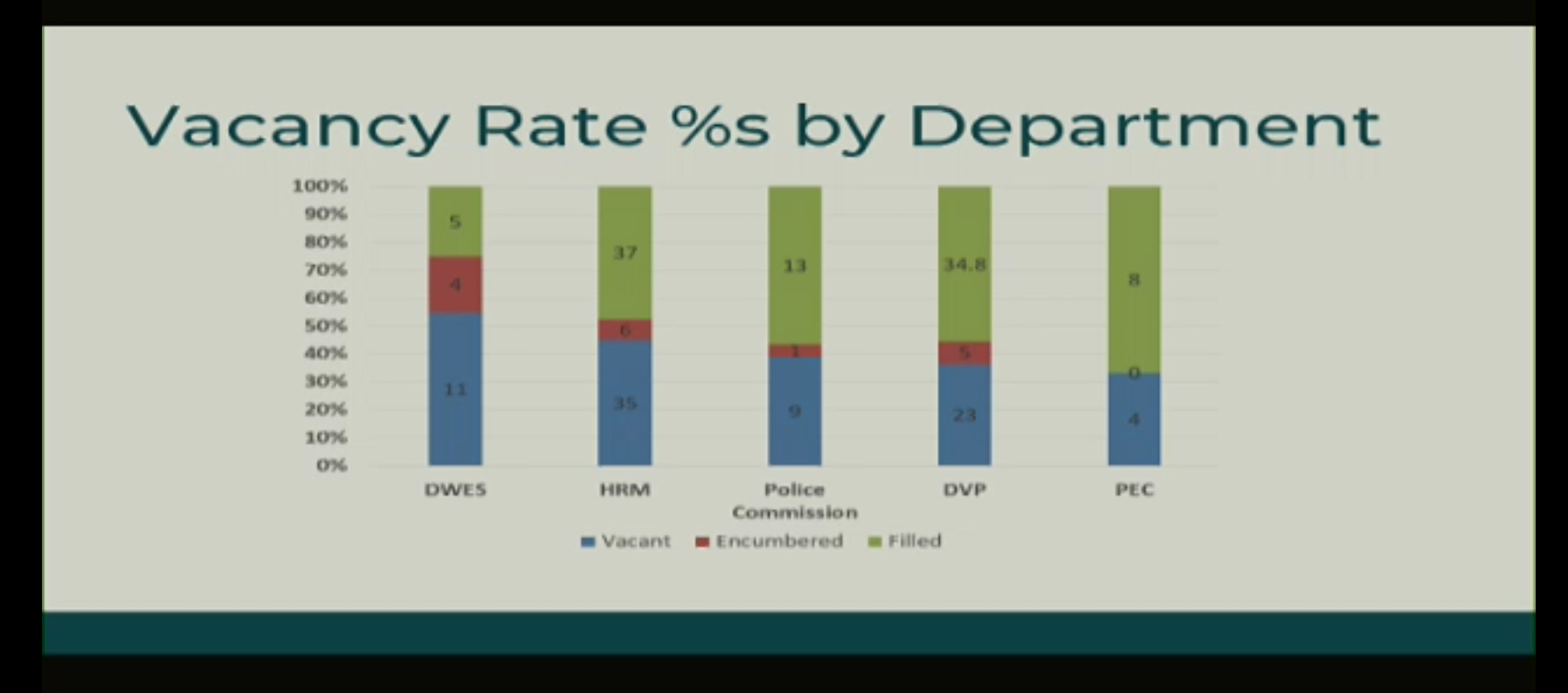
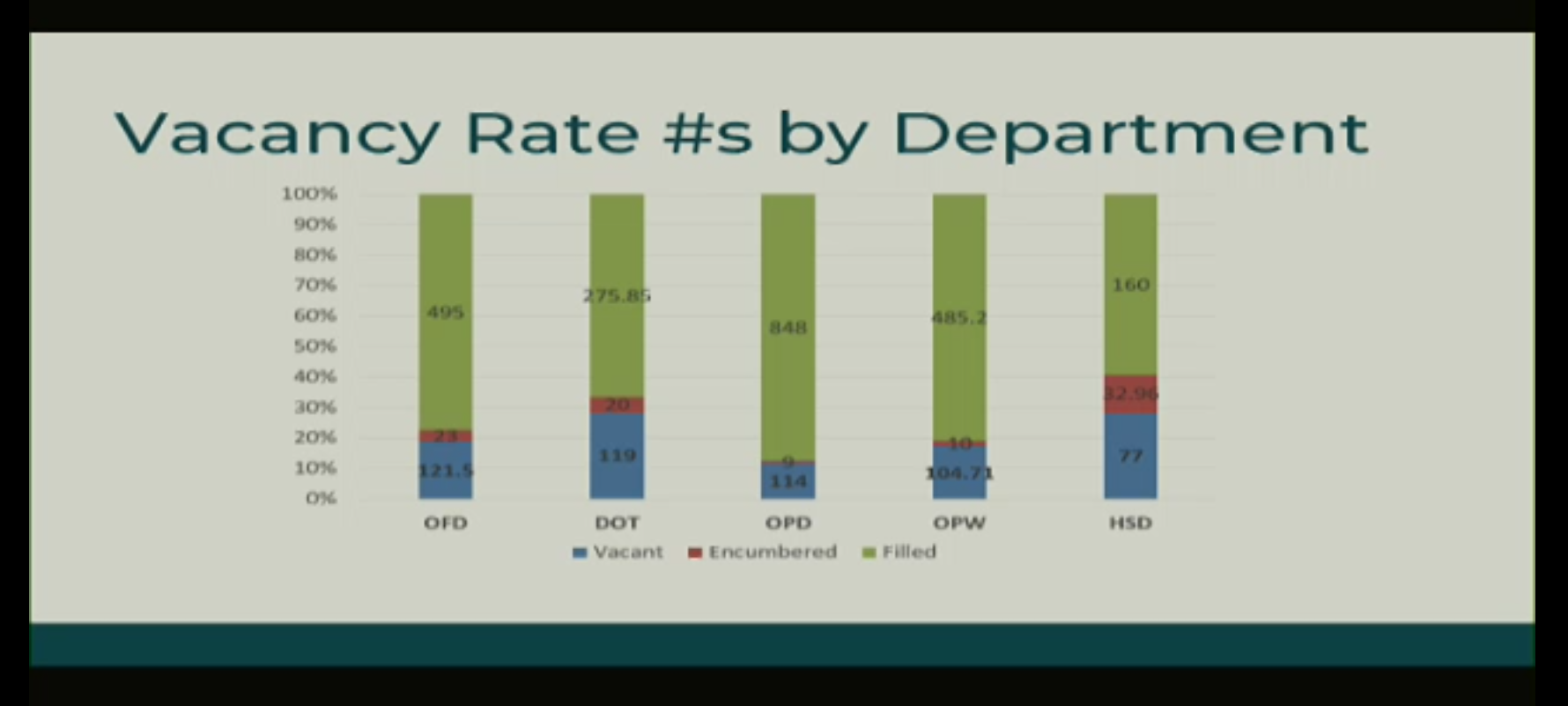
Lawson noted that the CPRA must undertake the same process as all of the City’s departments to hire, through Human Resources. Lawson described a 6 months to a year process of onboarding new hires because of slow HR processes and Civil Service rules.
Commission Chair Ricardo Garcia Acosta defended the record of Lawson at the CPRA after the statement.
“There's little things that get pointed out about how crappy of a job we're doing as a commission every two weeks…and that doesn't bother me one bit. But we have hardworking directors like yourself that's leading a department that's doing great work, and has really stuck to your mission, and have just named a bunch of positions that you've hired under your watch. I just want to thank you for your leadership, and how you're leading the department in the direction we're going,” Garcia Acosta said.
*In the Council/Manager system, the Council itself is the executive, with the elected Mayor serving as little more than a President of the Council. That system would give the Council the power to hire, direct and fire the City Administrator and other agencies of the city government.
Comments ()