
1) Air of Resignation at Public Safety Committee Over Dismal OPD Recruitment
Council’s Public Safety Committee visibly struggled with 2026’s startlingly low academy graduation numbers detailed in the OPD’s most recent staffing report Tuesday. But ultimately, the committee did not put forth suggestions or long-ranging plans to help increase flagging OPD recruitment, a departure from previous staffing discussions.
OPD’s Amber Fuller spent just three minutes presenting the report to the committee, with little qualitative commentary on the size of the most recent graduating class. CMs in attendance raised questions on why the graduating class had such a stark drop from its initial size—but in lackluster fashion compared to previous lengthy back and forths with OPD’s recruitment and staffing specialists in March. The 197th academy began with an unusually large class of 40, and ended several weeks ago with one of the lowest graduating classes of the past decade, 15.
After the presentation, Chair Charlene Wang, followed up on the 197th’s graduation.
“What were the reasons that individuals wound up dropping out of this academy, and is that rate typical? Or are there issues with our upfront acceptance process that is resulting in an extremely high drop rate? I'm just really trying to get at the heart of ensuring that our academies, which are not cheap—they're expensive—are being used most effectively,” Wang asked.
Deputy Director Kiona Suttle told Wang that each phase of the academy can pose a challenge for recruits, from physical fitness, to academics, to driving competency. But Suttle argued that she believed the failure rate was typical of other area academies, though she could not confirm that data point. OPD also revealed that failing students with high enough scores are recycled into the next academy if they are willing, a possible explanation for why starting classes are higher than typical and graduating with low numbers.
During the course of the discussion OPD representatives also revealed that OPD's academies are budgeted at 50 trainees. That number is far above a realistic expectation of enrollment each year [see graph below] according to OPD’s own data, but no CM followed up.
Sgt. Michael Romans-Rowe, OPD’s recruitment lead, offered that current efforts at recruitment had produced more than usual initial applicants going through background. But Romans-Rowe in March told the Committee that the Oakland-area hiring pool was exhausted and that the City would begin to have to recruit nationally. In the end, as CM Brown noted, a larger majority of the decreasing graduating classes in the past two academies are Oakland residents, suggesting that Romans-Rowe was correct, but that OPD did not succeed in recruiting effectively nationally.
OPD's Long Decline in Recruitment
The dismal graduation numbers reflect an ongoing recruitment crisis at OPD that began about ten years ago, and has grown demonstrably worse in the last several years according to public data provided by the OPD. An Oakland Observer records request obtained on academy recruitment and graduation from 2015 to 2023 obtained last year, bolstered with other OPD data provided through staffing reports through 2026, shows a steady decline beginning in 2017. The average number of graduating police in those 11 years is 22.
Since 2020, OPD has succeeded in graduating a class of 30 or more recruits only once. The average graduating class for the past five academies—including the last budgetary period, where budget direction from Kevin Jenkins and Janani Ramachandran aimed to increase recruitment—has been 16 graduates.
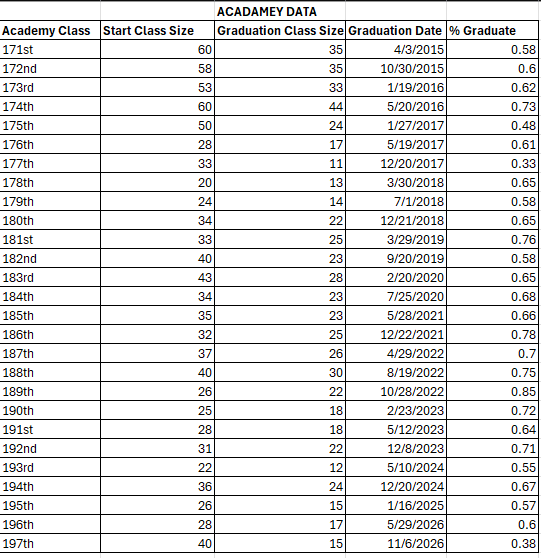
In fact, since 2022, OPD’s academies have not had a graduating class above 24, and most have been below 20. The most current academy graduated 15, from a starting class of 40—an almost unheard of attrition rate of 62%. That’s the second highest in over ten years, and the highest since 2017. Consequently, even after the academy graduation, Oakland’s police staffing level is at one of its lowest ebbs in history, at 612 [as of the report Tuesday].
Romans-Rowe also noted last year that one of the largest OPD attrition bleeds is in newer police officers being lured to other agencies with significant hiring bonuses. OPD has financial penalties for leaving the OPD before the 5 year post-academy cut off ranging up to $20K, but they don't appear to have been effective against signing bonuses that are as high as $80K. OPD appears to have given in to the reality that the penalties aren’t working, and rather than entice newer recruits to stay at OPD, is giving meaningfully lucrative retention bonuses to 10 year plus department veterans in the latest OPOA labor agreement. The strategy is a visible admission that holding on to veteran officers is the best route left for OPD to address its staffing crisis, not recruitment.
2) Civilian and Fire Unions Contracts Agendized, as Report Confirms OPOA’s “Me Too” Clause Adds $10 MM to COLA Costs Over Five Years
After months of unanswered questions about the financial repercussions of OPOA’s “me too” clause, it appears the recently negotiated union contracts will result in the OPOA receiving an additional 2% back door raise, according to a report accompanying legislation authorizing the City's civilian and fire union contracts.
The contract OPOA previously negotiated from 2019 to 2024 provided 16% in cumulative raises; an additional extension added another 6% raises up until June 2026—a total of 23% in cumulative OPOA pay increases from 2019 to June 2026. Now, OPOA’s five year contract ending in 2031 will add another 16% in cumulative raises. Unlike other city unions, which have gone years without cumulative COLA adjustments, OPOA has received regular adjustments every year since at least 2015, about a 38% wage increase since that time. A significant selling point in Mayor Barbara Lee's press release for the initial 2026 to 2031 OPOA contract was fiscal oversight, noting that OPD would only receive a 14% series of raises [14.9% cumulatively] and payments into the city pension and benefits packages compared to previous years. Lee described this as "compromises on both sides".
Questions swirled around OPOA's contract language as both fire and civilian unions expressed frustration publicly about a moribund negotiation process—and civilian unions threatened a strike and even came within days of delivering it. Eventually, both fire and the civilian unions negotiated COLA additions. While IAFF 55, the firefighters union negotiated a 16% increase over 5 years, they also agreed to paying more into pension and health benefits. The civilian unions won their agreement without taking on additional requirements to pay into benefits, which are of poorer quality for civilian unions.
The OPOA "me too" calculation is complicated. The equation subtracts the members commitments on benefits from the COLA in each year of the five year OPOA contract, and compares that sum in each year to any COLA raise in another city contract, plus or minus the same costs and benefits. While OFD’s larger set of raises did not trigger a “me too” bonus due to the unions concession to pay more into their benefits, IFPTE and SEIU's straight increase of 4% is larger than OPOA's differential in the 2028-29 fiscal year.
That third year COLA increase for those civilian unions will add 2% to that same year's pay raise in the OPOA contract. That will mean the cumulative raise over the OPOA contract is around 17%, an additional $10 MM through the five year life of the contract and a $98 MM total*.
The total costs of the civilian and fire contracts are about $42 MM over the three year civilian contracts. Police accounts for another $29 MM over that period up to FY 28-29. From FY 29-30 to FY 30-31, Fire will add another $40 MM and OPOA another 59.4 MM in city costs--about $170.4 MM over the five year period. OPOA's contract makes up about 58% of the total over the five years, and its not clear if the City's unions, which had to threaten a strike to get COLAs after three years without them will be able to win another set of COLA adjustments after this three year term.
The civilian and fire unions also won other non-financial gains in the contracts that are specific to areas of work.
*the cumulative amounts posted here are compound sums based on the reality that each year of pay increases raises the baseline by which the next year’s increase will be calculated. OPOA’s pay increase structure is also staggered within each year’s increases so the percentage cumulative increase is approximate. The City also claims that the pay increase total is offset by the OPOA’s larger share of benefits payments, but the total pay increase as reported by the Finance Department is used here.
Comments ()