
Oakland’s City Council completed the Mayor Lee Administration's rushed effort to approve the Oakland Police Officer Association’s [OPOA] 2026-2031 labor contract last Tuesday afternoon, approving the 5-year contract with minimal scrutiny in a visibly hasty voting process.*
After abbreviated discussion among Council Members [CM], CMs passed the legislation by a 7 to 1 vote, with D2 CM Carroll Fife the only representative who asked substantive questions about the contract as the only nay. The lack of comment from Council members—3 did not speak, and a fourth, Kevin Jenkins, the Council President, made no remarks about the substance of the deal—was notable. Of the four that did ask questions, only Fife posed followed up questions after answers. This dynamic included both the Chair and Vice Chair of the committee that normatively should have first vetted the contract, Public Safety. Vice Chair Houston said nothing and Chair Charlene Wang had minimal questions.
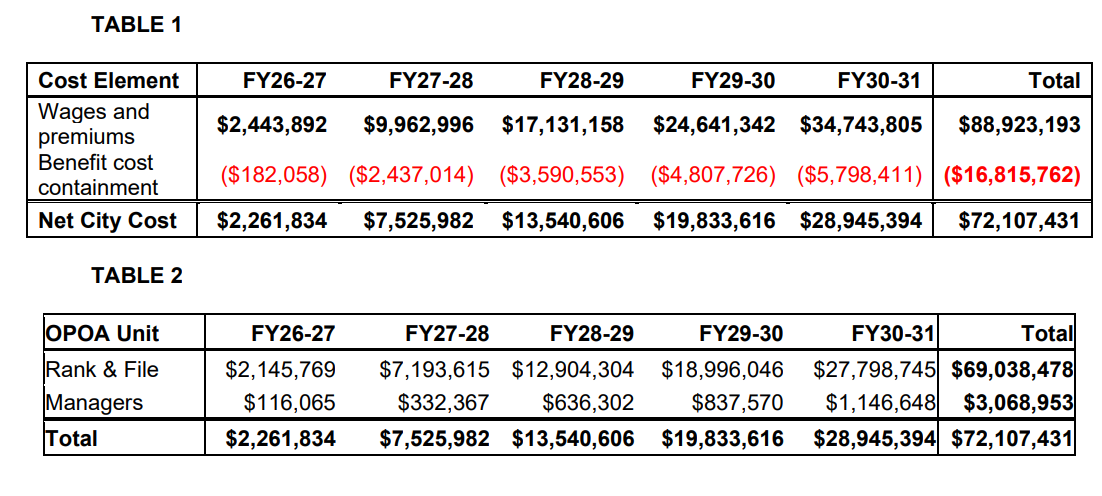
The lack of scrutiny comes as even according to the Finance Department’s own claims the contract is complex and novel. The MOU adds a stunning $72 MM in new costs over the next five years to the City’s budget, most of it ballooning in the last two years of the contract term.
The contract’s unprecedented “me too” clause has never been tested in Oakland’s labor environment and comes as the city’s civilian union negotiations have stalled and IFPTE 10 and SEIU 1021 have for months publicly expressed frustration at their inability to secure a just contract with the City, including unprecedented protest actions.
City union workers take their picket into city hall pic.twitter.com/tcR3Zc6eEB
— Jaime Omar Yassin (@hyphy_republic) June 17, 2026
Most of the OPOA Negotiating Team Stand to Receive the Contract's Highest Raises of Nearly 50%
The MOU’s “longevity” bonus formulation will guarantee many of the very officers on the OPOA’s negotiating team who brokered the deal, get an approximately 45% salary increase in coming years. During introduction, HR Director Mary Hao thanked the OPOA principals on the negotiating team by name—several of those same officers are among Oakland's highest paid employees. Huy Nguyen, Omar Daza-Quiroz and Timothy de la Vega all made above $398K in 2024 in overtime and base pay, according to Transparent California. And all three are 20 year veterans who will receive the highest pay structure that begins in 2027. No officer named by Howe on the negotiation team makes less than $200K with overtime.
City Auditor's Recommendations for MOU Additions on Overtime Ignored
Likewise, longstanding OPD governance and cost-control agreements that were recommended to be included in the new contract by the City Auditor's office were disregarded. City Auditor OPD audits and reports for almost a decade have advised the City to add overtime control into contract negotiations, but to no avail. The City Auditor recently reminded City leaders that these recommendations are outstanding from previous OPD audits, but they were apparently ignored during negotiations. The new contract effectively has little to no overtime controls [except for a clause that would require the contract to be reopened in the unlikely event OPD staffing meets Measure NN requirements]. The Auditor also suggested that the City negotiate with OPOA on the stalled efforts to activate response time-improving GPS in OPD cruisers, but this also apparently did not happen.
Fife is only CM to Interrogate the Contract as Chair and Vice Chair of Public Safety Stand Aside
Yet despite all these and other issues and a 5 year agreement that will prevent Council from adding regulatory processes and cost controls until 2031, the Council rushed to pass the contract after public speaking time was complete. Council President Kevin Jenkins appeared to be in a desperate hurry to call the vote roll and did so within seconds of the clerk announcing that public comment had ended and public speakers were still returning to their seats.
This 20 second video is unedited and a real time recording of the voting process that began after public comment on the OPOA contract
After an exceptional brief 3 minute report on the contract by the City's HR Director Mary Hao Council deliberation, CM Fife led the bulk of questions to the City about the problematic contract, in a back and forth that the record shows went on for 22 minutes. CMs Rowena Brown, Noel Gallo and Wang had brief questions, but left follow ups unpursued after minimal responses from Finance Director Bradley Johnson. Public Safety Chair Wang's exchange with Johnson lasted 5 minutes; Gallo's lasted under 2 minutes; Brown's went for a minute and a half. The public record shows that Janani Ramachandran, Zac Unger, and Public Safety Committee Vice Chair Houston did not speak at all. Aside from speeding the passage of the contract, Jenkins did not comment on the specifics of the deal.
Fife Pushes Back on “Me Too” Clause
Fife pushed back against the “Me Too” clause in the contract, the clause that would backdate any future raises won by civilian unions above those of the OPOA into the OPOA contract. Fife noted the irony that the Oakland’s civilian unions didn’t get a COLA raise last budget year, while OPOA did—but the civilian unions could end up adding their own raises to OPOA’s if their contract struggle succeeds in catching up on cost of living. Fife also expressed surprise that bargaining units that have low paid workers would be adding their small raises to proportionally huge increases for Oakland police.
“[Me Too] feels like apples and oranges because some of our highest paid staff are in the Oakland Police Department. So how do we compare that with someone in SEIU who is working at a library that's a temporary part time worker? I don't understand how we can open up [the OPOA MOU]... because $70,000 a year is a lot different than $200,000 a year,” Fife said.
Fife Pushes Back Against Costly "Longevity" Bonus Retention Strategy
Fife expressed serious doubts that the City’s gamble on "longevity: bonuses would stabilize the OPD’s staffing amid consistently declining academy graduation rates. Fife noted that half of the 197th academy’s 40 incoming trainees have so far washed out of training—out of a class of 40 recruits for the 197th academy in April, only 20 remained in September. Indeed, OPD told this publication that 8 members of the new 198th academy are recycled trainees who flunked out of the 197th academy, suggesting the higher than normal recruitment numbers for OPD academies in 2026 are illusory and won't transfer to staffing increases. Fife said she doubted retaining older officers at high rates of pay would reverse the impact of the nation-wide staffing crisis.
Johnson Caveats "Not Easily" After Claiming Increases to Budget are "Manageable"--City Report Notes $72 MM Cumulative Budget Increase
Finance Director Bradley Johnson responded to Fife’s questions, claiming that the additional $72 MM costs of the contract over 5 years are “manageable” because of the health care and pension concessions, before adding as after-thought “not easily”.
"[Its] a total package that, over the course of the five years, is affordable within a reasonable estimation of the city's budget. So, the total package sits within an element that is affordable that we can manage... not easily," Johnson said.
Johnson may have demurred on the increasing year to year budget gap produced by the contract, but the legislative report shows that the last year of the ballooning costs constitute a near-10% increase from current OPD costs, around $30 MM dollars in additional costs the City will have to somehow prepare to pay. Even as Council debated about which vital services to cut to balance the FY 26-27 budget in June, the new contract will add an unanticipated $2.26 MM in costs to this fiscal year's budget. The costs will quadruple from the second contract year to that fifth year.

Community activist John Jones III recalls that in June the Council had to debate whether to cut senior funding or lead remediation funding for schools to save 100K, an amount dozens of officers make yearly in overtime.
While Johnson argued that the concessions are an important cost-saver in the agreement, he also argued that the additional costs of the agreement will be covered by the savings in health care and pension concessions [collectively 10% and 3% respectively, staggered over the agreement’s life]. But later, Johnson also seemed to argue that those savings would only cover "longevity" bonus costs. The City’s own costing table shows that the health and pension concessions only cover 18% of the total wage and premium increases. It’s not clear if the "longevity" bonus and new concessions balance, but in that case, it would mean that the "longevity" bonuses would cost taxpayers at least $16 MM by the end of the five year period. How the "longevity" bonus and raises would affect total pension costs was also not discussed. Questions put to the CAO from this publication about these figures are still outstanding from the CAO.
"Me Too" Clause is Unprecedented, Though Johnson Calls it a "Standard" Contract Addition
Johnson also suggested that the unprecedented “Me Too” clause is a standard contractual clause in municipal negotiations, but no previous OPOA agreement has had one. Most of Johnson’s responses to Fife’s questions expressed confidence that the contract was an ultimate benefit for the City of Oakland, despite the reality that it would come at the cost of civilian unions while adding tens of millions to City expenses over the next several years. Johnson also suggested that he saw the OPOA contract as a good standard for all of its contracts, even as Fife noted that the civilian unions have to “beg” for a contract.
“There are certain groups in the city of Oakland that never have to come to council petition leadership to get the benefit of raises, of consideration, of anything in the city…we have a deficit in employees in almost every single department in the city of Oakland. And when my constituents call me, they're calling me about why aren't my lights on on Mandela Parkway? Why have we passed all of these pieces of legislation around homelessness, and it's increasing? Why is there illegal dumping continuously occurring? And the people who do that [work] have to beg us…and are out of contract right now because we cannot figure out how to make them whole, and that is deeply concerning to me,” Fife said.
Fife couched her coming no vote as good fiscal stewardship and the police spending as the actual cause of Oakland’s budgetary problems.
“So if the cost of employees is going up, but people are consistently saying it's poor management at the city of Oakland about how we do our budgets, I want to make sure that the decision I make today regarding one of the most expensive departments in the city of Oakland is a prudent decision. So, how does this benefit us long term, and how will this not cause those future budget gaps where we have to do all these emergency measures, pull from ballot initiatives to cover salaries if we're giving this type of increase, and we're we haven't even gone over the other units yet. We still have fire 10 to 1021, all the other units. This is significant,” Fife said.
Brown, Wang, Gallo Pose Minimal Questions
Though 4 CMs asked no questions, those that did ask questions with the exclusion of Fife did not follow up for specificity. CM Brown’s questions were strictly on apparent civilianization clauses in the contract. HR Director Mary Hao clarified that there are currently no barriers to civilianization in the current or future contract, and new current language only clarifies that. Brown stood down immediately after.
Wang asked whether the "longevity" bonuses would add significant costs, Johnson said the bonus would be covered by the health care and pension concessions, but offered no specifics and Wang did not press except to ask if other cities had similar clauses. Johnson said that San Francisco also has a similar pay scale escalation. Wang, the Chair of the Public Safety Committee, failed to explain in her comments why she did not ask for the item to come before her committee where these and other questions could be discussed at length.
Gallo asked if overtime issues that had produced scandalous headlines had been taken care of in the contract. Hao confirmed they hadn't, but said she thought Chief Beere had done a good job of managing overtime since the revelations which appeared good enough for Gallo.
Three Critical Stakeholders Urged Council to Pause Vote During Public Comment
About 18 residents spoke, including several IFPTE principals and the Budget Advisory Commission Chair person. All were critical of several aspects of the agreement. They, and all other speakers asked the Council to either hold off on approving the contract that evening or vote against it. The speakers included representatives of the Coalition for Police Accountability, the East Bay DSA, and D2 Council challenger, Nate Adams, who all opposed the package.
Mike Petouhoff, Oakland’s independent Budget Advisory Commission Chair, praised the idea of just compensation, but noted that the raises should be matched to performance, and was critical about structures, deployment and overtime at the department. Petouhoff said he was concerned about many structures in OPD that could be regulated under the MOU–including overtime, which he noted over-spends no matter the staffing levels of the department. Petouhoff also suggested issues such as deployment of officers, cost saving through civilianization and operational capacity could be addressed through the MOU, and should have been introduced regardless of how much time it added to the table discussions. With these issues in mind, Petouhoff suggested the Council pause the process and the City return to negotiations.
“If you passed this in November, the raises could still take effect in January,” Petouhoff said.
Noel, a member of IFPTE’s negotiating team roundly criticized the City’s focus on OPD and its inability to keep its overtime abuses in line. She compared the deference to OPOA’s needs to the indifferent way it has treated IFPTE’s negotiations.
“We’ve been at the table twice a week since March, been told time and again that the City can’t afford to pay us any cost of living adjustments, cannot pay for things like a bus pass…meanwhile we’re here seeing OPD getting a 14% increase over 5 years and "longevity" pay up to 15%. [the Me Too Clause] is not a floor to keep policy pay comparable, it’s a ratchet that guarantees OPOA always comes out ahead…” Noel said.
Xochitl, another member of the negotiating team, told Council the agreement is financially irresponsible.
“This proposal is egregious and unacceptable for many reasons. It is financially irresponsible for Council to accept an agreement with OPOA that ignores concerns highlighted by city audits, particularly OPD unlimited overtime. In 2019 alone, auditors found approximately 14 million per year over budget just due police overtime. 1/3 of officers worked over 500 OT hours per year. This new contract still sets no overtime cap,” she said.
After the public speaking period, Council President Jenkins left no time for responses before calling the roll call vote. About 10 seconds elapsed between the clerk’s announcing the end of public comment and Jenkins’ roll call vote direction.
*the contract covers all rank and file officers and represents the majority of the expenses. A separate parallel contract covers management officers, that contract represents a nominal share of the total, and $3 MM over the 5 year contract. The legislative motion passed the two resolutions for those contracts. An additional piece of legislation passed by Council in the same vote, sets the salary ordinance for the officers based on the new contract, without which, the new pay schedule cannot move forward. As an ordinance, that legislation must come before Council for a second vote on October 10.
Comments ()