
1) Council Unanimously Passes 10.5 Month Data Center Moratorium Extension
In a subdued second act to Oakland's data center controversy, the City Council voted Tuesday to unanimously add another ten and half months to its initial 45-day moratorium on data centers. The legislation, submitted by Carroll Fife, the original sponsor of the 45-day moratorium, will continue a freeze on granting permits to create or expand data centers while the Planning and Building Department [PBD] studies policy options up to and including an outright ban. The 45-day phase of the moratorium will end on November 20.
Fife went further to frame the moratorium as an issue of race and class than she has at past meetings.
"This is not about race specifically, but we know that the negative impacts of industry when done incorrectly affect the poorest..., folks who've been impacted by generational racism and generational environmental impacts. And I think we can do better," Fife said, highlighting the fact that the impact of Oakland's industrial areas causes shortened life spans and other health problems for Oakland's Black and Brown residents.
Overall, Council members spent little time deliberating on the merits of continuing the moratorium, and most CM questions were confined to how the moratorium would function and how community outreach would occur. The extension brought a smaller crowd of moratorium supporters, and little of the original organizing from Party for Socialism and Justice [PSJ] was evident. While PSJ organized a caravan ahead of the vote and posted a call out for speakers at the meeting, only one speaker specifically identified themselves as representing the organization during public comments. Most speakers appeared to be responding to Care for Community [C4C] organizing based in West Oakland. C4C also carried out an influential survey, relying on door to door and transit station interviews. The poll of 424 residents found that only 2% of the respondents opposed the ban, and about ¾ support an outright ban on the controversial infrastructure.
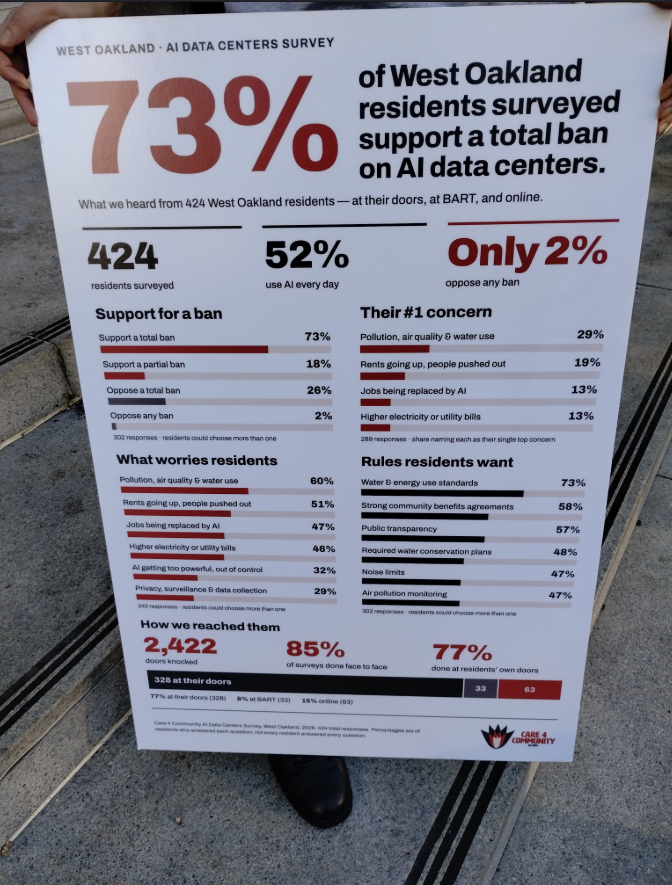
Gilchrist lauded the group's poll, and called it "remarkable work" that gave voice to community members that might not otherwise have been able to participate.
At the meeting, there were a little less than half of the speaker numbers at previous meetings, but the demographic of opposition to the data centers also shifted. Far more speakers identifying as native Oaklanders and African American spoke out against data centers.
Alan Temple Baptist Church Associate Minister Leslie Bowling Dyer was given additional time by other speakers, and told Council "technological innovation is not equivalent to social progress...corporate actors continually find that the straightest line to profit is to sever any sense of moral obligation to one's fellow human beings."
Allen Temple associate minister with a very worth listening to comment pic.twitter.com/8sORaJBwG1
— The Oakland Observer (@Oak_Observer) November 11, 2026
The legislation to extend the moratorium also included a required report from Planning and Building. The report, as PBD Director William Gilchrist originally told Council, was light on actual policy recommendations or data, and simply serves to suggest an extension to complete the acquisition of subject matter expertise and resources necessary for a conclusive report. According to Gilchrist, the next 10.5 months will be spent hiring consultants and subject matter experts and using the PBD’s own subject matter expertise to study potential regulatory frameworks. The PBD will also reach out to other stakeholders, including local utilities like PG&E and study other jurisdictions’ process and experiences. The next report will also be due 10 days ahead of the end of the moratorium. Another one year extension is also available under the same state law should that be necessary.
2) Oakland Divest Coalition Faces Mixed Messages at Council Scheduling Committee
After a long road to getting an ethical investment policy on a Rules agenda for scheduling to a Council committee, the city's legislative wheels are still moving slowly for the Oakland Divest [OD] coalition. The investment policy would bar investing Oakland’s funds into "any companies that facilitate and enable state violence and repression, war and occupation, and/or severe violations of international law and human rights", from the prison industrial complex to the occupation and apartheid of Israel.
The group has already cleared a significant hurdle to get the ethical investment policy to a place where potential introduction is a possibility. According to the Council's Rules of Procedure, residents and organizations may agendize legislation to the Rules committee if they first present it to every CM, and all the CMs decline to introduce it themselves. Rule 24, section 4, of Council Rules of Procedure was instituted in late 2023, under former Council President and Rules Chair Nikki Fortunato Bas. Although ostensibly designed to give residents an opportunity to find Council member sponsorship for important legislation, the rule also notably made it more difficult for a member of the public to place legislation at Rules. For years previous, members of the public were able to petition to directly place legislative and informational requests on Rules for scheduling—although legislative items often failed to pass City Attorney vetting, requests for informational reports sometimes made it to the agenda, and although they failed to advance, the process inherently created a public platform for the author. In the current rules, one or more CMs can draw out the process of vetting legislation for months or even years by appearing to work on the legislation with the author before giving a final no required to take advantage of Section 4.
OD began the process of finding a Council sponsor for the investment policy as early as 2024, but failed to get solid backing from CMs during that initial attempt. After focusing on building internal capacity and organizing networks, OD then tried again starting late last year, per a source with first hand knowledge of the process. Oakland Divest made little progress in persuading any CM to sponsor the legislation and in early 2026, moved to utilizing Rule 24 Section 4 to go directly to the Rules agenda.
All 8 CMs eventually declined to partner in moving the legislation forward, clearing the way for Rule 24’s direct public agendizing function earlier this year. But the coalition then ran into issues with the City's follow-through. The vague Section 4 text doesn't require the legislation to go to the agenda even after the requirements have been met, for one thing, as Rules Chair Kevin Jenkins made clear at the meeting. Jenkins said at the outset of the deliberation that he wanted to make it “abundantly clear” that Rule 24 “reads ‘may’, not ‘shall’”.
At one point, the legislation was put on the Rules agenda, only for that placement to be characterized as a mistake by the City Administrator’s Office and removed at the meeting. OD said in a statement last week, that off line conversations with Rules Chair Jenkins guaranteed an early November agendizing, and despite the failure to hit the first Rules meeting, the policy appeared last Thursday's Rules at long last.
During Thursday’s deliberation on the item, Jenkins alternated between defensiveness and defiance about the policy and Rule 24 process. While it's not clear if he is a supporter of the investment policy, he does not appear to support Section 4. Jenkins offered an unprompted and jarring promise in a response to Carroll Fife that this would be “the last Rule 24, Section 4–we will be changing the rules.”
Even as the investment policy finally appeared to be close to moving forward at Rules Thursday, with at least two CMs open to forwarding it to the Finance Committee, the deliberation broke down over the absence of that committee’s Chair, Janani Ramachandran, who is also a Rules member. Ramachandran was sick, and thus unreachable, according to her chief of staff—Rules members said they preferred to have the input of the Chair before scheduling it directly. Eventually, the three CMs present at the Rules committee, Jenkins, Fife and Rowena Brown, voted to move the policy to the "pending" list at Finance, to ostensibly pause deliberation until the Chair of the committee could weigh in on how and when to schedule it. CM Carroll Fife also suggested she would want to hear from the legislation's authors and the opponents.
The policy now faces another hurdle. To get out of the pending list will require an affirmative vote of the committee to schedule it to an upcoming Finance Committee meeting, and it would return to Rules for that scheduling.
At the meeting, it became clear that other influences on the policy could be in play. Representatives of the Oakland Jewish Alliance [OJA], and the extremely active Israel lobbying group, SFJCRC, both spoke out against even considering the policy. They were joined by a founder of the OJA, who was also once Deputy Director of the Northern California AIPAC Chapter from 2002 to 2005. OJA brought complaints against OUSD for such actions as allowing a Palestinian flag to be raised on a flagpole and for holding critical discussions about zionism, the ideology that dictates that all areas of historical Palestine belong to Israeli-state-designated Jewish people. SFJCRC led an aggressive propaganda campaign against the Council's deliberations on a ceasefire proclamation early in Israel's war against Palestinians in Gaza at both Oakland and San Francisco's legislative bodies.
The speakers suggested that the legislation unfairly singles out the state of Israel; that the legislation wastes the public and officials time with ancillary focus, similar arguments made by JCRC against the County’s ethical investment policy, which initially was passed by the Board of Supervisors, and is now moribund in a seemingly interminable analysis phase.
You can see some of the comments and deliberation from Oakland Observer's live report here:
Comments ()