
1) Fife’s Data Center Moratorium Forwarded to Full Council But Wang Fails to Add Legislative Imprimatur
Lots of details the others have missed: according to the OCA, passage will require an almost unanimous 7 votes. And Wang tried very hard to get her amendments into the legislation, but even the Planning and Building Department director characterized them premature and redundant. Read more here
2) Wang’s Anti-Trafficking Fines Program Has Levied No Fines as Process Remains Inchoate
Deliberation on a legislatively required report on the City’s anti-trafficking efforts revealed Tuesday that a much-celebrated new tool in the OPD arsenal, administrative fines for solicitation, has not yet been implemented nor levied any fines.
Public Safety Committee Chair Wang introduced the administrative penalties legislation in February, founded on a new state law that allows local jurisdictions to impose lower-evidentiary fines as a way of circumventing the hurdles of solicitation prosecutions* the fines would de-incentivize johns on the ever-shifting center of Oakland’s prostitution generally located off International Blvd known as “the Blade”. Fines would go into a dedicated fund to provide funding for organizations helping trafficked individuals. Wang's report at the time estimated that the generated funds would be about $250K-450K. The administrative fines ordinance itself required a report back by August and every six months thereafter, with the first report presented at the 9/22 meeting. The report, however, lacked any mention of the administrative fines process, as Wang noted with frustration at the start of the presentation by OPD.
In the discussion that followed, Wang blamed “bureaucracy” and lack of departmental interaction for the lack of movement on the administrative process over six months later, at one point stating that the problem revolved around the coordinating departments lacking a “credit card processing machine”.
“The challenge is a simple question of who can literally process those payments, and the city attorney's office, while they have the legal expertise to come up with kind of a citation-like process—I wish I was kidding, but this is what we've learned just through the course of implementing this legislation—there is not somebody who has like a credit card processing machine at the city attorney's office. That lies with Finance, right, and yet Finance is not yet willing to process those invoices,” Wang said.
The discussion led to an increasingly tense back and forth with Assistant City Administrator, Michelle Phillips, who did not back Wang's explanation of the issue. As communication broke down, City Attorney Ryan Richardson zoomed into the meeting to clarify the problems were far more complicated and fundamental than Wang was describing or attributing to City incompetence. According to Richardson, the legislative process had created a long runway to implementation– -given that funding for a necessary paralegal role in the City Attorney’s Office was not even budgeted until months later, in July, four months after Wang's legislation had been passed. The funds for the position, not to mention the hiring process, would also take weeks and months to solidify. Richardson told committee members that the temporary paralegal that Council had budgeted to run the program had not been hired yet. Richardson also noted that only budgeting for a year-long limited duration role made it difficult to hire a qualified candidate.
To some extent, Richardson’s comments were the first explanation of the proposed fines program made public. Richardson said the City’s administrative process would be similar to the DA’s process on criminal matters, with review of the citation and evidence, and a determination if there is enough evidence to pursue a fine–and in some cases, there would not be. Richardson suggested that the public had been given a misleading idea of how many citations could be effectively carried out and commensurate fines collected.
“Once [the citation has] been reviewed and and there's a decision that it is fair and just to pursue this person and we have enough evidence to meet our constitutional standards, that's when the process will go into place…I just I want to manage the public's expectation that it won't be a case where we send out hundreds of citations and demands for fees and the money just starts rolling in. People are going to be deadbeats, there will be people who appeal as is their due process right and demand a hearing. There will be people who, after that hearing, appeal it further,” Richardson said.
Public comments made during the meeting by stakeholders suggested that they had been operating with just such an expectation
“As was stated earlier, this holds sex buyers accountable. $4,000 for purchasing an adult or loitering for the purpose of prostitution with an adult. $12,000 for a child. Hundreds of arrests have been made since February, yet not one fine has been collected, and this amounts to a minimum of $824,000 that we have missed the opportunity to collect. This could have been used to address the tremendous gap in funding and human trafficking victim services, including exits, food, housing,” said Vanessa Johnson, the Executive Director of long-standing sex traffic survivors organization, Love Never Fails, who championed the legislation when it was passed earlier this year.
The report also noted that another Wang initiative, a street blockage off of International Blvd, had not yet been implemented.
3) Change Order for 19th St BART to Lake Merritt Greenway Project Almost Doubles Costs
A change order that almost doubles the cost for a greenway bike lane from MLK Blvd to Lake Merritt was forwarded to City Council at Tuesday’s Public Works and Transportation meeting, but only after significant concern about the unusual increase from both the public and committee members.
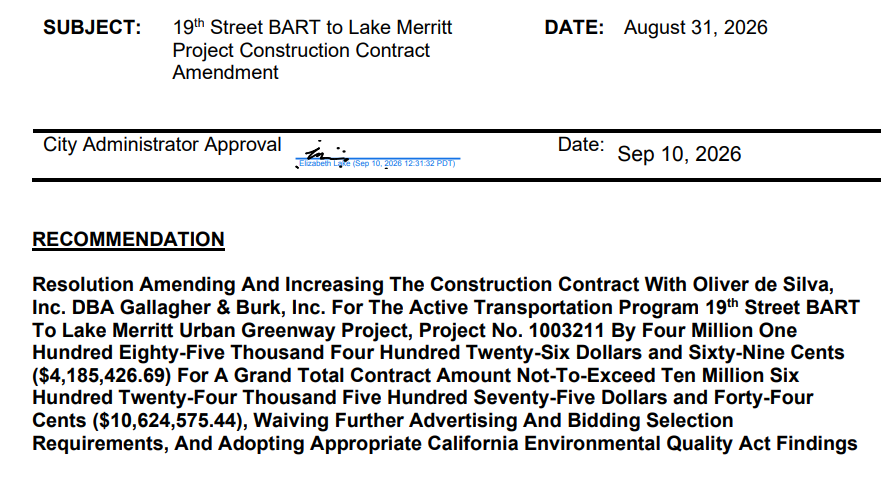
The original cost for the bike lane project was about $6.5 MM and it was originally expected to be completed by late 2023. But costs soon ballooned to 122% and are expected to continue to climb, due to what the City calls “unforeseen circumstances” that delayed and increased the scope of work. Infrastructure go-to entity Gallagher and Burk won the bid for the project and has run it since 2021.
The City claims major delays began almost immediately. After “previously unidentified underground utilities” were identified, negotiations were required with the utilities companies to complete the work. The project was subsequently required to be redesigned, which required new negotiations with Gallagher and Burk. That all led to a near-two year delay.
But even after work resumed in 2023, the project ran into more trouble, including the discovery of a sub-level basement under the sidewalk along the construction path, as well as railroad ties embedded in the sidewalk. The City’s report also says that construction had to be called for various city events, holidays and bad weather. Necessary negotiations with Gallagher and Burk, and delays in work to accommodate them, are cited several times.
Several stakeholders from Oakland's Black construction and business organizations present at the meeting were visibly troubled by the process around the change order. Cathy Adams, President of Oakland’s African American Chamber of Commerce, asked why the City was waiving competitive bidding for the change order, and how many local participating contractors had gotten the opportunity to bid and win work. The issue comes as a recent auditors report shows that almost all of the city’s high cost construction contracts go to a handful of contractors, including Gallagher and Burk, which in recent years has received more contracting dollars than any other contractor hired by the City.
Adams grew emotional as she recounted the lack of movement on the City’s well reported Black contractor disparity, with endless meetings that appear to be generating no movement on the issue.
Oakland African American Chamber of Commerce Director Cathy Adams Calls on City to Move with Greater Urgency to Remedy Contracting Disparities
*the city's administrative process targets "loitering" for commercial sex purchases as well as transactions
Comments ()