
1) OPD Bunts on ALPR Expansion
At Public Safety Tuesday, OPD withdrew proposed changes to its Flock use policy embedded in its 2025 annual report. OPD generally presents all of the annual technology reports required by the City’s Surveillance Ordinance as a package to Council for block approval. During that deliberation, the Council can potentially determine the technology is not a good fit for the City and discontinue it, according to the Surveillance Ordinance. But the OPD is also able to propose changes to its current use policy and embed them in a section of the annual report. OPD followed this practice for the reports, embedding a radical change to the search terms that users can utilize to search the gigantic database of stored Flock license plate images in the Flock use policy.
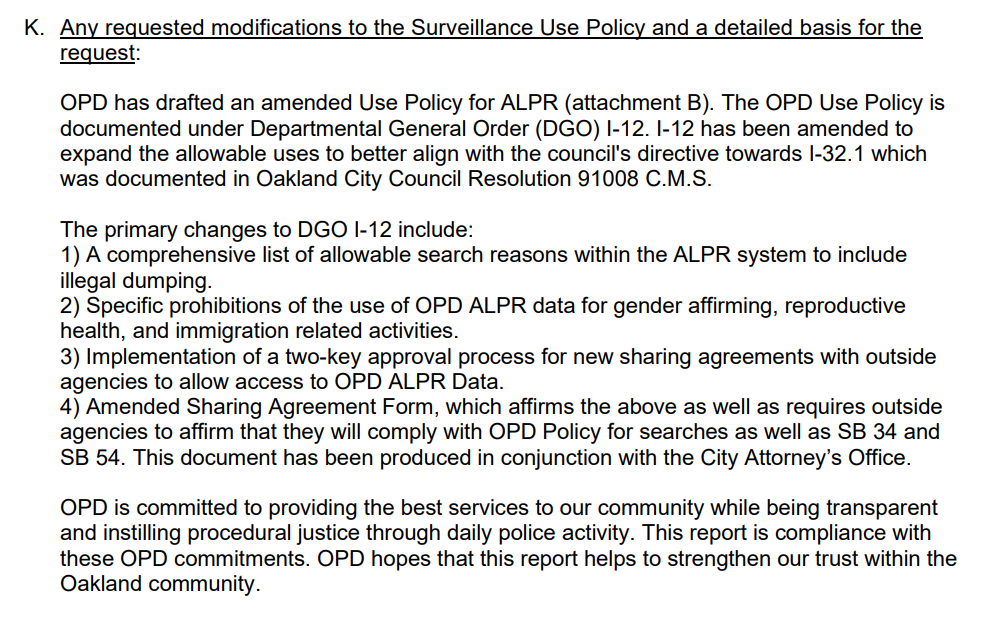
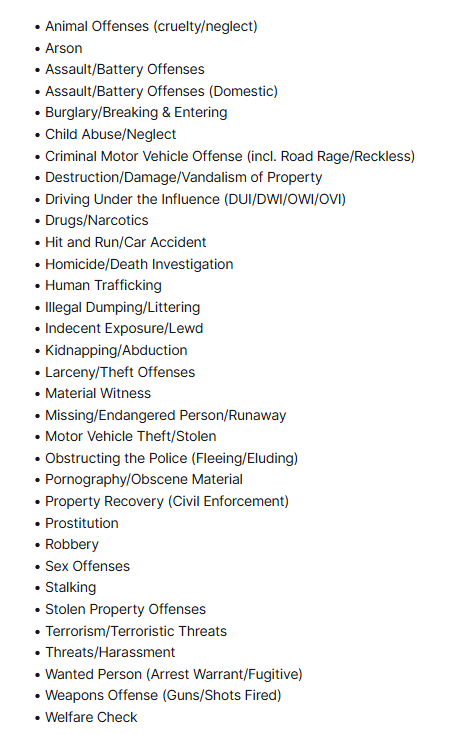
OPD’s representative Omar Daza Quiroz told the committee that OPD had neglected to include the requested change in the title of the legislation. Daza Quiroz said that the City Attorney had advised OPD to withdraw the item and reintroduce it after legislative recess with the search term changes included in the title. The Flock report was also removed from the title of the legislation for the reports that will come before Council this Tuesday. The requested change would add dozens of new rationales that can serve as the pretext for a Flock license plate database search, including some that are not a crime and others that are not serious crimes.
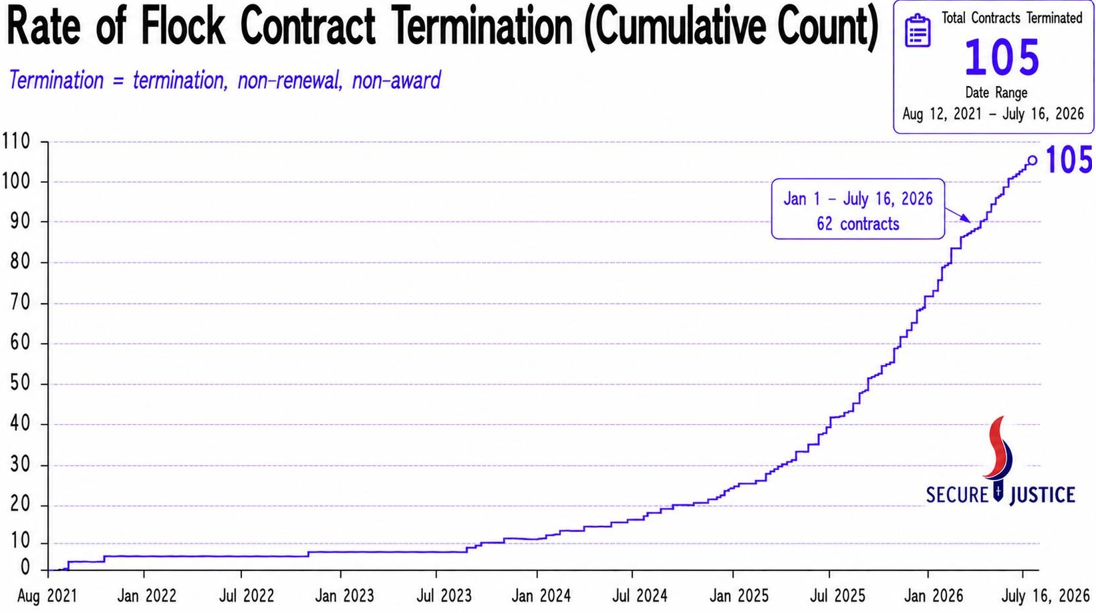
The proposed changes come as over 100 jurisdictions nationwide have cancelled their contracts with Flock due to the company’s scandals, dishonesty and abuses by law enforcement. Over the weekend before the deliberation, the LAPD allowed a Flock contract to lapse amid concerns for civil liberties, for example, one of the highest visibility hiccups for the company.
Oakland’s own status with Flock is currently a matter of speculation. Last December, OPD told Council the Flock service would terminate without an executed contract in January 2026 and that authorizing the contract was a matter of extreme urgency that would outweigh further inquiry and deliberation. But OPD appears to have no executed contract with Flock 7 months later, while continuing to use the system. The Oakland Observer regularly confirmed the lack of an executed contract until May when OPD stopped responding to the request for information. The PSC, chaired by CMs Charlene Wang and Ken Houston, has declined to ask any questions about the contract, or even acknowledge the lack of one, even as the public on both sides of the issue has become increasingly aware of the issue. From the point of view of police boosters, the lack of contract has prevented the expansion of Flock uses into pan and tilt video cameras and connectivity to resident cameras throughout the city.
About 20 people came to speak out on the item, almost all of them opposing the changes and Flock in general. According to Daza-Quiroz, the item will return in September to the committee.
2) New Amendment to Coliseum Sale Agreement Brings City Deal in Line with County’s, With Closing Expected by January 2027
In a short and often joyous deliberation, Oakland’s City Council authorized a new amendment to the City’s sale agreement of Oakland’s share of the Coliseum complex at a Special Meeting Monday. The changes will align the City’s deal with Oakland Acquisition Company [OAC] with the current Alameda County sale term sheet. OAC is the LLC consisting of AASEG, Loop Capital and other partners created for the single purpose of purchasing the Coliseum from the City and County.
All parties now expect the deal to close within months in an all cash exchange for the Arena for a total of $100 MM to shareholders ALCO and City of Oakland, and a staggered payment plan for the rest of the Coliseum site over the next 7 years in a similar structure to both owners. The special meeting was called on short notice during a Rules scheduling meeting Thursday July 9 using Council rules reserved for urgent matters—the City argued that an expedited approval would facilitate the sale of the Coliseum by year’s end.
County and Sale Versions of the Transaction Finally Sync
The new agreement corresponds to a similar non-binding term sheet with Alameda County. The amendments incorporate a new configuration for the deal, with an additional sale partner, Oak View Group [OVG], which intends to purchase the City’s share of the Oakland Arena. That iteration of the deal is slightly different from ALCO’s, which has the County selling its share directly to Oak View, in a sale brokered in OAC’s agreement with the County. Both sets of agreements have evolved over time, often mismatching, but the current deals are very similar.
OVG will pay $50 MM to OAC after OAC purchases the City's Coliseum share and $50 MM to the county—the latter in a simultaneous transaction with OAC for the rest of the Coliseum property.
New Terms Expedite Sale of Arena, Provide Security for City
In the new city deal, OAC will retain control of the site as it pays for the remainder of the value with three payments over the next 7 years, at 5% interest–a similar structure to the County’s term sheet. The City has several contingencies in the deal to secure its interests, including the requirement that OAC hold a reserve equal to the outstanding cost of the property and retain a third party guarantee of payment. The City will retain the ability to recoup the coliseum as a foreclosure in the event of non payment over the course of the deal terms.
Some other changes to the deal will exempt the Arena parcel from the deed restriction for the rest of the Coliseum requiring affordable housing. The Arena parcel contains only the Arena and a small area of surrounding land, and there is no room for residential there. More controversially, the amendment will also exclude the Arena parcel from any environmental liability for the new owner—a similar addition to the ALCO deal received some pushback from supervisors, eliding the fact that ALCO already agreed to exempt the A’s from environmental liability for the entire site in its agreement 7 years ago. Similarly, ALCO also gave the A’s a 5 year payment plan, but notably, requiring no interest.
It’s not yet clear where the environmental liability will reside on the County side of the sale. The deal would also have the City paying for the upkeep of the Coliseum between now and the closure of the sale, but thereafter being free of the costs.
Council commentary was mostly laudatory, praising the deal principals as well as CMs Janani Ramachandran, Carrol Fife and Rowena Brown, who were involved in the city’s side of the negotiation. You can see some of their comments and public comments praising the deal here.
Jenkins, Houston and Ramachandran had all been present at the previous press conference to release details of the deal.
CM Wang for her part offered the city an opportunity to debunk misinformation she said she had heard from “reporting this morning” before ultimately voting for it. Several organizations have referred to the staggered payment structure as a loan, even as they’ve refrained from characterizing the currently existing structure that required no interest for Fisher’s Coliseum Way Partners in the same way.
Noel Gallo said he opposed the deal but seemed to struggle with the facts, unaware that the County does not have a say in how the City disposes of its half of the Coliseum ownership, nor does the Coliseum Joint Powers Authority. Gallo also incorrectly believed that other members of OAC had not approved the negotiations, but was corrected on the dais by principals of the organization. Gallo was the only CM who voted no.
3) Council Largely Quiet on $4.5 MM Loan Forgiveness for Failing Seminary Point Leaseholder
The Community and Economic Development Committee [CED] forwarded an eyebrow-raising $4.5 MM million loan forgiveness for the leaseholder for Seminary Point, a shopping center in East Oakland, to full Council on Tuesday. The entity, Sunfield Development and other companies, owned by Sisvash Afshar, entered into a 66-year lease for the city-owned property in 2016 and the deal came with City financing and an additional line of credit to help Afshar's companies secure additional loans from private lenders to build the development on the city-owned site. Sunfield was exempted from any rent on the site for the first seven years of the lease, and was only required to pay $1K per month for the next 12 years. Thus, after 10 years as the leaseholder, Sunfield has never paid rent, according to the City’s report and the outstanding $40K debt for the three years it was required to pay rent would also be forgiven.
Sunfield constructed the development, which consists of several separate buildings and a parking lot, with additional loans from the Silicon Valley Bank*. The City’s report says that the site was never able to recover after Covid and soon found itself underwater on both the city loan payments, interest on the line of credit, as well as the SVB loan. Sunfield is currently defaulting on the SVB loan and without intervention, SVB will reclaim the development in a foreclosure action by April of next year. The City's loan is subordinate to the SVB loan, and thus it would be SVB that would hold the site development, not the City.
In its report to Council, EWD argues that forgiving the city-bound loans is the only way to pave the way for Sunfield to sell the site.
Deliberation on the loan forgiveness by committee members was short and vague. Council President Kevin Jenkins, who is the district’s representative but not a member of the Committee, told committee members he supports the deal in order to ease the transition to another owner.
"This is truly a crown jewel in the neighborhood...but this truly needs some help, and I've talked with CJ [Carolyn Johnson, CEO] from the Black Cultural Zone, and I'm really interested in the Black Cultural Zone, running this facility. But a barrier to that is the city loan and the city line of credit," Jenkins said.
During her comments, At Large CM Rowena Brown twice expressed some concern about the performance of Sunfield and vaguely referenced tenant complaints. Brown said she was hopeful that the next leaseholder would do a better job with tenants and running the site, and suggested the next landlord should be able to "welcome back" the closed Walgreens at the site.
"I know that there was a lot of feedback about the current owner and just really making sure that we're able to attract an owner that can really pour into this space and attract actual businesses that the community needs...no matter what that may be and it could also be sustained, right? And avoid...blight and etc.I think maybe my last comment would be just as we are looking at a potential buyer...just really ensuring that they have the track record in order to really like liven up these retail spaces and attract key businesses and to also be a very good landlord because I'm sure you all maybe heard some of the feedback that came from some of the the business owners that were renting the spaces as well," Brown said.
Brown may have been referring to comments by a former Sunfield tenant Roxanne Moseley, who runs Sweetfinger at a previous meeting. Though the Seminary Point was not agendized, the owner complained bitterly about Ashfar’s management of the site, and claimed that extortionary and exclusionary rental practices were what ruined the site and prevented the replacement of an anchor tenant after the closing of the Walgreens there. About a month later, Sweet Fingers moved to a downtown Oakland location. While Brown's critique was extremely muted, Mosely directly blamed Afshar for the decline of the site.
“Walgreens isn’t there anymore. Some other places are vacant there as well. Why is that? Because he [Ashfar] does not care about the Oakland residents or Oakland businesses…he prices the units extremely high. My particular unit, he has at $12,000 a month when I actually invested in that property...now I am being forced out of this property because I will not agree to a $12,000 a month rent. That particular community, although I love it well, cannot sustain a $12,000 a month rent...we need to take steps to make sure that if we have a slum lord...is not allowed to stay there. I know for a fact that when that particular contract was awarded to him, he was supposed to make that an affordable place for businesses to thrive and to grow…it's half empty because you cannot thrive and grow with some made up CAM [Common Area Maintenance] charges…this man is lining his pockets while he doesn't even live here," Mosely said.
During public comment, BCZ Public Representative Regina Johnson said the organization supports the legislation. BCZ has been building a portfolio of owned and lease city land for several years and, per Jenkins' statements, is considering buying Afshar's development, which would put the organization under the City's existing lease terms.
4) Houston Proposes Unusual Severance Agreement Proposal for Former CAO Johnson Then Withdraws it 24 hours Later
CM Ken Houston proposed and promptly withdrew legislation to give former City Administrator Jestin Johnson a “severance package” contingent on an agreement to refrain from suing the City. Such severance package deals are not uncommon for terminated staff, but Johnson resigned and would thus not be eligible for one under city policy.
Data from the City’s legislative site suggests that Houston requested the item for Rules scheduling at some point between last Friday and Wednesday. Houston’s severance package deal was first published on Wednesday 7/15, the date that Thursday's Rules agenda is released. At some point between the publication of the agenda and the start of the meeting, Houston withdrew the legislation, according to a statement from Rules Chair Jenkins and it was never considered.
The legislation is at least the second impromptu scheduling request from Houston in almost as many months, written and introduced with less than a week’s preparation time. At a meeting in late April, Houston told Oakland’s City Auditor he would craft a ballot measure proposal to amend the Police Commission based on comments he misunderstood from the auditor’s presentation. Houston's Police Commission-undermining legislation was scheduled to the next Rules meeting two days later. But at that Rules meeting, Houston withdrew his legislation in mid-presentation as he struggled to defend it to committee members.
Comments ()