Oakland Police Commission [OPC] was on various policy makers' minds this week, so that’s why it is a bit more represented than normal in this week’s In the Details. Oakland’s Mayor re-introduced the alternate Commissioner appointment of Doug Wong; the City Auditor recommended strengthening the independence of the OPC , recommendations misread by CM Houston so he could propose an OPC-focused ballot measure to unravel the Commission. And at the OPC, new Mayoral appointee Evelio Grillo impugned the character of the Inspector General in full session, while appearing to suggest he was appointed to the Commission to impel controversies.
1) At Public Safety, Oakland's Auditor Recommended More Independence for the OPC, But CM Houston Introduced a Ballot Measure to Weaken it Instead Two Days Later
When City Auditor Michael C. Houston presented his audit of the Oakland Police Commission [OPC] at the Public Safety Committee meeting Tuesday, he focused on strengthening the OPC and its agencies with more independence and funding. Though conflicts that exist between the Charter and the municipal legal structure of the Commission are also a focus of the audit, Auditor Houston recommended reintroducing moribund legislation to rectify the conflicts on the legislative, not charter side.
But after the presentation, Public Safety Committee member Ken Houston appeared to hear something else entirely, claiming he saw clear direction in the report to introduce charter changes.
"It's clear, it's clear, we need some charter changes, and I'm going to bring some charter changes forward, because it's definitely clear from what you just said. And I'm going to start working on it right now getting moving forward," Houston said.
A few moments later, CM Carroll Fife confirmed that Auditor Houston hadn't recommended charter changes and that any changes to fix discrepancies between the Charter and City law could be fixed by re-introducing former CM Dan Kalb’s enabling ordinance legislation that has lain dormant since he left the Council at the end of his term in 2024. Auditor Houston said he left the recommendations intentionally broad in case there was a desire to change aspects of the OPC via charter, but that there was likely no need, since conflicts could be resolved by reintroducing the legislation and ballot measures are expensive.
For the record, here's the exchange between Auditor Michael C Houston & CM Carroll Fife at last week's Public Safety Committee meeting where Auditor Houston notes most of the inconsistencies between Charter and Municipal Code can be solved with an existing unintroduced ordinance pic.twitter.com/LJuJCuTgu8
— The Oakland Observer (@Oak_Observer) April 27, 2026
Kalb's legislation passed its first reading in December 2024 with Council President Kevin Jenkins oddly abstaining during that vote. Before the legislation could have its second required reading, it was pulled. The ordinance faced resistance from Empower Oakland, but the OPC also was uneasy about some passages and recommended an overhaul. It's not clear who pulled the legislation–Jenkins as Mayor or Council President could have done so—but it was never reintroduced. The legislation could easily be reintroduced through an act by council, however.
police commission enabling ordinance [for S1 changes] has been pulled from today's Council agenda; it passed on first reading under old council. There could be several reasons for this. First, worth noting Jenkins opposed ord. He can pull it from agenda as interim mayo, thread:
— Jaime Omar Yassin (@hyphy_republic) January 21, 2025
Two days after the Tuesday committee meeting, Houston brought his ballot measure legislation to Rules for scheduling, which according to his own comments, was written between Tuesday and Wednesday.
The ballot measure, if passed by Council and authorized by vote, would completely change the dynamic that voters twice approved by an 80%+ margin, making the OPC direct appointees of the Mayor and Council. The measure would also transfer authority over the IG to the City Auditor, an elected position. And in a vague process, it would take the role of hiring the Chief out of the hands of the OPC.
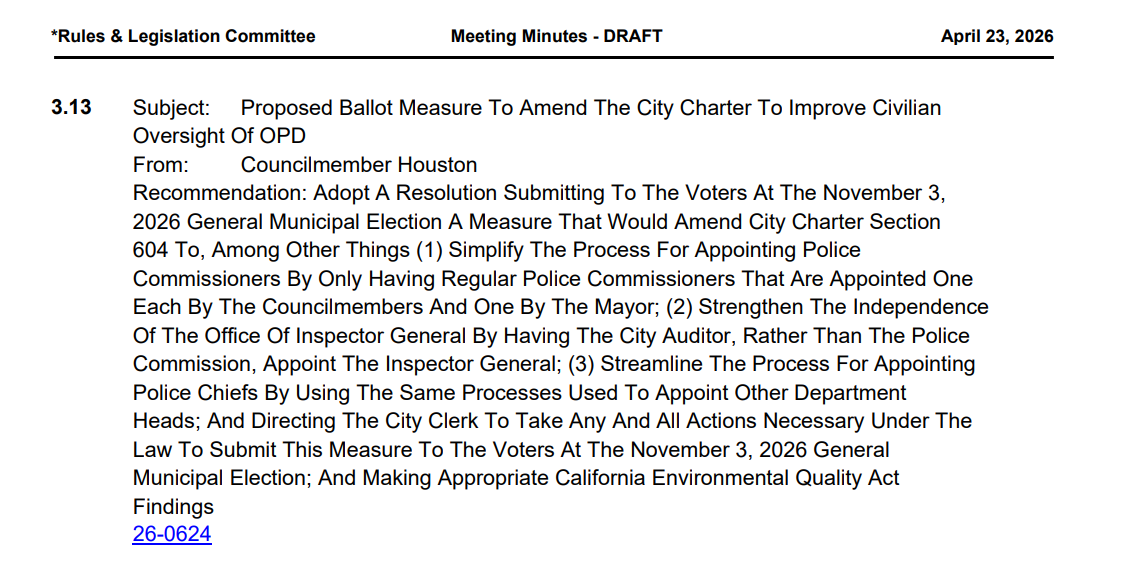
Addressing the Rules body on Thursday, Houston rejected claims that his goal is to undermine the OPC, arguing that the legislation title clearly states that the intention is to improve police oversight.
Houston says that the title of his ballot measure proposal says "to improve police oversight" and that means people who are saying he wants to undermine it are spreading a false narrative pic.twitter.com/ITMVtI29Ux
— The Oakland Observer (@Oak_Observer) April 23, 2026
Despite his claim, Houston's accompanying legislation is nearly bereft of any argument about how the changes would strengthen police oversight—the closest thing to such an argument is Houston's questionable premise that transferring oversight of the OIG to the City Auditor would strengthen its independence, a recommendation not found in the Auditor's report.
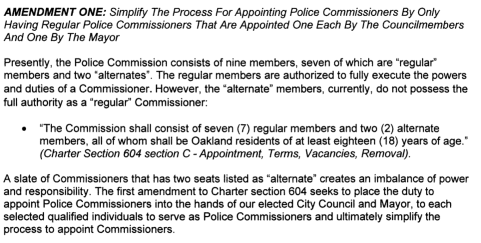
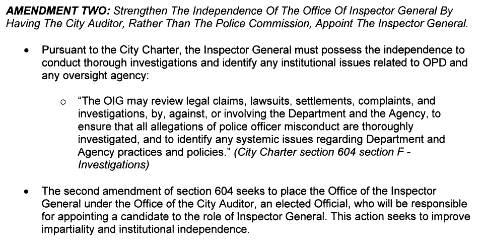
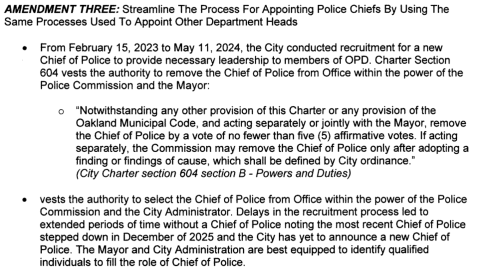
As a ballot measure, the item must be heard at Rules as a substantive matter, and it is currently on track to be scheduled to the May 7 Rules meeting.
2) Mayoral-Appointed Police Commissioner Berates Inspector General in Live Session, Claims He Was Not Appointed to Commission “to be a Milquetoast”
In a surprising move Thursday night, the OPC’s newest Commissioner berated the Commission-appointed Inspector General, Zurvohn Maloof, claiming the IG’s public statements during a presentation called into question his “fitness” for the role. The comments came after Maloof's presentation, which noted that failures by OPD to respond to requests for materials were impeding the Office of Inspector General's [OIG] charter-mandated requirements to complete audits of completed NSA tasks.
The presentation, given the Auditor’s report to Council just two days earlier, is timely, as the Auditor noted that the OIG was behind on auditing previously satisfied tasks in the NSA. You can hear the totality of Maloof's comments on that issue below—the comments were stated during and at the end of his presentation.
I expected to find egregiously reactionary OIG's comments, given Grillo's offended tone. But it was clear OIG was making a public record that OIG could not carry out charter-mandated duties because OPD has not responded to audit info requests. Here's his full comments on it pic.twitter.com/4zvRPR98Ns
— The Oakland Observer (@Oak_Observer) April 24, 2026
The measured statements prompted an immediate and surprisingly heated response by Mayoral appointee to the Commission Evelio Grillo. Grillo called Maloof’s presentation “posturing” and his actions “reckless” “negative” and “confrontational”.
“I feel that you have postured this issue of the audit of the NSA tasks with the police, with the police department, negatively and confrontationally. And I don't feel it was necessary, or I don't feel it was needed. I think it was reckless. You have been told, and it has been discussed with you, that right now, there is not the bandwidth over at the Oakland Police Department to respond to some of the requests you were making. Rather than attempting to negotiate that and deal with it in a manner which could get this NSA audited, these additional tasks completed in a reasonable amount of time. You've chosen to bring a public confrontation that I believe misrepresents the fact, and I think it's reckless, and it calls, in my mind, it calls in your fitness for this job. I am sorely disappointed. I'm flabbergasted.”
Here's Grillo's response, which not only seem inordinately disrespectful, but mischaracterize both the tone and content of IG Maloof's comments. Grillo says the mild comments "call in your fitness for this job". pic.twitter.com/RpCiXgEDEE
— The Oakland Observer (@Oak_Observer) April 24, 2026
Grillo's comments did not land well for several commissioners. The commission’s longest serving Commissioner, Angela Jackson Castain called out the comments, while avoiding mention of Grillo by name. In her rebuttal, Jackson Castain noted that the ask from the OIG was simply for a timeline for response [which Maloof later confirmed garnered no response at all by OPD]. Jackson Castain instead described Maloof as an exemplary OIG.
“I think that you've done a phenomenal job as IG. All of your reports have always been consistently thorough and comprehensive and well thought out, and you go above and beyond when it comes to community outreach and input and hosting events...and I don't think that you should be publicly reprimanded for simply trying to do your job that is required of you—and has also been called out by the City Auditor, that you're in breach of [required duties] because you're not getting the response and collaboration that you're requesting of OPD,” Jackson Castain said.
Although Jackson Castain referred to comments from “commissioners”, Grillo was the only Commissioner who spoke negatively of the OIG during the meeting.
Jackson Castain noted Maloof's request was a time frame to look at requests & defended Maloof, noting his performance is exemplary. To Grillo's comments: "I don't think you should be publicly reprimanded for doing your job." AJC also noted City Auditor's critiques due to delays pic.twitter.com/kJdMXKbQFA
— The Oakland Observer (@Oak_Observer) April 24, 2026
Commissioner* Omar Farmer was more direct and blunt in his responses, initially made to Maloof, but triggering a brief back and forth between Farmer and Grillo. Farmer thanked Maloof for bringing the issue to the public’s attention, and agreed with Jackson Castain that the requests were easy to fulfill. Farmer also noted that the lack of OPD response had generated the complaints from the Auditor about the OIG’s completion of duties.
“I can't think of a better person for the job, so I am extremely disappointed in OPD to not be able to just provide you with a timeline of when they can do it. I think that's a pretty basic thing. And thank you for bringing this to our attention publicly, because not only do we need to know, but the public needs to know,” Farmer told Maloof.
Farmer's comments prompted an even more inflamed response from Grillo, who doubled-down on his claims that the statements were unnecessarily conflictual and uncooperative.
“My issue has to do with needlessly creating a public confrontation that has no purpose. Now, if the Inspector General needs to get some documents from the Oakland Police Department…I would prefer that it be brought to us, and if we have to, you know, subpoena the documents or do something else, that's fine. But as a commission that supervises the police department, we also have to look at the bigger picture. What's the bigger picture? Oh, my goodness, the federal lawsuit where we're trying to to get compliance with the last three issues. There's a lot of big issues that have to be considered. A public confrontation with the police department should be the last thing that anyone does, because in this city, there has been a history of a lack of cooperation—and not attempts to cooperate, but to confront. And that has to stop,” Grillo intoned.
Grillo went further, saying "there's been [less attempt to] cooperate, but confront, that has to stop." Farmer retorted, "I disagree, I think your confrontation w/him is what's inappropriate" & praised Maloof. Grillo responded, "I didn't take this position to be a milquetoast" pic.twitter.com/T4m2IuYCqA
— The Oakland Observer (@Oak_Observer) April 24, 2026
Farmer directly responded that it was Grillo’s behavior that was unacceptable.
“I disagree with you. I think your public confrontation with him is what's inappropriate,” Farmer responded.
Grillo immediately replied, “I wasn’t appointed to be a milquetoast”, a remarkable insight into the Mayor's selection process, or at least what Grillo believes her intent was when she appointed him.
Despite the collapse of the usual composure of Commission proceedings, Farmer was later officially elevated to replace Wilson Riles for the remainder of his term to celebratory acclaim by a unanimous vote of the current Commission [Commissioner Samuel Dawitt resigned abruptly two weeks ago as well, leading to loss of quorum for the April 9 meeting when the move to elevate Farmer was originally scheduled to take place]. Commission Chair Garcia Acosta noted that the move was essentially a “procedural formality”. Grillo said that more than a formality, the elevation is a “charter imperative…I don’t see what the debate’s about”, Grillo said, referring to the Montclair community's opposition to the appointment.
If Doug Wong is appointed by Council vote at an upcoming meeting of the City Council, still an open question given his struggles on the dais on Thursday [see below], he will also likely be quickly elevated to the role of full Commissioner due to Dawitt’s resignation. The Selection Panel would then fill the alternate roles, and choose new Commissioners whose terms would start at the end of the terms of Riles and Dawitt in October.
3) Rules Chair Jenkins and Rules Member Fife Express Concern About Wong Responses on Fundamental OPC Role
Hours before the contentious OPC meeting, the Council Rules committee had an unusually direct interaction with a potential Mayoral appointee to the OPC as the Mayor reintroduced the appointment of Doug Wong for alternate commissioner. Under the Charter, the Rules committee must take up Mayoral appointments where the appointee gives some insights into their lives and motives for the appointment.
Wong has been here before for the appointment—in January, Mayor Barbara Lee submitted Wong’s application for alternate Commissioner along with current Commissioner Evelio Grillo’s. After both appointments were forwarded from the initial Rules hearing, Lee withdrew the appointment of Wong just as it became clear that the City had not carried out a mandated background check for Wong. At the time, Lee’s staffer Preston Kilgore also told Council as he withdrew the appointment that Wong had a personal issue that would prevent him from taking up the role at the time. Wong’s background check was later completed in late January as reported by this publication, but his appointment wasn’t resubmitted for months. In his brief remarks before responding to questions from Rules members, Wong said he’d had an “injury” that had delayed his acceptance of the role.
After Wong’s brief remarks, Fife reminded him that he’d flubbed her previous question on constitutional policing in January’s Rules meeting and gave him another chance at giving his definition of it. Ensuring constitutional policing by OPD is one of the main goals of the OPC cited in the first sentence of the City’s website for the OPC.
“The purpose of the Oakland Police Commission is to oversee the Oakland Police Department to ensure its policies, practices, and customs conform to national standards of constitutional policing, and to oversee the Office of the Inspector General, led by the civilian Office of Inspector General for the Department, as well as the Community Police Review Agency (CPRA), led by the Executive Director of the Agency, which investigates police misconduct and recommends discipline.”
You can see Fife's questions below:
Fife to her credit noted Wong hadn't really answered well the role of constitutional policing. And he again struggled. Fife gave him two chances to make his thoughts clear and then advised that he do some research, talk to orgs pic.twitter.com/Xg2Ko6wfqe
— The Oakland Observer (@Oak_Observer) April 23, 2026
Wong again struggled to answer the question and referred to issues of civility and perceptions of bias. Fife returned to the question again during their back and forth, noting that she felt that Wong had again not answered and encouraged him to bone up on the issues that he would confront at the OPC.
In a surprising move, Council President Kevin Jenkins also asked the question following Fife's back and forth, and this time Wong basically admitted he was not well-acquainted with the concept. "I'll read up on constitutional policing for sure to get a better grasp", he said after referring again to his experiences playing basketball with the "Black community" in West Oakland.
In scheduling the item, Jenkins noted that the failure on the question suggested the item go to non-consent at the May 5 Council meeting.
Council Jenkins surprisingly proposed again the question of constitutional policing to Wong and he seemed to indirectly admit that he didn't have one pic.twitter.com/488HkSWqzz
— The Oakland Observer (@Oak_Observer) April 23, 2026
As the scheduling wrapped up, Fife was more forward with her critique on Wong's apparent lack of preparation for the role as well as his references to the NSA as a burden to be escaped, not put in practice.
"I intend to be fully transparent, even though it's uncomfortable, even though I'm alone, to state that what I experienced the first and second time with you speaking to this body, is deeply concerning on not being able to answer questions...what I heard today about expediting getting out of the NSA, but not doing the work to ensure that the tasks are completed, is very concerning," Fife said.
That's it for mtg...here's Fife's final comments on the Wong nomination, she stepped fully into the critique that Wong does not appear ready for the role and offered to have more convos with him. Fife noted the increasing bias in selection. Wong's performance being conspicuous pic.twitter.com/UKzzlHiw89
— The Oakland Observer (@Oak_Observer) April 23, 2026
The performance prompted CMs Ken Houston and Janani Ramachandran to step in to defend Wong's candidacy. During public comment, Houston said he supported Wong's appointment after a lengthy conversation with him. CM Janani Ramachandran, who co-sponsored the legislation to appoint Wong along with CM Wang, spoke up for Wong, suggesting that Wong was simply responding poorly under pressure.
"It's easy to stumble on a question when you're put on the spot," Ramachandran said, apparently referring to the now numerous times Wong was unable to answer the question about the fundamental Commission role.
Starting here is the thread of Wong's interaction with Rules today on appointment to OPC; no exaggeration to say it did not do well. The testament of his poor performance is Ramachandran and Houston both stepping into defend his candidacy on grounds other than competence. https://t.co/wiBIBlcAYV pic.twitter.com/jcnFPKxXdo
— Jaime Omar Yassin (@hyphy_republic) April 23, 2026
The comments were in sharp contrast to Ramachandran's complaints during the failed Commission re-appointments of Omar Farmer and Ricardo Garcia-Acosta, where she passionately suggested that their appointments through an open process of the Selection Panel was nepotism.
Ramachandran's operatic and absurd claims of nepotism when Farmer and Garcia Acosta were chosen by Selection Panel in January vs her claims today that despite appearing unqualified to be a Commissioner, Wong, a friend to her and Mayor, should get the role pic.twitter.com/HcPG8nLKcr
— Jaime Omar Yassin (@hyphy_republic) April 23, 2026
Writ Large:
...even briefer notes on other happenings
—CM Charlene Wang Continues to Plead for Live Surveillance of BRT Cams at AC Transit Meeting
At an AC Transit [ACT]/Oakland City Council liaison meeting, CM Charlene Wang again brought up the issue of allowing OPD unrestricted access to the BRT station cameras to observe East Oakland’s International Blvd. Wang argued that full spectrum surveillance would be necessary to remove Oakland’s “redlight” district. AC Transit’s Public Safety Manager, Ron Erb, argued that use of the BRT's system would not be possible under current law and ACT policies.
CM Wang has been pressuring AC Transit to give OPD unlimited access to BRT surveillance of International Blvd under pretext of disrupting sex trafficking. By policy/law, OPD can only view exigent situations, not just sit and watch everyone. Wang wants regular live surveillance. pic.twitter.com/KoAy8D10SN
— Jaime Omar Yassin (@hyphy_republic) April 22, 2026
This is the second time Wang has brought up the request to turn the BRT into a mass surveillance system; here she is in December asking that OPD be allowed warrantless surveillance using the BRT station cameras.
Here is the clip of Wang at an ACT Board meeting 1 week ago directing a request she attributes to OPD of allowing OPD to access BRT median station surveillance footage, which captures daily life on the streets of East Oakland, without a warrant, i.e, whenever OPD wants pic.twitter.com/FowlAZyX6B
— Jaime Omar Yassin (@hyphy_republic) December 17, 2025
—Cellebrite and Peregrine Police Contracts Will Go To Full Council Deliberation Due to Split Vote at Public Safety
A vote of conscience by CM Carroll Fife against Israeli-owned Cellebrite and Palantir-linked Peregrine on Tuesday night means the contracts for the items will be heard on Non-Consent during the May 7 Council meeting. Fife referenced the Martin Niemoller's famed poem, "First They Came..." and cautioned that the City and nation were following a dark path by empowering surveillance technologies pushed by Trump allies linked to fascism.
OPD Chief James Beere rebutted the comments, calling the Israeli-owned device used in various documented human rights abuses around the world a "voice" for those murdered in Oakland violence. Beere's sudden passion for Cellebrite comes after years of the technology going virtually unused by OPD due to lack of upgrades and failure to comply with Oakland's surveillance law to develop a use policy for it.
Fife's eloquent refusal to vote for Cellebrite last night, a lone voice noting local and national are not separable, especially in bay area. Chief Beere's manipulative rebuttal must be viewed skeptically as OPD's multi-faceted incompetence prevented Cellebrite use until mid 2024 pic.twitter.com/6QeKYUHDzn
— Jaime Omar Yassin (@hyphy_republic) April 22, 2026
—CAO Claims of Halting Minority Contractor Waivers are Walked Back a Bit
In the introduction to a report back on measures taken to implement recommendations on minority contractor disparities, the CAO’s representative, Sofia Navarro, read in a statement from City Administrator Jestin Johnson that seemed at first to claim the City has halted waivers to the L/SLBE requirement in procurement.
"one area that the stakeholder focus group meetings spent considerable time on is eliminating SLBE waivers. I have given preliminary direction to our directors to halt these waivers and I continue to receive feedback for future consideration," the statement read in part.
The City has requirements on the contracting of Minority and small business contractors, but the recent contracting disparity report found that waivers of that requirement were a key component of the disparities.
After a follow up from CM Fife, the chair of the Life Enrichment Committee where the item was heard, it was clearer that the stoppage is more in a preliminary stage, requiring City department heads to report back on their current waivers. Fife has led the process of implementing changes in contracting policies that have disadvantaged Black and other minority contractors. Navarro gave a somewhat different response.
"The statement that City Administrator Johnson shared was that based on the feedback from the focus groups on the SLBE waivers, he gave preliminary direction to the Directors to halt these waivers. He's still getting feedback from directors, and we're hoping that that will be officially accepted next week, but they are, at the moment, halted...it's preliminary direction to halt the waivers"
The claim and others prompted contractors and advocates at the meeting to ask that changes be memorialized in documented reports and resolutions.
* Farmer was still acting in capacity of alternate Commissioner, but was later at the same meeting officially elevated to full Commissioner to carry out the term of Wilson Riles, who resigned from the Commission due to serious health concerns. As the only current alternate, the OPC is charter mandated to elevate him, with a nearly ministerial process.
Comments ()