EAP Pulled Again Tuesday As ICH Pans Confused High/Low Sensitivity Plan, But Dozens of Public Speakers Stay to Denounce It Anyway
After months of on/off scheduling that often seemed designed to evade public scrutiny, a freshly amended EAP proposal was pulled at the start of Tuesday’s City Council meeting with a unanimous vote. Opponents, who numbered in the high dozens, applauded in the chambers as Council President Kevin Jenkins’ motion to pull the controversial homeless policy passed. Every CM voted to pull the EAP but co-author CM Kevin Houston.
In his brief explanation ahead of moving to withdraw the item, Jenkins cited an email to the City Administrator citing continuing concerns from the Interagency Commission on Homelessness [ICH] and the consequent risk to tens of millions in homelessness funding received on Monday. The brisk note from the ICH's Executive Director Meghan Marshall suggests that the body’s critiques from August, when the EAP began circulating behind closed doors, have still not been resolved adequately enough for conformity to ICH’s guidance necessary for a successful HHAP application. The ICH creates guidance for local jurisdictional homeless policies but also reviews those policies for conformity in city and county HHAP applications.
“After an initial review, the State’s primary concern remains unresolved: the definition of “high-sensitivity areas” is still so broad that, in practice, it appears to classify nearly the entire city as high-sensitivity. As written, it is difficult to determine where Oaklanders experiencing homelessness can exist in the City without being subject to enforcement under this policy. Without clearer parameters or meaningful narrowing of the high-sensitivity definition, we cannot assess how the policy would be operationalized or whether it aligns with State funding requirements.”
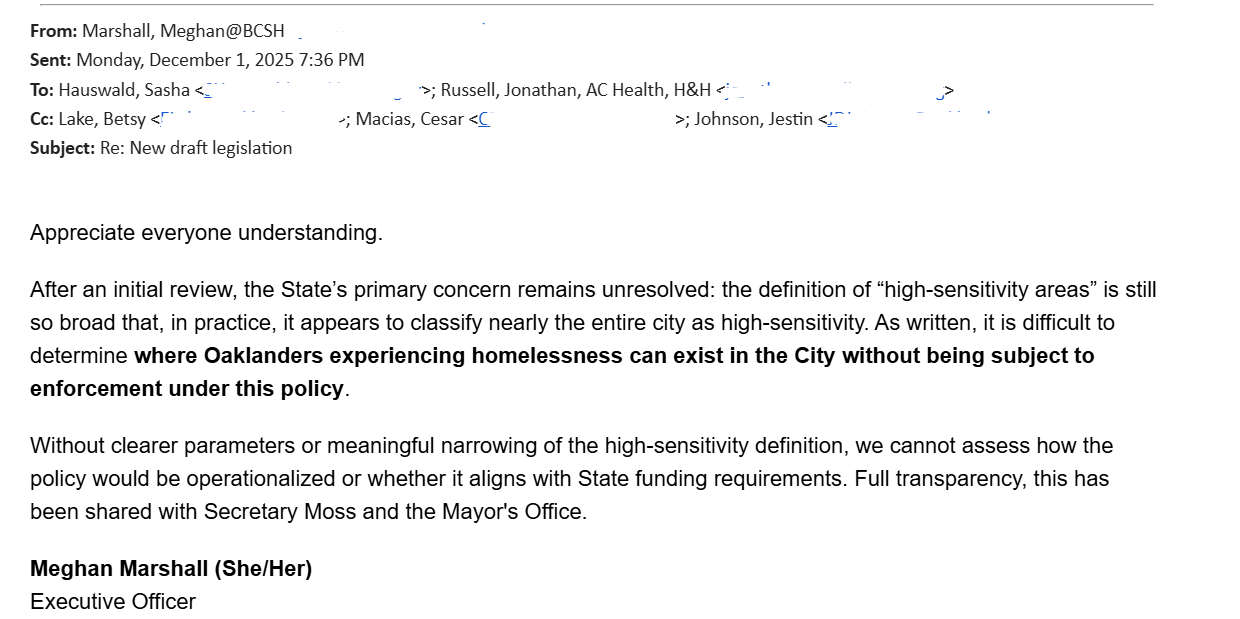
The email was addressed to Sasha Hauswald, Oakland's Homeless Solutions Office Director and her counterpart at Alameda County, Jonathan Russell and CC’d Cesar Macias, a Special Assistant to the Mayor, and City Administration officers. Marshall noted that the information had been shared with the Oakland Mayor and the state’s Business, Consumer Services and Housing Secretary, Tomiquia Moss.
Houston appeared as surprised as audience members as Jenkins moved to withdraw the EAP, and asked him in open session why the ICH would still oppose the plan, after he had, in his own opinion, conformed it to their guidance.
“Are you saying that …we need to add more to the non-sensitive locations? Is that what they're saying, like in District one and four…is that what they're saying? We addressed all the items with Cal ICH. They’re moving the goal, it looks like…” Houston said.
The ICH found several problems with the D6/D7 Office generated EAP over Summer and Fall, including the EAP’s deletion of current practice of offering shelter to victims of closure as a prerequisite to closing encampments. But perhaps the most central ICH critique was that the EAP did not clarify the existence of areas of the city where homeless residents could still live on the streets after closures elsewhere and expect some level of stability. This left the question of “if individuals can’t sleep here, where can they sleep?” posed in ICH guidance unanswered.
"High and Low" vs Tiers
An ICH redlined edit of the August original EAP that was made public thanks to a public records request from this publication, suggests an outline of the problems the ICH may have with both Houston’s old and new formulations. ICH Executive Director Meghan Marshall edits and margin notes outline a different structural concept than High Sensitivity and Low Sensitivity zones—High and Low Sensitivity are features brought over from the original EMP.
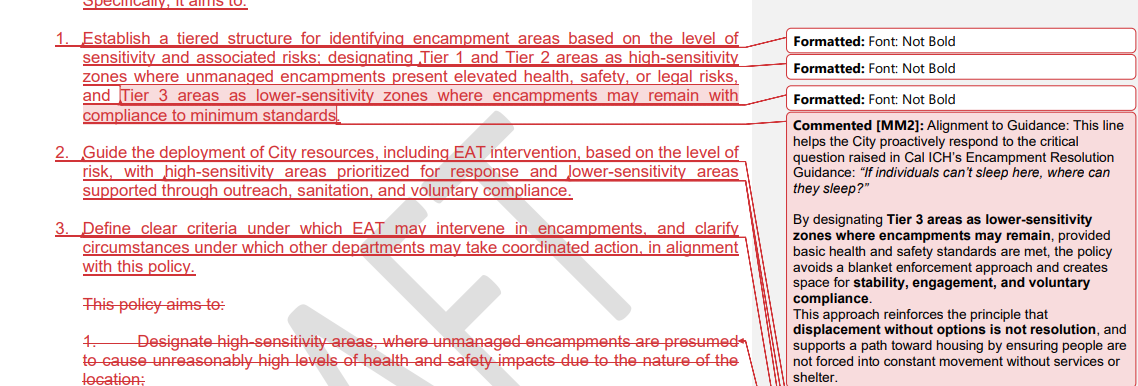
In the EAP's High and Low Sensitivity structure, “High” areas are always subject to closure due to their proximities and situational reality. But in redlined edits and margin notes, Marshall suggests instead a “tiered approach”, with Tier 1 and 2 encompassing areas “involving vulnerable populations or critical infrastructure risks” have high priority for closure.
In the ICH’s vision, encampments in Tier 1 and 2 areas would still need to be risk-assessed and documented with findings before closure, leaving closure something undertaken only after significant consideration and attempts at compliance. Meanwhile, the EAP suggests High Sensitivity areas would simply be scheduled for closure whenever resources to do so are available and with no process of documentation.
ICH Redline Suggest the EAP May be Foundationally Incongruous With the ICH Guidance
The ICH notes that the Three Tier structure is meant to “reinforce the principle that displacement without options is not resolution [to] support a path toward housing by ensuring people are not forced into constant movement without services or shelter”, a core value that may be difficult to fit into the thematic origin of the EAP.
In the ICH-influenced amendments finally made to the EAP after months of off/on scheduling, the EAP had appeared to make changes to respond to central ICH criticisms about the “where can they sleep” question. The new EAP even incorporated the ICH’s terminology of low sensitivity areas as “temporary stability zones”. And the plan does now compel the city to “make every reasonable effort to offer shelter”, a significant departure from Houston’s previous ambivalence to offering shelter ahead of a closure, another issue in the ICH’s critiques. Text in the new EAP also suggests that the EMAT [the Encampment Management and Abatement Team] would avoid closures until it does have shelter options for affected encampment residents.
But the EAP still expands “high sensitivity” areas to an unknowable degree—and includes ALL parks and recreation areas and any bike or pedestrian area within those zones—while failing to identify the areas where encampment enforcement would ostensibly be avoided. Though the EAP now accepts that Low Sensitivity Zones are “temporary stabilization” areas—the ICH term—the policy leaves no guidance about where the new low sensitivity areas exist after the addition of high sensitivity increases of vaguely described magnitude.
These were the very problems identified in the original ICH critique, the structure that makes the EAP appear to be the “blanket enforcement approach” lacking “space for stability, engagement, and voluntary compliance” for the homeless that the ICH warns against.
The continued large and amorphous designation of high sensitivity zones in the text of the policy and the lack of any defined "low" zones appears to have led to the email that gave the City Council pause. The authors appear to be reluctant to lose the "blanket enforcement" mode of the proposal, making the new copy an incoherent merging of the two opposing goals.
Significant Public Outcry Against the EAP
As in the previous Committee meeting that introduced the EAP, dozens of members of the public arrived to contest the EAP. Per Brown Act rules, when an item is pulled at the last minute, speakers must still be allowed to speak on the item, though no deliberation is allowed. According to the clerk, that number of speakers was around 150—and around 65 stayed until the end of the meeting when the item was scheduled to speak to voice their opposition to the EAP. Only 3 of those speakers supported Houston’s plan, per the OO count—a marked contrast to Houston’s suggestion during scheduling last month that the additional weeks of prep and later time of day would provide more opportunity for business owners and residents supporting his plan to speak. About ten additional opponents of the EAP spoke on the item earlier in the meeting during the comment period for Consent items, with no supporters speaking.
Here's Oakland Observer's live reporting of the meeting in both web and PDF.
Ironies Mount As Jenkins, Ramachandran, Unger, Wang and Brown Try and Fail to Suspend Council Rules… In an Effort to Pass New Rules of Procedure with Little Notice to Public
The Ramachandran-Jenkins led proposal to change the City Council’s Rules of Procedure has been a fount of ironies since it was introduced at a 9am special meeting in November.
The Rules changing legislation that could regularly see the non-consent agenda completed by 6pm ran into opposition led by Fife at that meeting in November. CM’s Janani Ramachandran and Kevin Jenkins' proposed new rules would reverse the Consent and Non Consent order and remove the requirement that Non Consent items only be heard after 5 pm, among other things. But at the meeting Jenkins was absent, ultimately dooming the legislation.
Tortured Initial Deliberation Leads to Tie in November
During deliberations, Fife had argued that the current structure, though imperfect, was more likely to give working people a chance to opine on Council business and made a motion on a portion of the Ramachandran/Jenkins new rules to keep the agenda structure as is. Before anyone could vote on the Fife's proposal, however, Ramachandran offered two substitute motions essentially proposing the Jenkins/Ramachandran legislation in rapid succession ahead of Fife’s motion. Both failed, however. The process became acrimonious when Ramachandran made a third substitute motion, essentially the third time she tried to get her original rules passed with minor changes over Fife’s substitute motion–that failed to get a second, likely because the process was visibly losing credibility.
Fife’s substitute motion was finally heard and failed on votes. Ramachandran then made essentially the same motion to pass the Jenkins/Ramachandran Rules changes again. But that motion tied–the Jenkins/Ramachandran Rules of Procedure changes had four votes, and would have passed with the ostensible fifth vote from the proposal's co-author had he not been absent.
Per the Charter, when the Council is evenly divided [and per Measure X, this means when there are four affirmative votes vs absences, nays, and abstentions from the other 4 CMs], the Mayor is allowed to break the tie. The mayor can do this at the meeting where the tie occurs or at the next regularly scheduled Council meeting. The Mayor isn’t obligated to break the tie, however. Mayor Barbara Lee was not available on the day of the vote.
Tortured Process Continues by Other Means at Tie-Breaking Vote
During the waiting period for Lee, it appeared that CM Ken Houston, who had previously been on the yay side of the vote, had found several faults with the legislation. Houston appeared hostile to the legislation he had previously voted for. At Tuesday’s meeting, the agendized date for the tie-breaker vote, Lee sent a staffer who announced from the dais that Lee would refrain from casting a tie-breaking vote in interests of allowing Council to determine its own Rules of Procedure. This meant that per Council rules, the item had failed in its current scheduled iteration.
But Council President Jenkins had other plans. Immediately after the statement from the office of the Mayor, Jenkins moved for a vote based on Council Rule 16 to temporarily suspend Rule 29 of Council’s Rules of Procedure [on tie-breaking] so that they could deliberate on the item at the same meeting—something few members of the public would have likely been aware was possible on a tie-vote. Jenkin’s stated “finding of necessity” was that the next meeting of the Council on 12/16 was too impacted.
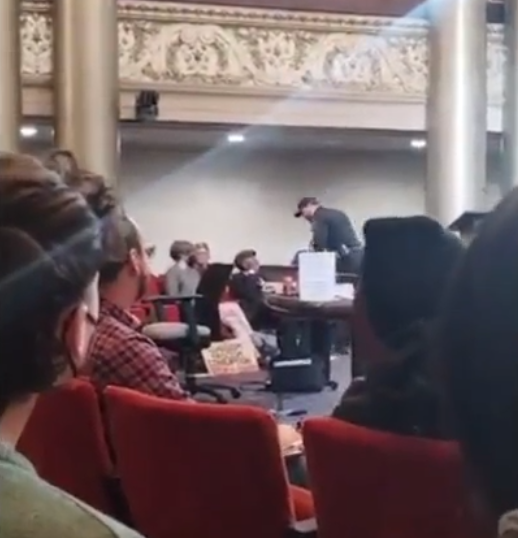
Prior to the vote to suspend Rule 29, Council comment mainstay and gadfly Gene Hazard took to the podium and objected to the process before the vote. President Jenkins warned Hazard twice that he would eject him for being out of order, and directed a present Oakland Police Officer to escort Hazard out of the chambers prior to the vote. That was possibly the first time in over a decade where police were called in to remove an individual.
The motion to suspend the rules required six votes, and it failed, with Gallo, Houston and Fife voting no. Jenkins then restated his motion for another vote, suggesting to Houston that it would be the only way to have his issues dealt with. The proposal was initially vague on the first vote. Jenkins seemed to imply the item would just be discussed, but eventually the Clerk asked the City Attorney’s office to confirm that the discussion could end in further motions, including a vote. The motion failed again with the same vote outcome, with Houston remaining unconvinced.
On a motion by Ramachandran, Council then took a vote to reschedule the item to the 12/16 meeting. That motion passed with the required five votes. Prior to her nay vote, Fife noted the irony of now scheduling the item to the meeting Jenkins said was too impacted to hear it and criticized the entire process.
“I do want to be clear…as the public has stated, at the last meeting and this one, this process is anti-Democratic…[the item] failed multiple times and again tonight…”, Fife said.
The Rules of Procedure changes will return December 16. At a following Rules committee meeting, Jenkins said he may make that a special meeting to alter the start time for the impacted agenda.
Here's Oakland Observer's live reporting of the meeting in both web and PDF. [same link and PDF as above]
Comments ()