After Council antagonism toward Selection Panel appointments in December, the Rules Committee praised the Mayor’s picks and forwarded them to the Consent Calendar, though they lack Charter-mandated background checks. Meanwhile, OPOA confirmed it has exerted pressure on appointments.
A long-standing Council tradition of approving Mayoral and Community Selection Panel Police Commission candidates with a lack of visible bias continued its public deterioration last Thursday at the Council Rules Committee of January 8. The four member body that reviews some charter-mandated board appointments before forwarding them to Council accepted Mayoral appointments to the body with neither background checks nor biographical statements, scheduling them to the Consent Calendar of the January 20 City Council meeting. The Consent Calendar scheduling means that the appointments could proceed with no Council inquiry and get passed in a bulk vote along with the entire calendar. At the same meeting, a resubmission of the Selection Panel’s slate of reappointments to the Commission, including the current body’s twice-elected Chair, will be on the Non-Consent Calendar—where a fraught process like the one that previously led to the rejection of the same candidates on questionable grounds could repeat.
Though as of this writing the legislative packet for the Mayor’s appointments contains no background information on her appointees, Mayor Barbara Lee’s selections are well-known in certain communities. Doug Wong, who she is appointing as an alternate, has been involved in fire safety organizing and is a former fire fighter, fire official, and city government staffer but has not been active in police oversight or community policing work. Former Judge Evelio Grillo, a candidate for full Commissioner, briefly became known a little over ten years ago as the judge who ordered that minor Jahi McMath was legally dead and could be taken off life support after a tragic outcome for simple surgery. Grillo is retired from the bench, but is currently an arbitration specialist at ADR Services, based in Oakland. ADR is the same company that was tapped to arbitrate the termination of former Chief Leronne Armstrong, with a finding that he should not have been fired.
Mild Review of Mayor's Appointments Still Manages to Express Bias Against Selection Panel Appointments
Thursday's Rules Committee process for the Mayor’s picks was for the most part conversational, with a casual air based on an apparent implicit trust that the Mayor’s picks were above reproach. Rules member Carroll Fife posed the most incisive question of the day, asking Wong what his idea of constitutional policing is—a question he ultimately left unanswered, according to the meeting’s record*.
Council President Kevin Jenkins, who led the previous move to veto the Selection Panel appointees, current alternate Omar Farmer and current Chair Ricardo Garcia-Acosta, asked Wong to weigh in on his own complaints about the Commission.
Council President/Rules Committee Chair Kevin Jenkins comments and question to appointee candidate Doug Wong, Rules Committee 1/8/2026
Jenkins said a draft letter written by two Commissioners to the NSA court accused Council of undermining the independence of the Commission. Jenkins also complained to Wong that the current Commission often tries to rush policy to avoid Council "weighing in", but did not specify what he meant. After painting the portrait of a Commission with an anti-Council posture, he asked Wong how he would bridge the two bodies. Wong followed Jenkins' lead and said that he believed a report or document should not be rushed, and complained about what he claimed was "animosity" with community members and the Commission.
"I noticed the animosity between some of the members in the community and the disrespect, I guess, from other people. But we all want the same thing. We want a police department that not only protects us and works with us, but works with the community...so as I come on and look at it and read these letters, I noticed that there was like, people expressing their personal opinion, not facts, and you have to deal with the facts. If we can't do it and pass it on to city council in a timely manner, or what I would say a fair manner, I would table the issue until the next time we meet," Wong said.
When asked by this publication via email what rushed policies he specifically was speaking about, Jenkins did not provide an answer. As for the letter, Jenkins confirmed he was referring to a draft produced by an ad hoc committee that was formed by the Commission to prepare the body's majority-voted communications with the NSA court. The communications were agendized for a regular meeting of the OPC that night, and contained the draft.
At the Police Commission's meeting later that night, several Commissioners, including one of the apparent drafters of the document, came to an agreement that the tone and content of one section of the letter, describing in detail the undermining of the Commission, could be counterproductive and voted to delete much of it. But Commissioners also agreed the section was factual and that there had been concerted efforts to undermine the Selection Panel and the Police Commission.
Commissioner Angela Jackson Castain, while agreeing that much of the section should be deleted or edited, noted that there should be room in the letter to catalog attempts to undermine the OPC's independence:
"I agree that we definitely need to change the tone of some of the language and take out sort of the non-essential details, but I do think we need to recognize that in the past year, there has been an assault on oversight in Oakland, and there's been some undermining of the Selection Panel process. There has been some undermining of the Police Commission's role and oversight. And I think you know, part of what the judge ordered...was to develop this collective working group...essentially, a lot of the parties in that working group have been undermining that effort as well, and so I think there should be some room to make note of some of the challenges that we have faced and how important and critical our role is, despite the erasure of of oversight in the city," Jackson-Castain said.
Jenkins acknowledged and praised the changes and integrity of the OPC in his response to this publication, and also appeared to acknowledge that there have been attempts to undermine the body.
While the letter acknowledges that civilian oversight has faced attacks—including from some stakeholders the Commission must continue to work with—the Commission unanimously chose to soften certain language in the interest of cooperation and maintaining productive working relationships. That decision reflects the Commission’s responsibility to balance candor with collaboration, and I respect the Commission’s judgment in doing so. I remain supportive of the OPC’s independence, its authority, and its ongoing efforts to carry out its mandate effectively and professionally."
You can read Jenkins' entire statement at the end of this article.
A Citizen's Commission That Depends on Council and Mayoral Approach for Its Independence
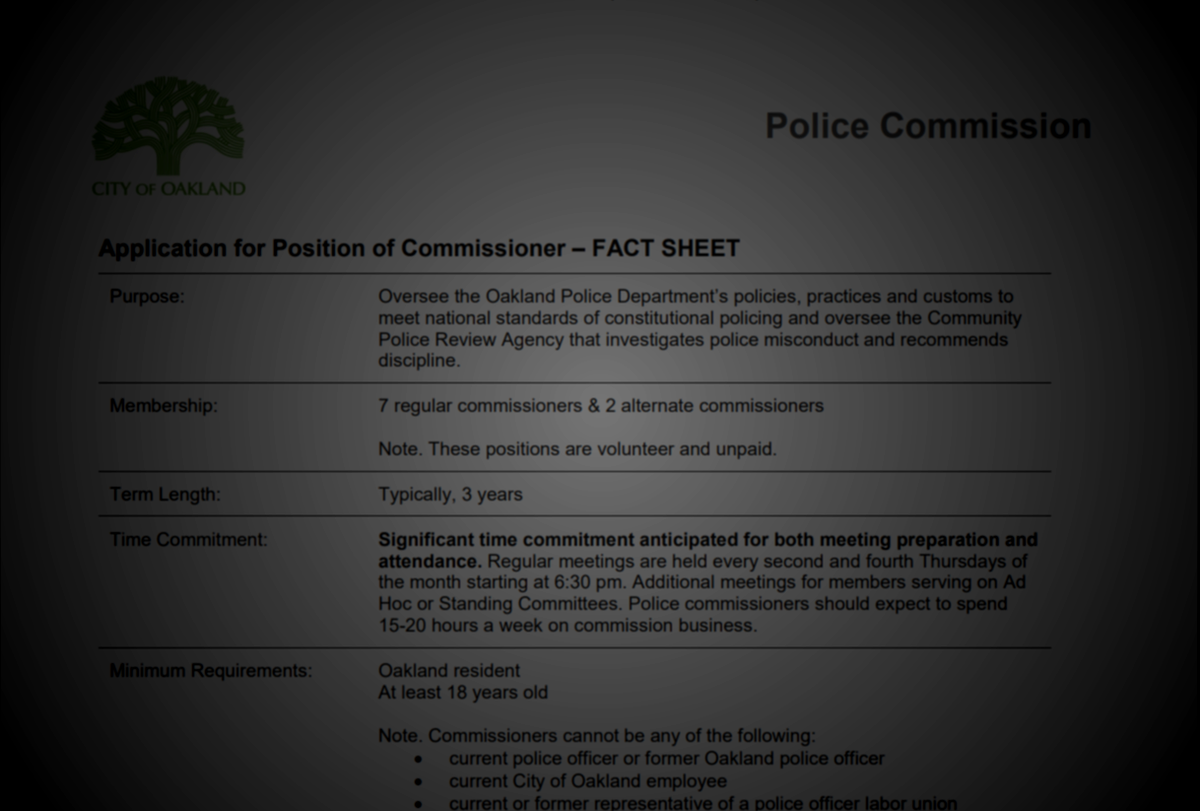
The Oakland Police Commission selections of 7 full Commissioners and two Alternates are split between the Mayor’s Office and a Selection Panel of unpaid appointees, with 4 of the picks and one of two alternates going to the Panel. But those processes are quite different. The community-driven process must abide by the Brown Act and unfolds in open, recorded meetings. The Panel has a paper-trail for applications and their evaluations and holds public interviews with candidates followed by a public discussion and majority vote for selection. The Mayor’s process occurs behind closed doors and has no required application or adjudication process.
For almost a decade since the process began, Oakland's City Council, which must ratify the appointments, has mostly honored the will of both the Selection Panel and the Mayor—likely in no small part to avoid a perception of interference or bias. The Council’s sessions usually have minimal inquiries and resemble inaugurals more than hearings.
But that all changed late last year as the process grew visibly politicized over the Selection Panel re-appointments of the current Chair, Garcia Acosta, and alternate Commissioner Farmer. Apparently reacting to a letter from an Oakland Report columnist—an organization with links to Oakland police**—Rules Chair Kevin Jenkins on his own initiative removed the appointments from the scheduling list, claiming he would send them back to the Selection Panel to reconsider. Jenkins not only has no such powers through the Charter, the Council has a limited timeline to weigh in on the changes or its role is forfeit. The CAO was obligated by the Charter to resubmit the appointments for scheduling.
When the item finally was ready for subject matter focus, weeks later, the body scheduled it to full Council, the only body that ultimately selects the appointments, with little discussion. At the meeting, all CMs but Fife, who was travelling abroad, voted against the reappointments but had little to say about their rationale aside from their claims that the process of announcing the application period was not carried out well.
Acosta and Farmer Stay on to Stabilize the Commission
That could have been the end for not only the candidates but the Commission in the near-term. If Garcia-Acosta and Farmer had indeed left the body, an OPC with only 5 Commissioners would have struggled to consistently maintain quorum—with the recruitment process for a new Chief, and City-mandated action on the OPD’s militarized equipment left to finalize, among many other tasks. Farmer and Garcia-Acosta stayed on to stabilize the Commission, however, through a state rule on carry-over appointments that the City Administrator endorsed. In essence, the City relied on the same volunteers that had just suffered through an aggressive and hostile public process to ensure that the Commission could carry out the Charter mandated functions the City requires it to.
When the Selection Panel had its first meeting following the awkward Council hearing on December 18, members of the panel complained about the Council’s treatment of panelists and process in open session. Several members described a politicized and disrespectful reaction to community volunteers in unpaid city service. Panelists disputed claims from Council members who had blamed the Selection Panel and its City Administration liaison for not notifying them about the application period. The panelists said Council members failed to take the opportunity to publicize the application period and the new City Administrator’s report for the appointments appears to side with the panelists on the question:
“During Spring 2025, public outreach for the Police Commission vacancies was conducted through a press release; social media postings, including Nextdoor; outreach emails to local nonprofit organizations; and advertisements placed in the Oakland Post and El Mundo. The Selection Panel members also distributed Police Commission recruitment flyers in East Oakland. Additionally, City Administration staff distributed flyers and provided recruitment information to the City Council”
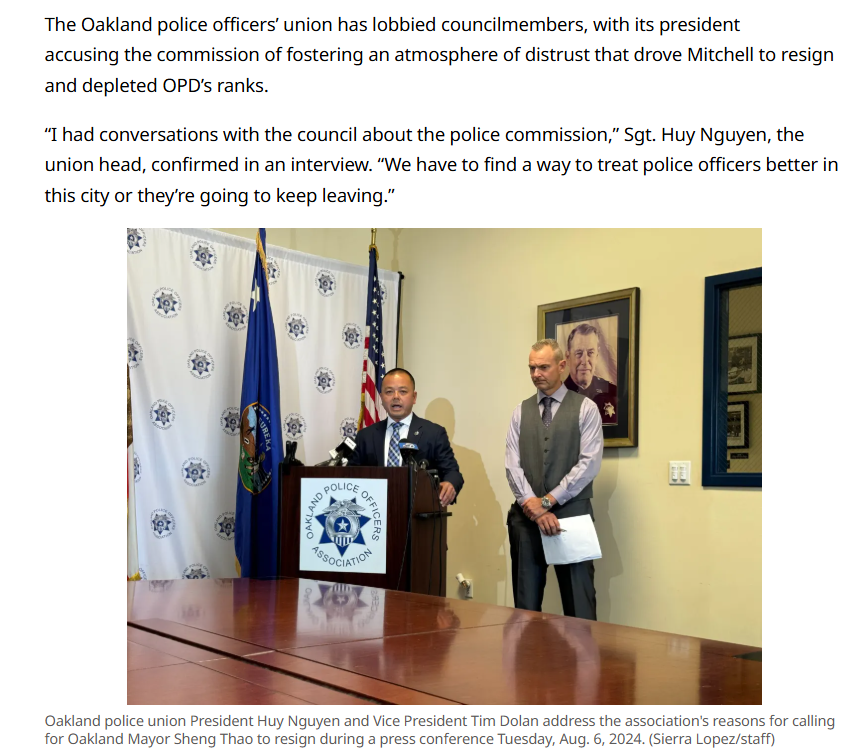
Rickisha Heron, the Chair during the meeting, said that she had reliable information that the Council's rejection was an act of "pandering" to the Oakland police union, the Oakland Police Officer's Association [OPOA]. That suspicion has been apparently confirmed in an East Bay Times report on the process, which quotes the union's head Huy Nguyen as saying he has tried to influence the Council's appointment approval process.
With the goal of retaining independence and the integrity of the Panel, the body voted to re-send the same submission Council had already rejected—the body's City Attorney counsel confirmed there is no prohibition in doing so. But the resubmission has now created a potential laboratory for evaluating Council bias at next week's meeting.
City Administrator Dropped the Ball on SP Process, Mayor Has Yet to Complete It
There are other issues that indicate a breakdown of the process at the City Administrator’s Office and the Office of the City Attorney which could also come into focus. During the council session last year, City Attorney Ryan Richardson gave an on the record legal opinion that the 60 day timeline in which Council must take action on the appointments begins when the appointments are scheduled to Council. But that’s not in the charter. In fact, the charter specifically states that the timeline for both Mayoral and Selection Panel appointments begins after both background checks and notice of the appointments to the City Council.
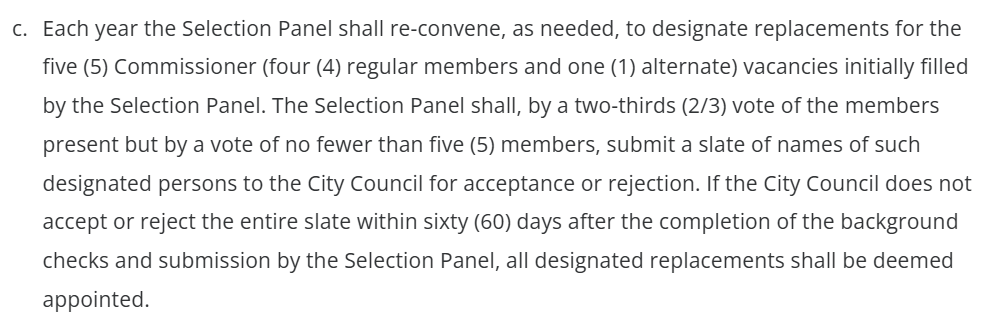
At the Selection Panel meeting, the Coalition for Police Accountability’s claim that no background checks had been carried out for either Farmer or Garcia Acosta [as evidenced by a public records request by this publication] was confirmed by the City Administrator’s liaison to the Panel. Thus, apparently, aside from the tumult of the process created by Council’s politicized opposition, the appointments may have been sent in error before the process was complete. That could have potentially obviated the Council decision if the Selection Panel had not sent the appointments back.
The issue appears to extend to the Mayoral picks too. Lee’s Deputy Chief of Staff Preston Kilgore who presented the appointments at the January 8 Rules meeting, admitted on the dais that the same Charter-required background checks had not yet been conducted for the Mayoral appointments after CM Carroll Fife inquired about the process.
“We’ve been in touch with the City Attorney’s Office and we’re aware that there needs to be background checks and we’ve been in touch with the City Administrator’s Office with regards to expediting those background checks and so we fully expect that they’ll be done prior to any vote at City Council,” Kilgore said.
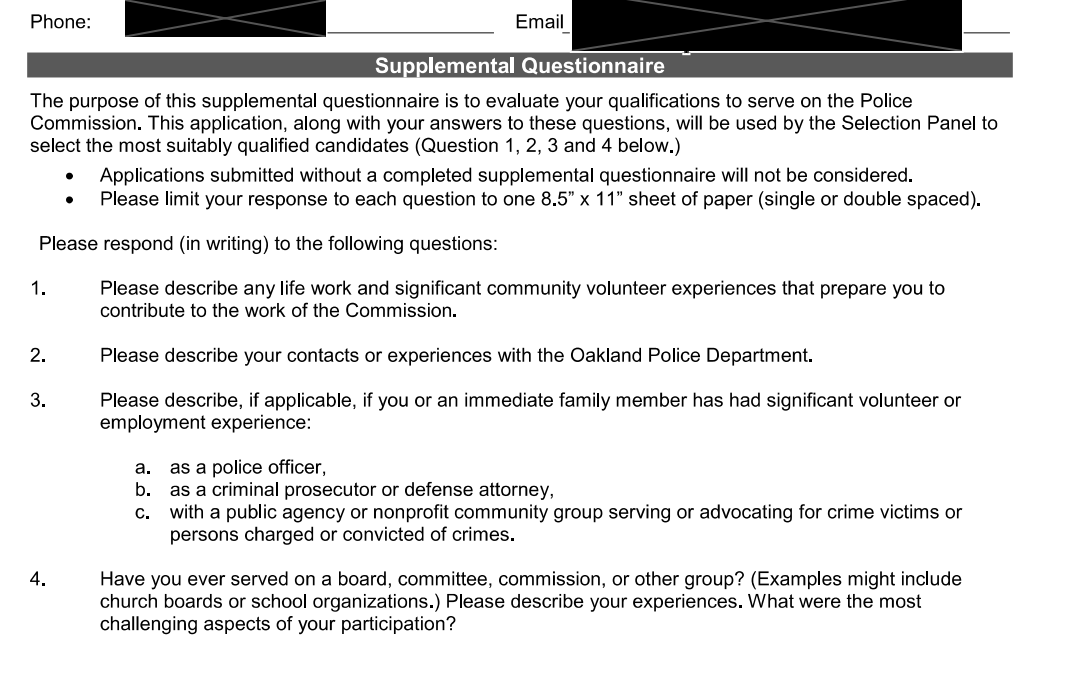
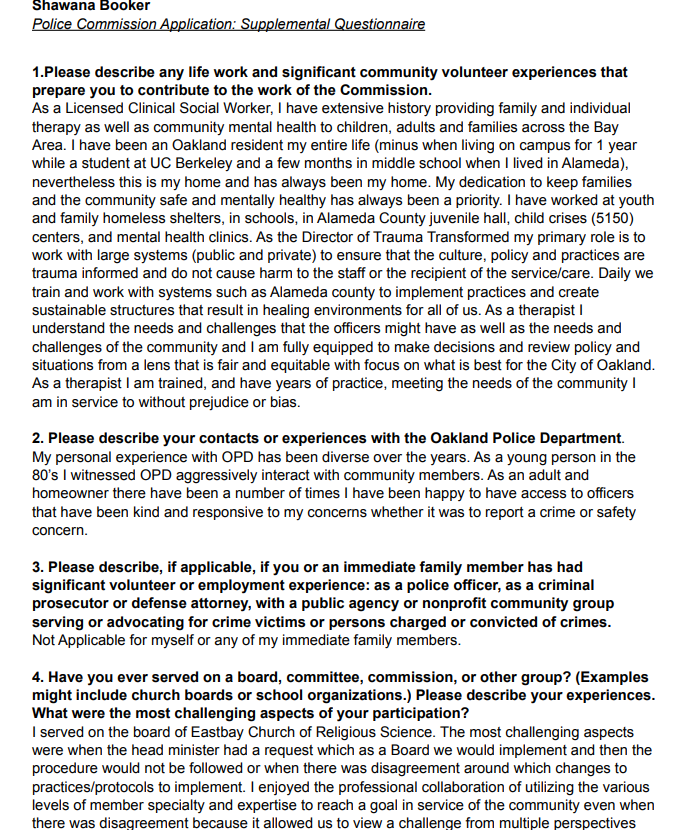
In fact, the legislative packet for the Mayoral candidates contains nothing to suggest the Mayor carried out an official vetting process. Previous Mayoral appointment legislative packets have almost always contained at least a completed application form for the role from the candidate, but Lee’s submission lacks those. Current Mayoral appointee Commissioners Shawana Booker and Shane Thomas-Williams both submitted applications and questionnaires for the role—and Mayor Thao included those in their packet when she presented her picks.
Indeed, during the Rules process for that appointment, CM Janani Ramachandran drilled down on responses from the questionnaires in a detailed series of questions for both appointees. By contrast, while Ramachandran praised Wong, she had no questions, and Grillo did not appear at the meeting either virtually or in person.
In 2024, Ramachandran posed questions for Mayor Thao's appointments based on the appointees applications/questionnaires
Former Mayor Libby Schaaf’s appointment packet for Brenda Harbin-Forte, whose seat is finally set to be filled by Grillo, contained her resume. A second Harbin Forte appointment packet that was ultimately withdrawn by Thao after choosing to not renew her term, also contained an application form. Most of the Mayor’s picks after the first appointments that inaugurated the body have contained the application, biographical information or both, according to the legislative record database. There’s been no explanation for the departure from the custom and the Council members at Thursday’s Rules did not ask for one. Today just a few minutes before publication, the City's Public Information Office confirmed that Farmer and Garcia Acosta's background checks are complete, but acknowledged that Grillo and Wong's are still not complete a week after the appointments were forwarded by Rules to full Council for 1/20. The Office said the checks "should be completed by the end of the week".
Police Commission Continues Critical Work, Though Rarely Mentioned Amid Criticisms
Meanwhile, despite the public controversies, the Police Commission has continued its work, which seems to exist in a parallel universe apart from the criticism—the body focuses on issues seldom, if ever, mentioned in critiques by the OPOA-aligned organizations or Commission antagonists like CM Ken Houston. Farmer and Garcia Acosta continued to serve in the roles and the Commission brought forward a city mandated review of the OPDs militarized weapons. Farmer in particular, served on an ad hoc focused on the militarization policy.
On Thursday, the Commission completed its review of OPD’s update to its criminal investigations of officers policy [DGO M-04]. OPD promised such an update in an after-action report on the failed investigation of officer Phong Tran that OPD delivered to the court at July's case management conference. The report committed OPD to rewrite the policy in partnership with oversight bodies as a way of demonstrating to the Court that it is rectifying the practices that led to the disastrous Tran investigation. The Oakland Observer asked Jenkins his opinion about this IAB failure, the new policy, and the Commission and CPRA's role in uncovering the corruption [which occurred under the leadership of Garcia Acosta], but he did not respond to those topics.
As a testament to the confidence of the body in Garcia Acosta’s leadership, both he and Vice Chair Shawana Booker were re-appointed in the roles on Thursday, despite the precarious state of Garcia Acosta’s appointment.
*Wong's Response, which did not include any comment on constitutional policing:
"Well, every department, every law enforcement department, has SOPs. They're operating procedures, and they're supposed to be followed. But unfortunately, sometimes, in any situation, personalities get involved, and somebody might say something or act in a way which somebody finds offensive. So myself, having been stopped by ICE and asked to prove I was an American citizen, I was terrified, just absolutely terrified. And I don't want that to happen to our city, our citizens. I have a lot of places, and working with different committees and commissions to work with the entire city of Oakland, you have to find out what, where are they coming from, because everybody has a different background. Everybody has different family values. That's what we have to work together to find out a solution where everybody, people involved, can get together, come up with a viable solution and smooth over and, you know, compromise is the name of the game. You just can't get your way all the time."
**The Oakland Report briefly hired a former OPD officer who'd been terminated for cause after a IAB/CPRA investigation into the actions of Michael Chung, as the organization's "Managing Director".
Council President Kevin Jenkins asked for his response to questions posed by the Oakland Observer be printed in whole or not all. Here is his statement to the Oakland Observer:
"I am a strong and unwavering supporter of civilian oversight and will continue to maintain productive working relationships with stakeholders who share a commitment to independent, effective oversight and accountability. Civilian oversight works best when all parties engage in good faith, even when there are disagreements, and I remain committed to that approach. I have an excellent working relationship with the Chair of the Oakland Police Commission and fully support his leadership and the Commission’s role in safeguarding the integrity of civilian oversight. With respect to the letter to the NSA judge, I was referring to the draft letter that ultimately came before the full Commission and was voted on last night. As the Commission has explained, the letter was issued at the request of the judge and reflects the collective voice of the entire Oakland Police Commission, not individual members.
While the letter acknowledges that civilian oversight has faced attacks—including from some stakeholders the Commission must continue to work with—the Commission unanimously chose to soften certain language in the interest of cooperation and maintaining productive working relationships. That decision reflects the Commission’s responsibility to balance candor with collaboration, and I respect the Commission’s judgment in doing so. I remain supportive of the OPC’s independence, its authority, and its ongoing efforts to carry out its mandate effectively and professionally."
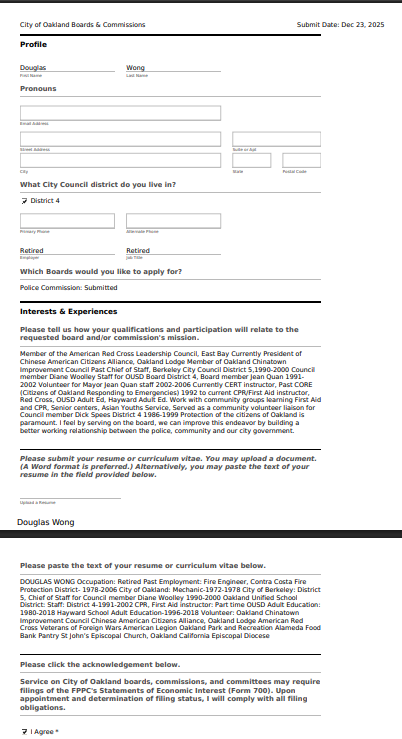
Note: The day after this article was published, the Mayoral appointment legislative packet was updated with a general application for boards and commissions for Wong, and a resume for Grillo. The entry is dated 1/15. Wong's application is dated 12/23. Generally, previous Mayor's have included a Selection Panel application form with specific questions focused on criteria for that particular board, but Wong's does not have that information. The application for the body from Mayoral appointment under Thao, Shawana Booker, is added in the second image for comparison. Grillo's resume has been added, but no application.
Comments ()