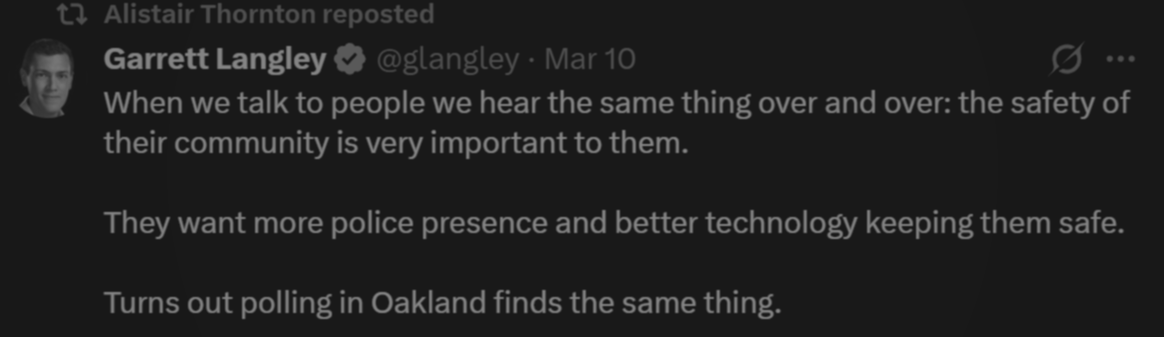
Tuesday a mysterious organization’s Oakland attitudes poll was promoted across a spectrum of center-right sources, with several of its marquee findings used to argue that Oaklanders want more policing, surveillance and homeless displacement.
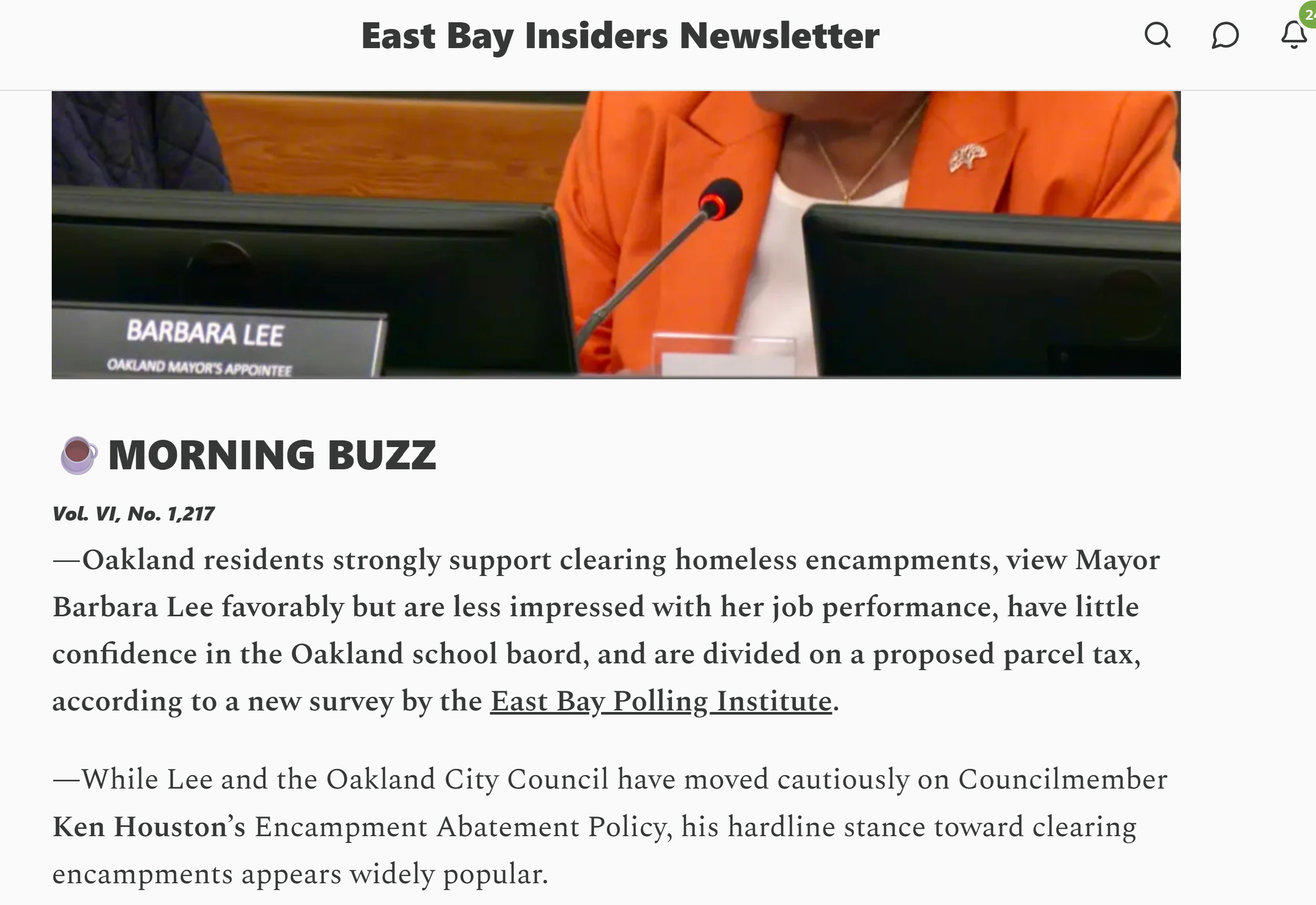
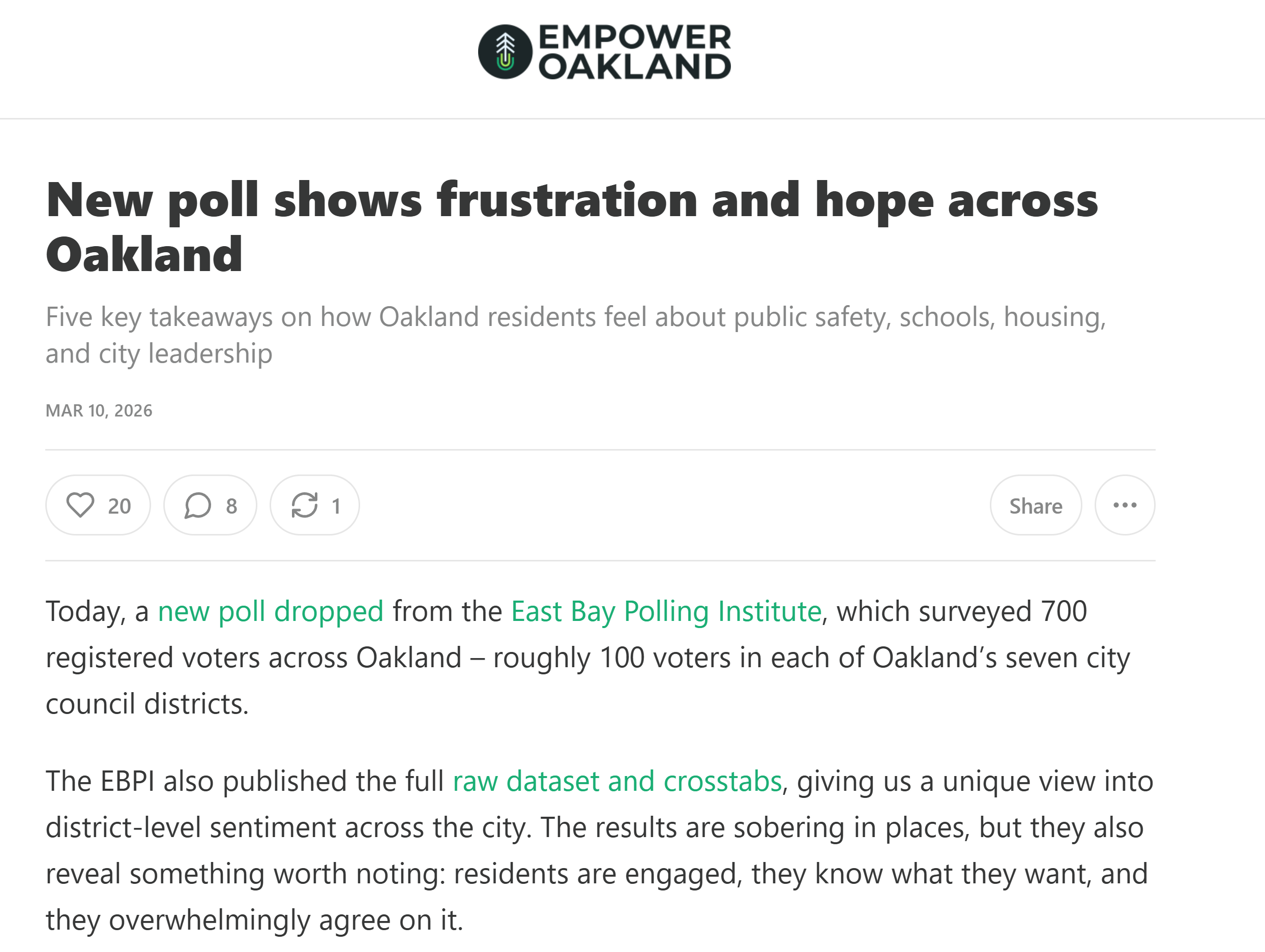
But any civic-minded Oakland resident following links to the website of the prestigious-sounding East Bay Polling Institute responsible for the data that day would find a website bereft of all the information one would want to know about an institute. The org’s About section listed no principals, officers, address, history or bonafides.
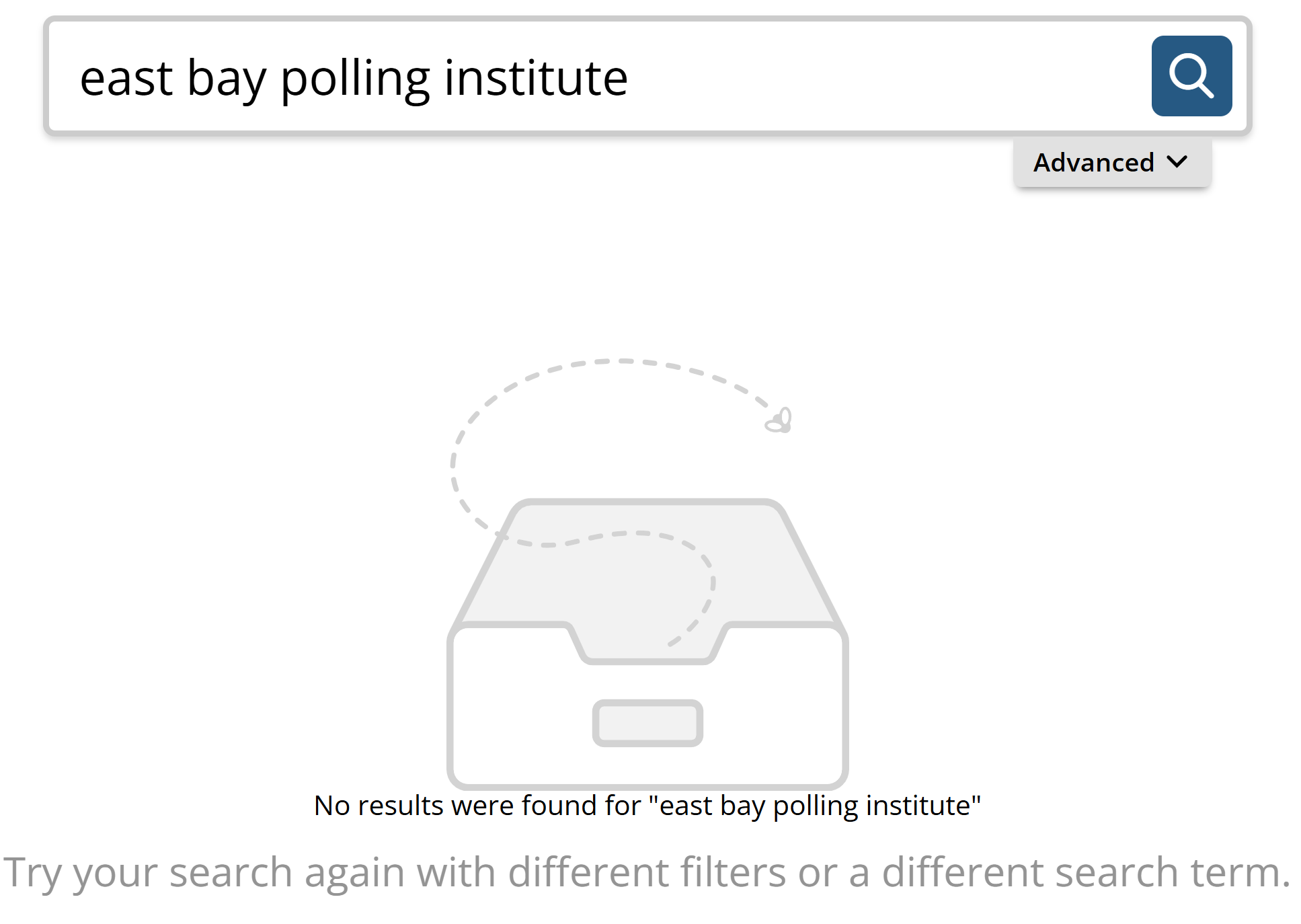
On paper, the East Bay Polling Institute does not exist. The Oakland Observer confirmed that the Institute currently has no visible corporate filings at the Secretary of State. And though it appeared initially to be ready to appeal for donations, the institute doesn’t appear on the state’s charity Registry, which is the minimum requirement for a non-profit to solicit donations.
That all could be a function of how remarkably new the institute is. State of California corporate and charitable filings take time to process and it's clear the Institute is being birthed into existence on an express timeline. The Institute’s website “whois” entry shows it was only registered about 26 days before the poll was made public, for example.
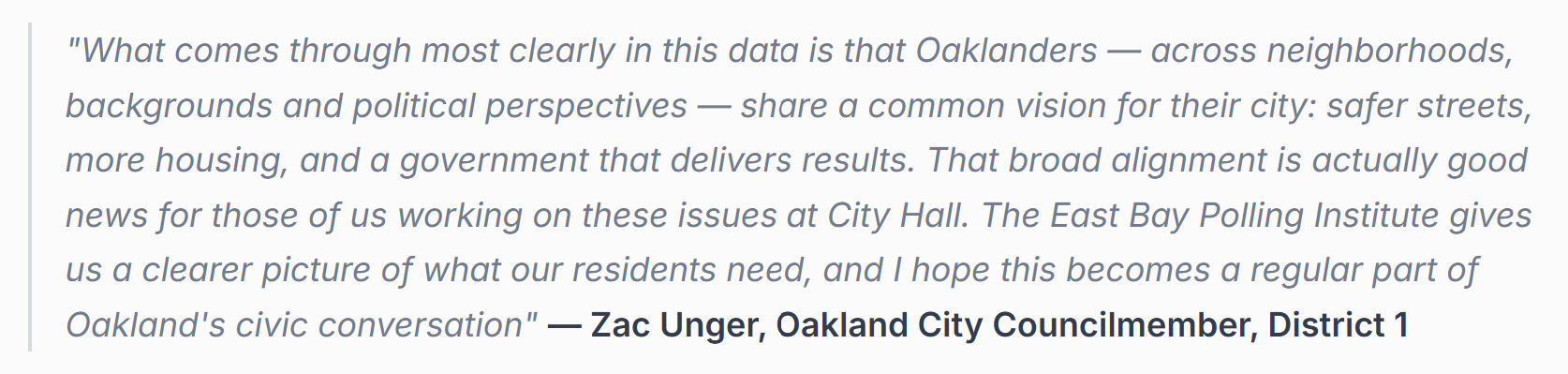
But strangely, the institute’s born-yesterday vibe did not stop several electeds from heaping effusive praise on the mystery organization and its poll in the website's About section, including Oakland’s D1 CM Zac Unger. Unger’s endorsement appears alongside those of assemblymember Buffy Wicks, OUSD board member Patrice Berry and former Oakland Mayor Libby Schaaf, among others. Initially, all those names and plaudits were situated above a grayscaled donation link labelled “coming soon”.
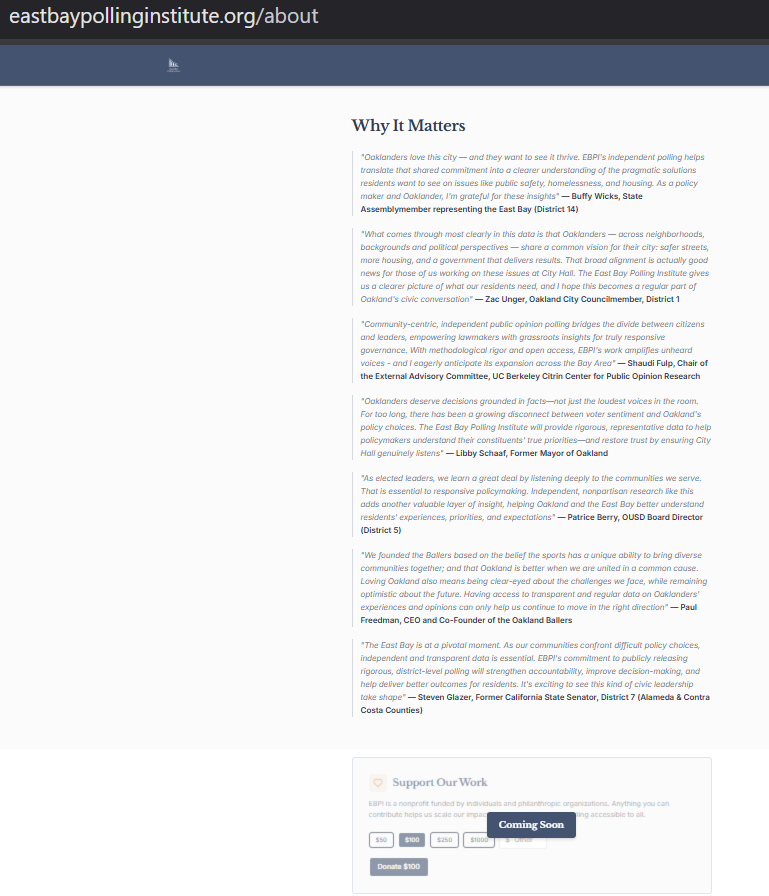
When this publication followed up with Unger to ask why his endorsement was linked to a potential fundraising campaign for a phantom polling institute on Tuesday, Unger replied that he had not given permission for his statement to be used for marketing or fundraising. Unger said the OO inquiry prompted him to request his statement be removed from any marketing or fundraising appeals.
Still Unger’s rationale for plugging the organization at all seems incomplete. This publication asked Unger the identity of the individual that gave him the confidence to publicly support an organization that does not appear to exist on paper. Unger said his comments were only meant to highlight that the Bay Area needs more independent polling.
"I think we don’t have nearly enough polling or public opinion research in Oakland. All polls are imperfect, so I’d like to see many more of them from many different organizations so that we can have many different results to compare," Unger wrote via email.
But it's clear Unger's online endorsement praises the organization and its poll, not just the idea of polling. Unger declined a repeated request to go on the record about his confidence in the poll.
Other Oakland residents and news-gatherers also noticed the lack of attribution on the site. Aaron Bady, one of the founders of the online publication Oakland Review of Books, said several oddities prompted him to contact the organization via email to ask for more information.
“I had read the poll, found some of the way the numbers were framed to be a little bit slanted, even editorializing, specifically the bit about encampments. That made me curious who was behind it, and since there weren't any names listed, or sources of funding, and it wasn't even clear if they were a nonprofit, I emailed them to ask. They emailed right back.” Bady told this publication.
In the email exchange reviewed by this publication, the “institute’s” originator Alistair Thornton identifies himself and refers to the organization as an "independent non-profit", but admits that he and his partner “Eli” are “in the process of establishing an entity”.
Presumably, the scrutiny from more than one source prompted action by Thornton, Eli Bildner or both. The next day, Wednesday, after the poll had already been released, Thornton and Bildner’s name were finally posted in the About’s introduction and the “coming soon” fundraising appeal was gone.
Thornton's email to Bady and the lack of any other names listed on the site make it clear that Thornton and Bildner are the whole of the organization. And though both are new to the polling world, they have a deeper history in an untransparent network of California center-right campaign fundraising populated by wealthy tech personalities. British-born Thornton is the East Bay division co-chair for Govern for California [GFC], an extremely anti-public-sector-union coalition of wealthy donors who back political slates throughout California. Thornton is also a principal at Meta. Govern for California identified Bildner as a "leader" in its East Bay chapter in this document.
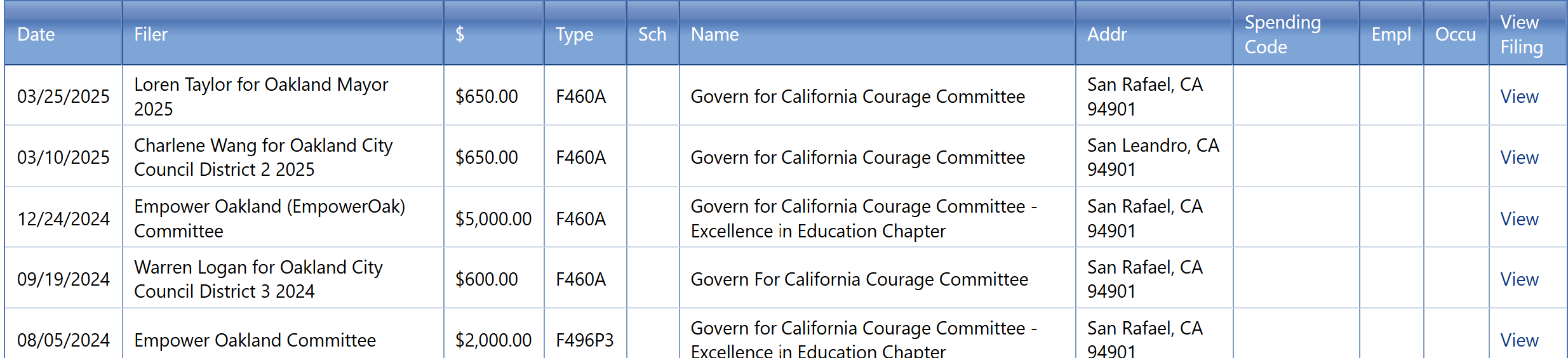
In 2024, the East Bay Chapter of GFC run by Thornton and Bildner promoted several “moderate” branded center-right candidates in Oakland and ALCO, including Warren Logan and John Bauters. The chapter also endorsed Patrice Berry, whose praise for the organization and its poll appears in the About section of the EBPI. Thornton and Bildner endorsed the entire Empower Oakland slate in 2024—which included Unger.
At state level, GFC dabbled in Oakland's last election cycle, giving donations to Charlene Wang and Loren Taylor, as well as a significant contribution to Empower Oakland.

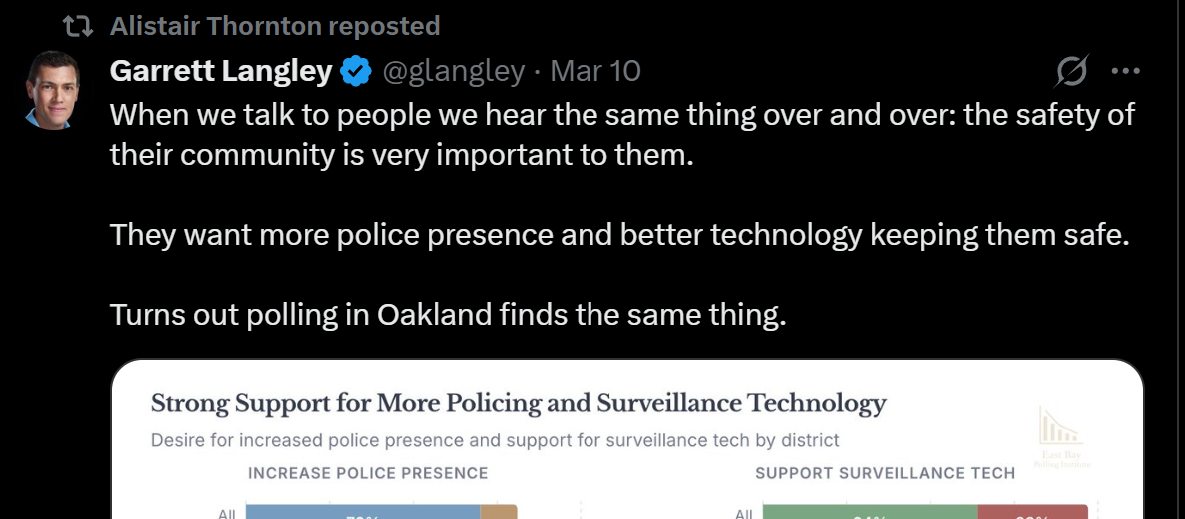
It's an open question if either Thornton or Bildner originally intended to be the public face of the poll or if their "institute" will be established as a non-profit. On Tuesday, Thornton used his twitter account to retweet Flock Safety CEO and Founder Garrett Langley's promotion of the poll, but Thornton did not personally promote his own poll. Thornton’s twitter bio doesn’t reveal that he is literally one half of the polling institute.
Govern for California's founder and principal David Crane also published a brief with a link to the poll, but did not mention that it was produced by what is essentially the GPF East Bay chapter.
 David Crane
Both Bildner and Thornton’s public resumes lack any polling experience, which is likely why they contracted EMC Research to actually conduct the poll—the “partner” organization given credit in the “project information” section of the accompanying data sheet.
EMC is a high profile company that has been used by the City of Oakland for its own research on such things as the likelihood of ballot measures success. The institute website does not confirm whether the institute paid for the poll, but any other scenario seems unlikely. EMC’s polling price tag isn’t cheap—city contracts for EMC's polling on ballot measures in 2022 and 2024 have a price tag of up to $200K.
EMC also has a somewhat checkered reputation in the Bay Area. EMC has been accused of conducting push polls–a poll constructed with leading questions and false information—at least twice in the past. Energy giant Valero hired EMC for what was essentially a push poll in its campaign to change the composition of Benicia's City Council in the company's favor. In 2016, CM Rebecca Kaplan called out EMC for a very visibly push-oriented poll benefitting her Schaaf-linked opponent.
The poll presentation bring up questions about the methodology and conduct of the poll: almost 60% of the unweighted respondents are white, for example and demographic data is not disaggregated by district. Importantly given its reputation, the exact wording of questions asked by the pollsters are also not available on the website’s data sheet, there are only short summary themes.
On Saturday, an SF Chronicle story on Oakland Mayor Barbara Lee's homelessness policies mentioned the East Bay Polling Institute by name in passing to bolster an assertion that residents want a more aggressive eviction response, despite clear indications the institute does not currently exist in any real sense. Only time will tell if media companies like the Chronicle will do any investigative reporting on what appears to be a political operation run by a state-wide political organization.
Comments ()