
Auditor: During Revenue Department Crisis, Over 2K Business License Payment Status Entries Were Manually Altered Without Supervisory Approval
In a startling admission to the Finance Committee Tuesday, the City Auditor’s office revealed that during tenuous years at the Revenue Department, any staff member could alter the status of a business license account without supervisorial approval or knowledge. The period from about 2021 to early 2025 became infamous when city workers began to call out the mismanagement in 2024, as millions of dollars in Business Tax revenue went uncollected. While most of the investigation focused on these failures, the lack of security around altering accounts has been a lesser known area of inquiry in the investigation.
During the audit period, conducted in 2025, the auditor found that any staff member could make changes in the account payment status of a business license tax account without supervisory approval and up to $2.7 MM worth of changes were made during this period, the majority with no supervisorial approval.
During the exchange, George Skiles, a representative of the City Auditor’s contracted firm for the audit, Sjoberg Evashenk Consulting, told council members, that along with the other failures of noticing and pursuing liens on delinquent accounts, there was also widespread mismanagement of account tracking.
“Multiple staff members, including non-supervisory personnel, had the ability to change account amounts owed in the system. There was no written policy requiring a secondary approval or documentation supporting those adjustments. Our analysis identified more than 2800 manual adjustments totalling approximately $2.7 MM during this audit period with roughly 75% of them being performed by non-supervisory personnel,” George Skiles said.
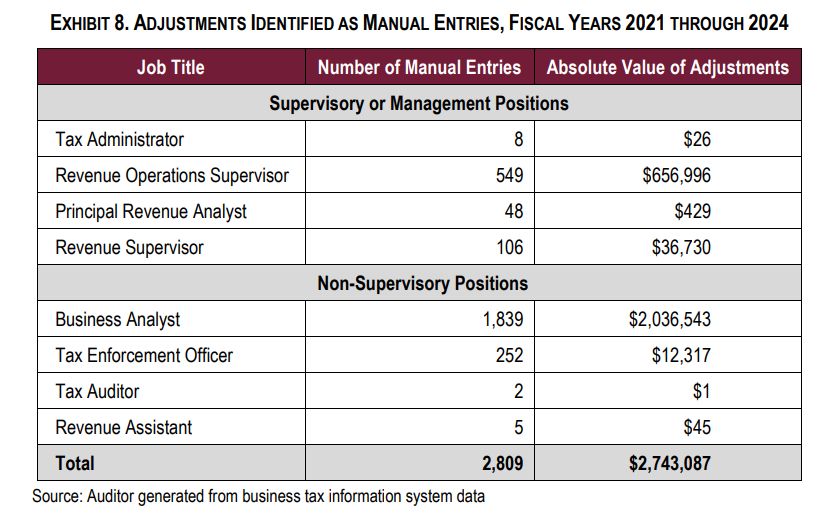
The audit shows that about 2 MM of the changes were made by the position "business analyst" with no supervisory approval.
CM Janani Ramachandran agendized the issue in 2024, and at that time cited an estimate from sources that the amount of business tax revenue could be as much as $50 MM, although the City’s estimates of the potentially lost revenue was lower. The audit, however, found only about $12 MM in lost revenue opportunities, with the caveat that accounts had closed in the meantime and the true amount could have been higher.
“When we extract reports from the system, the data we are receiving is as of the date of the extraction…when we extracted data in July, November 2025, many of those accounts could have been closed out…so the data set could have been different.”
City Unions Critique Lack of Police Spending Discipline As CAO Negotiates City-Wide Labor Contracts & Measure E Goes to Polls
Dozens of City workers came to Council during the Finance Committee on Tuesday to criticize the City’s lack of rigor in controlling OPD costs and civilianizing positions. The occasion was the presentation of a report back on the status of Council directives to the City Administrator’s Office in the last budget cycle. Among several that had no discernible outcome, were OPD civilianization and other cost-cutting measures that would shifted hundreds of hours of desk duty in questionable oversight of other police in IAD, to the CPRA.
This is the most direct critique of the OPD/OPOA's effect on budget I've seen. Clearly, to me, they are pushing back on police union messaging on Measure E pic.twitter.com/4cdXnzntOd
— The Oakland Observer (@Oak_Observer) May 12, 2026
Despite direction to convene a taskforce to study a transfer of IAD roles to the Community Complaint Review Agency [CPRA] almost a year ago, the CAO appears to have simply never moved forward with the directive during an entire year of expected outcomes from several different departments, including the Police Commission. In its response, the City Administrator simply states that there is no shift "anticipated in the foreseeable future".
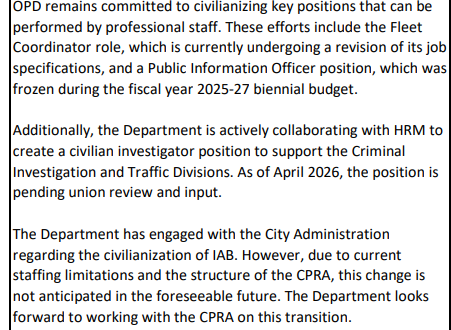
The partial civilianization of IAD began as a budget measure in 2023, but has since encountered resistance from both OPD and the CAO, even though it would save millions yearly.
City workers and residents also critiqued the OPD’s abuse of overtime. The organized presence of IFPTE 21 workers occurs as the City finalizes new contract agreements with its civilian, police and fire bargaining units, as the civilian union-backed Measure E goes to the ballot and the mid-cycle budget period begins.
Despite Wang Advocacy, Public Safety Committee Says OPD Plan to Host Social Work Interns is Not Ready for Primetime
For nearly a year, Public Safety Committee Chair Charlene Wang has promised out of the box thinking for enhancing OPD’s flagging academy recruitment process, including recruiting from "social work schools". Now that “brainchild” is coming before Council.
Wang's idea has been adopted by the OPD, and the agency has brought a proposed MOU with USC's online Dworak Peck School of Social Work masters internship program. The agreement would embed a student social worker with OPD. But fellow CMs felt uneasy going forward with an MOU with the institution when OPD brought forward her idea, according to a wide ranging discussion that showed all three fellow committee members, CM Carroll Fife, Rowena Brown and Ken Houston, were unconvinced that the program parameters are ready to be implemented in Oakland.
At times, the deliberation was confusing, because Wang is not the sponsor of the legislation, OPD is. Wang identified herself as the “brainchild” of the idea to reach out to a social work graduate program that sends interns to police forces in southern California. Per Wang’s statements, the target group would be Bay Area students using USC’s Dworak Peck School of Social Work online course.
During the presentation, OPD's representative and Wang both argued that the interns would not be in the field with police, but rather in the office dealing with domestic violence cases. CMs complained that the scope of the OPD’s program, and of USC’s commitments under the MOU were not well fleshed out, and declined to give carte blanche to add civilians to police work without a more robust sketch of the program. The issue was made more fraught by the fact that despite nearly a year of preparatory work, the OPD brought the proposed agreement with a very short timeline for agreement before the beginning of the program’s academic year in August. CM Fife has protested about the way OPD brings critical agreements to Council with little lead time and enhanced pressure and criticized the process, while ultimately remaining positive about the idea.
Not mentioned during the deliberation is the fact that a class action lawsuit currently brought by students of the online Dworak Peck program alleges that the online class is a distinct, low quality version of the in-person of program at USC, managed by a third party company and simply run online to increase tuition revenue to USC. The former students allege that the program is essentially another academic program using the Dworak-Peck reputation to recruit students.
However, USC’s in-person and online MSW programs are not at all the same, and USC’s representations about the online MSW program are egregiously false and misleading. In fact, USC provides a very different program to its online students, including by using different instructors, different course content, and by outsourcing other important services such as the clinical placement program. Indeed, USC has outsourced substantial aspects of its online MSW program to a for-profit corporation in exchange for splitting the tuition; USC does not administer this program. Rather than provide the same academic program that it represents to students to induce them to enroll in its online MSW program, USC merely profits at their expense.
Mayor’s Office Releases Budget Too Late to Discuss at First Budget Townhall Held at Secluded D6 Hills Location
Despite holding a press conference for an amended mid-cycle budget on Wednesday, the Lee Administration did not publish the new FY 2026-27 budget until late afternoon on Friday night, little more than an hour before the first of several Town Halls on the budget revisions the Mayor’s office itself advertised.
Council President and D6 CM Kevin Jenkins’ town hall is the first of several advertised town halls, apparently held on Friday at 6 pm. But even as the Mayor’s office sent out email notifications of the event Friday afternoon, with a link to learn more about the mid-cycle budget amendments, the link did not have the Mayor’s amended mid-cycle budget. The Mayor’s budget was not published until some time between 4 and 6. Leona Lodge is far from Oakland's D6 mainstream life, on the border of D4 and a one hour bus trip from Eastmont Mall.

Questions to the City administration about the mid-cycle budget published Friday evening will have to wait until Monday, but they are numerous. The mid-cycle budget’s “Measure E Sized” hole is borne mostly by OFD and OPD in the budget, which does not rely on Measure E funds—with many of the City’s other departments actually getting increases on what was originally proposed for the coming fiscal year in the biennial budget. The new mid-cycle proposal cuts a proportionately significant and glaring $700K from the already poorly resourced Community Police Review Agency, regardless, which will do little to change the appearance that the City opposes independent oversight.

Lee has fashioned the budget and its messaging as a budget that can do without Measure E—but in which police and fire budgets experience cuts in infrastructure and personnel funding if it doesn’t prevail at the ballot box. OPD would only have 2 academies in a non-Measure E budget, although that’s how the City budgeted the academies in the first place in the biennial. The number of officers budgeted for, would be cut by 22, but the OPD has little chance of achieving the staffing levels regardless. Lee's mid-cycle budget has an auxiliary budget module that would plug into the main budget should voters approve Measure E.
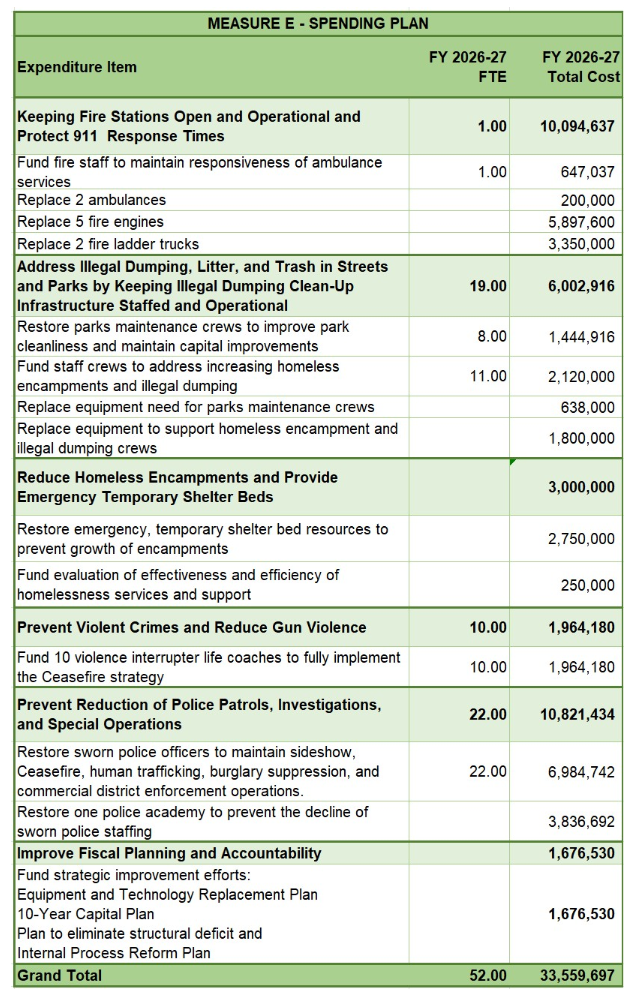
Left unanswered in the narrative is whether the cuts in OPD spending would be enforced by actual fiscal discipline, or, if as in most budget periods, OPD will be allowed to spend beyond its overtime budget but without the padding afforded this fiscal year of over-budgeted personnel funding. During the contingency budget for example, OPD exceeded not only its targeted reductions for overtime during an extreme fiscal crisis, but exceeded the original overtime budget by a significant amount as well, bringing into question whether City officials are able to control OPD spending.
Most unprofessional budgeting imaginable: OPD's OT was cut by $20 MM to 22 MM in December in city-wide cuts. OPD had overspent the cut by $4 MM by then. Thus, City just made that new baseline: 22 became 26. OPD's projected to spend 55 MM by June, 11 over original budget, anyway pic.twitter.com/55VMroJIt3
— Jaime Omar Yassin (@hyphy_republic) February 23, 2025
OO will have more on the budget as questions are answered and public venues held.
Lee's Sunday Morning Announcement of City Administrator Johnson's Resignation Follows Revelation of “Degrading” Texts
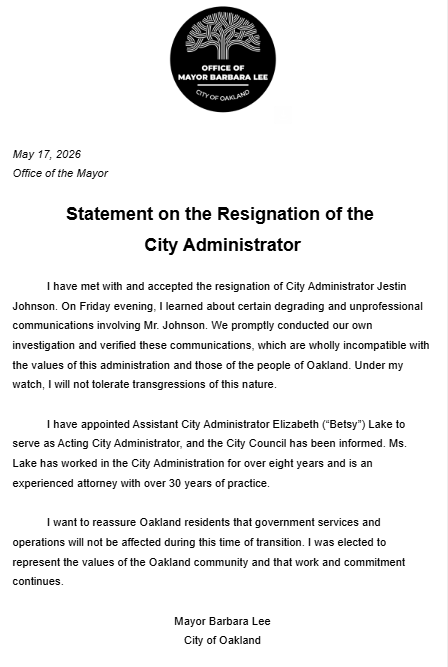
In an unusual Sunday morning announcement, the office of Barbara Lee announced that Jestin Johnson had resigned from his position as the City Administrator after an investigation carried out by her office confirming text messages released in a public records release of texts associated with DOJ subpoenas. In the texts Johnson appears to trade sexist comments about women both men find attractive with former Assistant City Administrator G. Harold Duffey, who left the city last year.
The records come from a vast trove of texts from Johnson, or that include him, capturing texts from dozens of other parties both in the City government and beyond, so it’s unlikely revelations will end here. It's unclear what individual or agency put in the records requests, but there are several that appear to have been placed by the same entity for the text records of several other City officials in 2025.
Comments ()