
1) A Public Records Request Reveals Only 2 Complete Applications for Oakland Police Commission Since October Council Decision to Deny Appointments
Two weeks ago, the Oakland City Council again voted to deny the appointments of Police Commission Chair Ricardo Garcia Acosta and Omar Farmer, after the Selection Panel met in mid-December and voted nearly unanimously to resubmit the same appointments for Council consideration. Though much of the Selection Panel’s deliberation centered on the body’s independence in the face of Council’s pressure, the Panel’s action was instead often characterized as a question of dereliction of their responsibilities by Council members during their deliberation.
Council members intent on recasting their same vote against the two focused on questions about the lack of review of any new pool of applicants to the body before submitting the Farmer and Garcia Acosta slate again. In an exchange with CMs on the dais during the mid-December Council meeting, the CAO's liaison to the Selection Panel, Felicia Verdin, told Council that 12 or 13 residents had sent applications to the Panel after the October meeting. Several CMs, including Janani Ramachandran, Rowena Brown and Ken Houston seized on the number as their rationale to deny Farmer and Garcia Acosta’s appointments, claiming the SP had failed to carry out a rigorous process once again. The CMs also argued that they had carried out significant outreach to muster up a stronger pool of applicants and were frustrated that residents who’d reached out to them to apply had not been considered.
But a public records request for all of the applications sent from the day of the Council’s first decision to the day of their second returned only 6 applications this week. Of those, only 3 were dated after October, despite the timeframe requested, and one of those was the application by Doug Wong, dated December 18, the day the Selection Panel deliberated and intended for the Mayor's review. Another application is potentially from former Oakland Mayor Jean Quan, but is blank except for her signature.
The small number of applicants may also be a harbinger of a sequel to the same issue Council members have claimed as their rationale for denying the Farmer/Garcia Acosta slate, as two more Selection Panel appointed Commissioners' terms expire in October 2026. Thus, the Selection Panel will be seeking to fill four seats instead of the normal two in 2026—as serving on the Commission becomes an increasingly public reputational gamble. The Oakland Observer has asked for clarification and confirmation from the records liaison and will update this story as more information comes in.
2) NSA Judge Cautiously Optimistic That Oakland, Under Mayor Lee, Can Exit Federal Oversight—But “We’re Not There Yet”
Judge William Orrick, who oversees the Negotiated Settlement Agreement [NSA], which sets the framework for federal court mandated oversight of the OPD, sounded cautiously optimistic about the possibility of the OPD exiting oversight soon at a Case Management Conference [CSM] last week.
But Orrick also sounded notes of caution, embodied best in his admonishment of a petition submitted by a group of Montclair-based residents led by Rajni Mandal. Though Orrick sympathized with the desire to exit oversight, he instructed the petitioners that OPD is in oversight for a good reason, which has now continued for over two decades.
“But there's a reason the city agreed to achieve 100% compliance with NSA, and that is a recognition of paramount importance of constitutional policing and the destructive legacy of racism, corruption, brutality and cultural rot exemplified by the Riders," Orrick said.
The majority of the petition’s signers identify from North Oakland or Montclair and include the OPOA’s spokesperson, Sam Singer, per the documents in the CMC packet.
Between the lines of Orrick’s praise and optimism lay clues former OPD-Chief Floyd Mitchell’s departure. Orrick had distinct and unusual praise for Interim Police Chief James Beere—opening questions about whether former Chief Floyd Mitchell’s departure was connected to his performance on issues of oversight. Mitchell famously told the Police Commission during a public meeting that he believed oversight makes police afraid to do their jobs.
Mitchell: "culture and conditioning of our police dept is one of fear...if a vehicle strikes a bus or a car or anything on the side of the road in Oakland, that is a traffic accident..."
— The Oakland Observer (@Oak_Observer) January 11, 2025
Orrick also noted disarray in Internal Affairs prior to Beere’s term, which Mitchell was forced to reform as the Internal Affairs Bureau [IAB] under his own direct leadership last year in the wake of the Chung and Tran scandals.
Much of Orrick’s and other parties' optimism revolved around new directions taken under Lee, and specifically the appointments of Beere and Michelle Phillips in the City’s Constitutional Policing role. Phillips' description of her month and a half tenure included regular meetings and liaising between the City, OCA, Police Commission and its associated agencies. Phillips described seeing a genuine “cultural change” at the OPD, and noted that OPD command staff seek out her subject matter expertise on issues of constitutional policing.
"I think that's one of the first, if probably not the first recognition that the city and OPD succeed together and they fail by pointing fingers at each other" Orrick said, praising Mitchell’s presentation.
Orrick set the next CMC for May, where he expects a detailed data driven report about whether the disparities in officer discipline, which show reflect significant issues of systemic racism, have been corrected. OPD is still falling short of its requirement to complete 85% of IAD investigations on time as well—in the past, Orrick has been firm in that the bar for that task is low and failure by OPD untenable.
Though during their presentations before the judge, plaintiff attorneys Jim Chanin and John Burris sounded more optimistic than they have in the past, their concerns around the disparities study and timeliness of investigations were noteworthy. Chanin noted the City's new visible "will" to complete tasks was relatively new and laudable. But Chanin also cited the Tran case as an ongoing and iterative example of OPD’s problems.
“[The Tran case involved] the Chief, the head of Internal Affairs, one of the deputy chiefs….and it's very disturbing to see, after so many years, that something of this scale happens at this size and magnitude. It's unacceptable, and it can't happen anymore, as it has over and over again."
Chanin also noted the core issue of OPD, not of individual officers, but of the actual core culture.
"The Tran case did not involve a single officer. They were all supervisors," Chanin noted.
Burris told the court that the discipline disparities would obviously reflect in officer behavior in policing a largely Black and Brown public, echoing similar comments made by Orrick. Burris also sounded similar pessimistic notes as Chanin on the Tran scandal, linking it back to bias in the discipline process.
“And we know that from the Tran case and other cases we've had now for years, that when the push comes to shove an officer who is liked is well defended, and somehow the rules are not followed…that, to me, raises the question of the racial issues here, because there has to be some reason why we're having numbers like this,” Burris said.
Mayor Lee’s presentation boasted of her accomplishments in bringing city, CPRA and police together to escape the NSA and her new innovations to amplify police staffing. But Lee’s comments sounded an odd note when she spoke of the Police Commission only in reference to her two recent appointees, and not the work of the Commission to date.
Meanwhile the Tran prosecution has faced worrisome challenges in the office of DA Ursula Jones Dickson as yet another murder conviction is dismissed due to the connection to Tran. Jones Dickson's office took extremely irregular actions during the preliminaries in the murder of Stephen Taylor by a former San Leandro police officer, Jason Fletcher, to help Fletcher's defense. Fletcher was defended by the OPOA's designated law firm, Rains Lucia Stern.
3) Despite Claims of an Imminent End of Flock License Plate Reading Services Without a New Contract, OPD and City Have Yet to Execute One
Despite claims of urgency and inability to continue Flock services without a contract, the OPD and city currently have not executed a contract with Flock, according to a public record’s request made by this publication and fulfilled last week.
The contractual void appears in stark contrast to claims from OPD that the contract authorization was so urgent it had to bypass committee multiple times. The excuse of an impending end to Flock’s services was also used to brush aside best procurement practices and competitive bidding.
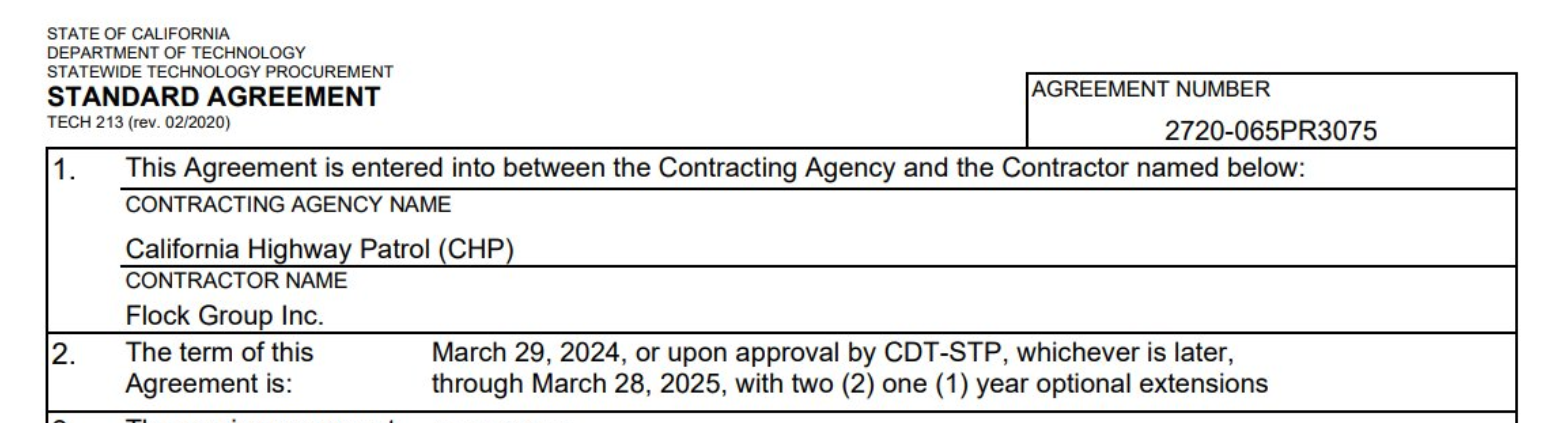
During the mid-December meeting that approved the Flock contract, the OPD’s technology coordinator Carlo Beckman repeatedly told Council that CHP’s contract with Flock was for only one year, and was already terminated and that OPD would soon lose Flock services if a contract was not executed between the City and Flock. But the CHP’s contract is for a potential 3 years—one year, with 2 one year potential extensions and could be proceeding on a month to month or year-option extension. Oakland’s MOU with CHP reflects the longer potential period of the CHP’s Flock contract, three years, ending in 2027. The City Administrator’s office told this publication that Flock is still providing services, but has not responded to questions about how and under what contract that’s proceeded.
4)Financial Analyst Says that Jenkins/Ramachandran/Brown $40 MM Tax Ballot Measure Revenue Patch for FY 26-27 Had Role in Credit Downgrade
The City’s financial experts and its go to financial firm, PFM Advisors, told council members at last week’s Finance Committee that the use of a future tax ballot measure to patch the 2026-2027 budget deficit is one outstanding factor in recent downgrading of the City’s credit to “negative outlook”. The City’s credit rating had already lost a somewhat insignificant series of rating points with Moody’s, S&P and Fitch in 2024 due to ongoing instability and a mini-scandal in the Finance Department beginning—but the "negative outlook” rating is a warning that the agencies could reduce their ratings again in the coming periods.
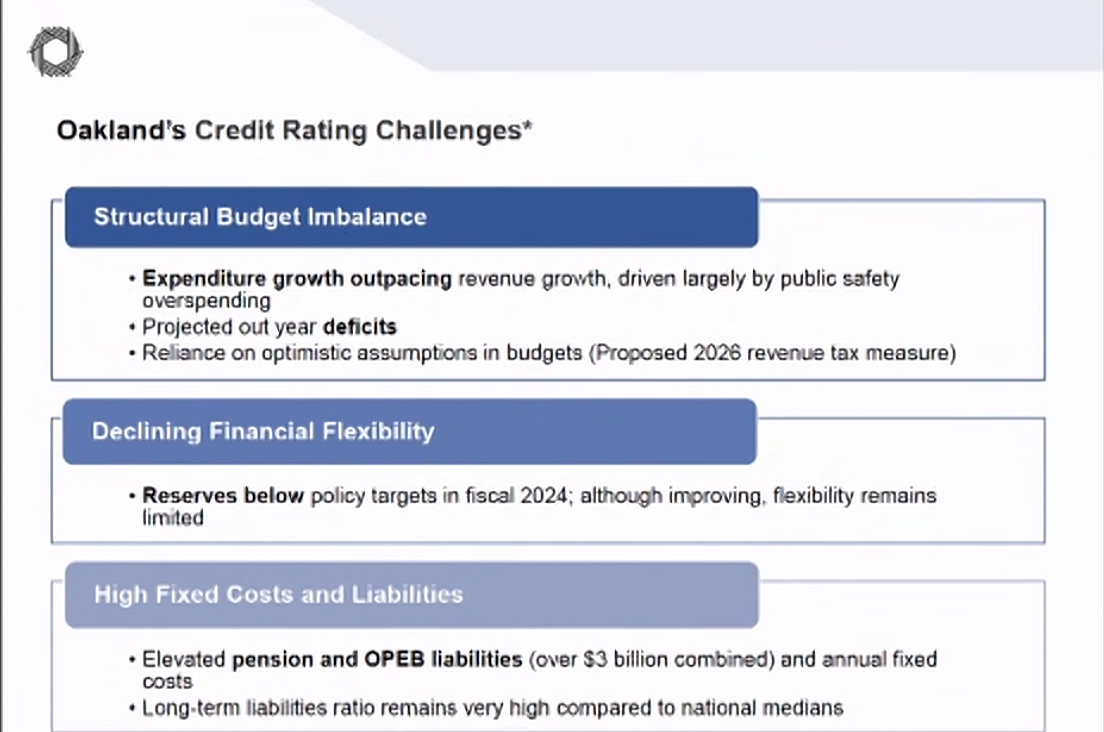
Oakland’s credit rating is still comparable to those of other mid-sized cities, according to PFM’s Jaime Trejo, who told Council members that Oakland’s rating is “average” for a city of comparable size. But Trejo’s presentation suggested that “overly optimistic outlooks” in budgeting were partially responsible for the credit rating ding in late 2025. The City’s Treasury Administrator David Jones later went further and specifically noted that the main onus of that criticism was the ballot measure patch in the 26-27 budgeting.
“With regards to the optimistic assumptions…it's primarily tied to that measure for the $40 million that is going to go before the voters, so they [agencies] are mindful of that as well,” said Jones.
Regardless, per the report, Oakland had strong demand for its bonds such that it could not completely fill the demand for its 334 million worth of bonds in its sale of Measure U bonds in December.
Comments ()