
1) Four Months after Authorization, OPD Still Hasn't Executed a Contract with Flock, Has no Additional Video Surveillance
Inquiries by the Oakland Observer confirmed this month that the City of Oakland has still not signed a contract with Flock, over four months after the City Council initially authorized the CAO to do so in a contentious mid-December 2025 meeting. OPD confirmed that the original Flock service contracted through the CHP and a side agreement with Flock for about 300 Flock Automated License Plate [ALPR] reading cameras continues with no contract.
OO first confirmed that OPD hadn't yet signed the contract in January, and has confirmed the ongoing absence of the contract every month, with the most recent confirmation Thursday, April 16. OPD has declined to provide any information for the ongoing per diem use of Flock or whether or not the memorandum of understanding with the CHP continues. This remains an Oakland Observer exclusive, as no other media organization has reported that the contract authorization, controversial at the time it was passed in December, has yielded no contract.
The CHP's contract with Flock for Oakland services technically terminated in March 2025, but it had two optional year-long extensions. The first was clearly being used for the period running up to the contract vote in December. The second, which would terminate in March 2027, could be in play now. OPD's MOU with CHP was for a period of three years—the MOU was authorized by Council in July of 2024 and likely would terminate in 2028. OPD's side MOU with Flock based on the CHP MOU has no end date and continues for as long as the CHP contract is active.
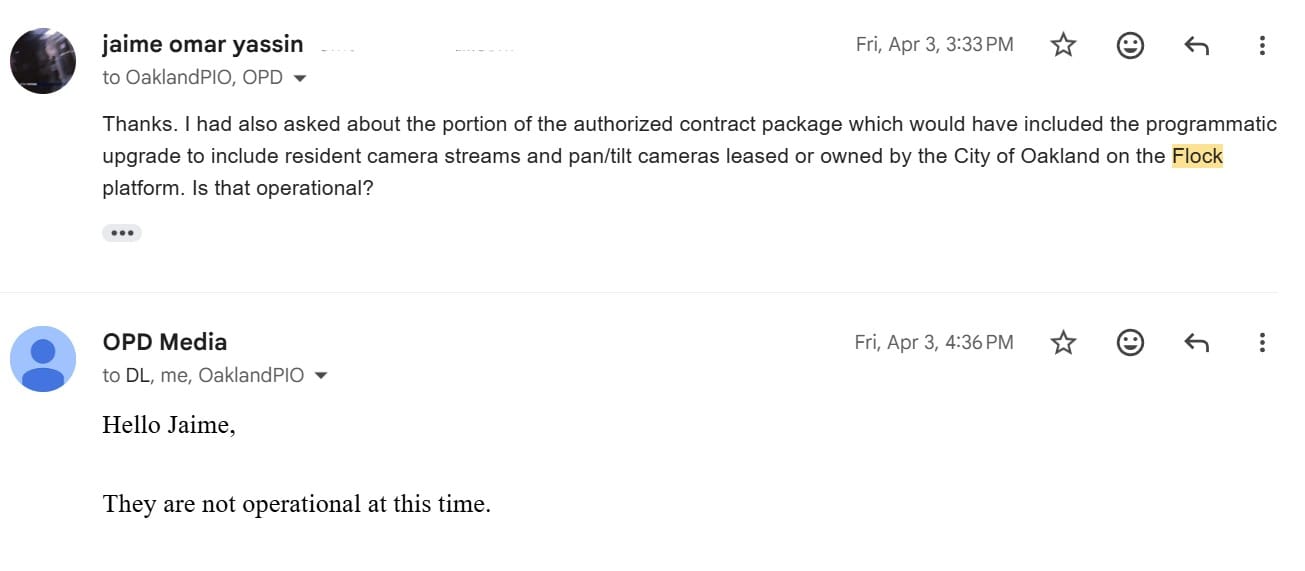
OPD also confirmed that a significant element of new services voted for by Council in December was never implemented. The legislation passed by Council in December authorized the lease of 40 Flock pan/tilt cameras, and a Flock platform that also adds video streaming services for authorized resident and business owned surveillance streams. With no executed contract, those services and hardware, which the OPD said were vital to continue to lower crime with declining staff, were never acquired or brought on line.
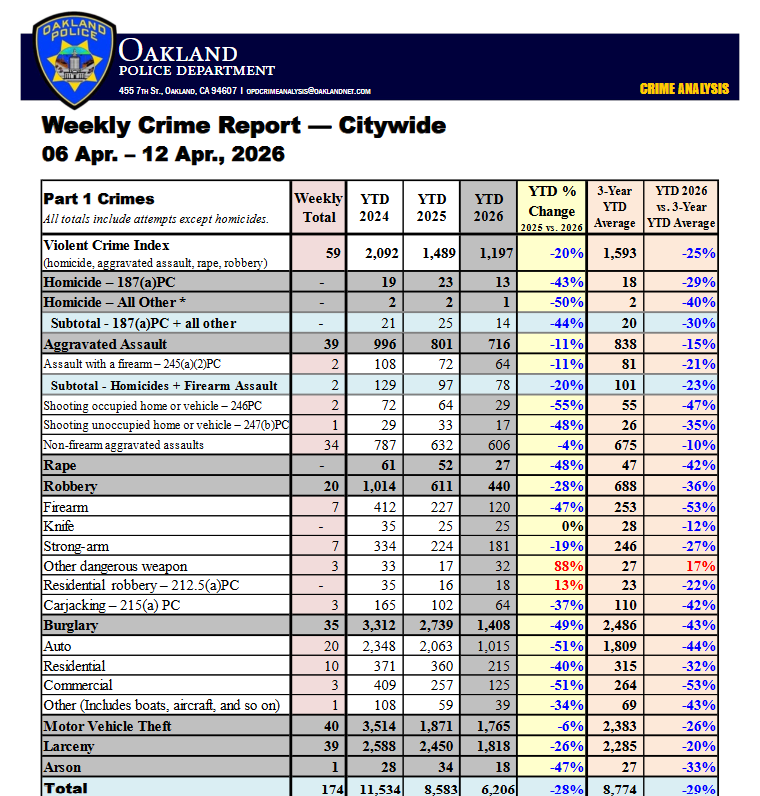
Crime has continued to decline, however, despite OPD warnings that the new pan/tilts and resident streaming services were vital to keeping crime low–the new contract period matches almost perfectly to an entire OPD calendrical quarter of crime stats that show crime continuing to decrease as it has since mid-2024.
On Tuesday, the ALCO BOS will vote on renewing [and backdating] its expired contract with Flock for non-incorporated areas of the county. The Bay Area is increasingly an outlier in the growing unease with Flock, as dozens of other jurisdictions have terminated their agreements with the surveillance company.
2) EAP Passage: a Pyrrhic Win for Houston and an Uncertain Path Forward for Oakland’s Homelessness Policies
What should have appeared like a handy win for D7 Council member Ken Houston ended up looking like a pyrrhic victory by the time Council narrowly passed his EAP legislation at Tuesday’s early morning special meeting. Overwhelmingly negative public comment opposed the legislation and pilloried Houston, while CMs aired concerns about Houston’s original framework as they added amendments.
Off to a Bad Start: Houston and Brooks Unable to Describe Changes in the EAP on Introduction
With an overflow crowd of nearly 100 waiting to comment on Oakland’s homeless policies, Council President Kevin Jenkins gave Houston an abbreviated 7 minutes to introduce and explain both the EAP and the changes made to it since it was first introduced last September. Jenkins said at the start of the meeting that ostensible quorum issues obligated him to limit speaker time to one minute as well as CM speaking time.
But rather than explain the changes made to the EAP over its circuitous journey since last September, Houston used up nearly all of his time circumnavigating the Council round table with a mic in hand, showing an old news segment of himself from 2016 and carrying oversized poster-sized images of homeless encampments. Houston failed to explain details about how the EAP would function or the many ways it had changed.
Houston continues his performances on EAP about halfway thru his seven minutes for presentation he has not yet spoken about the EAP specs pic.twitter.com/CD8tMyMPRk
— Jaime Omar Yassin (@hyphy_republic) April 14, 2026
A dense redline copy of the new EAP riddled in red underlines and cross-outs accompanies the legislation, showing changes to the current EMP, the original EAP, the changes made in November, and the changes made thereafter. But Houston made no reference to it.
By the time Houston handed off the presentation to his legislative partner, D6 chief of staff Patricia Brooks, she only had 1 and a half minutes to explain the EAP edits. Other Council members jumped in to “donate” their speaking time for Houston’s presentation—but even the time donations weren’t enough, and would have also left the CMs unable to comment on the legislation. Jenkins' claims about limited time–which many present suspected were only an excuse to limit resident speaker time—collapsed and he had to give Houston and the CMs who’d donated time additional speaking time. As Jenkins gave the EAP presentation his own time so Brooks could complete her share of the presentation, even he seemed to lose patience with Houston's showboating.
“Council member you have to get to the to point, you have to get to the issue,” Jenkins admonished Houston.
Brooks gave a brief slideshow explaining why the EAP was necessary which lacked any references to changes or earlier drafts. In their follow up questions, both CMs Rowena Brown and Carroll Fife asked if Brooks and Houston had brought an additional presentation to explain to the public what had changed from earlier versions. Fife criticized the rushed pace of the meeting and scheduling—a meeting on top of the regularly scheduled meeting later in the day—and said she wanted to see descriptions of the changes in the new legislation. Fife reminded Jenkins that the rationale for having a special meeting exclusively for the EAP in the first place was to give ample time for the public and CMs to grapple with the issue.
Brown also asked Brooks and Houston if there was a slide presentation showing what had changed since the last time the EAP had appeared at Council, but Brooks had no additional material. Brooks added that there are now offers of transport during closures and vague “technical changes” but seemed challenged to describe what had changed since September and referred Brown to the redline version of the EAP.
Houston, for his part, used extra time he received to ask department principals to explain the necessity of giving OPD more leeway to tow vehicular dwellings. Representatives of the EMP, OPD and OFD all said it would be helpful to give OPD more powers to interact with occupied vehicles and sanction them for towing. But neither they, nor Houston, could explain how that feature of the EAP, now complicated with additional changes made since September, would function.
Brooks, in a revelatory moment, then gave the task of explaining the edits to Assistant City Administrator Betsy Lake. Lake read off a list of the changes since September and described the additions as added alignment with the Mayor’s Strategic Action Plan on homelessness, published in February. Notably, at one point Lake appeared to inadvertently claim that the City Administrator’s Office, City Attorney and Mayor’s office are actually responsible for the edits to the EAP. Lake told CMs:
“The main thing that the administration has done between the last version and this version is to work with council member Houston and the City Attorney to ensure that we have a path for alignment between the EAP and the Mayor and Administration-led Homelessness Strategic Action Plan.
So the main things that we worked on with the authors and they were open to making the majority of changes that we asked for, and those changes include allowing a path for the city administration to work cross departmentally to draft standard operating procedures to guide outreach, engagement and transparency to the public, including a specific requirement for a standard operating procedure around vehicles. The authors added clarification that individuals cannot be arrested for re-encampment, but may be arrested for criminal activity. We strengthened the outreach section, including as Patricia mentioned, coordination on transportation. The authors also included a provision allowing the City Administrator, in consultation with Council Members, to update Low Sensitivity Areas. And then finally, in the big picture of the substantive changes, we added a provision for…or the authors added a provision for…the City Administrator to communicate this policy widely and in a user friendly manner.”
A Significant Departure from Houston’s Vision
In fact, the EAP presented Tuesday represented a long journey from Houston’s intended plan, the original EAP and his claims about it. Off-dais meeting notes with other CMs published by the City Attorney’s office when it sanctioned the offices of Kevin Jenkins and Ken Houston for Brown Act violations last year, reveal that Houston originally sought to remove not only provisions for shelter, but the capacity for it, arguing that the role of providing shelter is strictly ALCO’s.
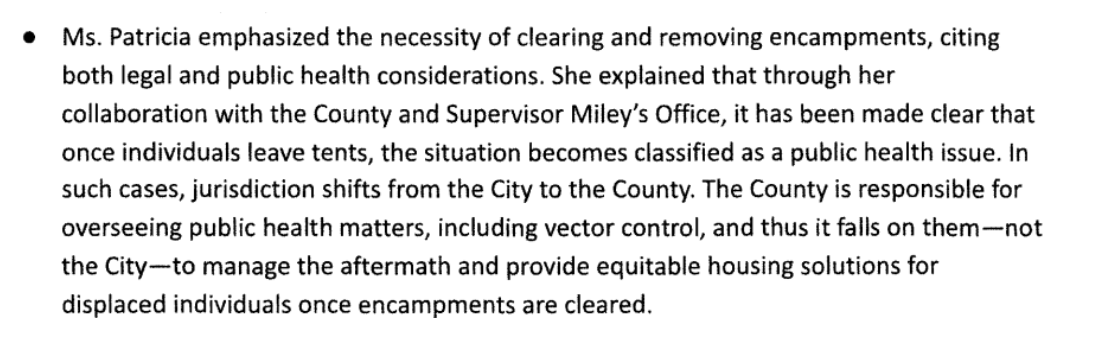
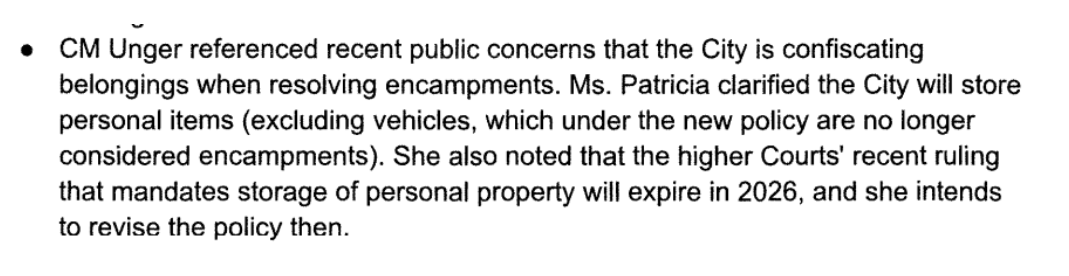
Brooks, representing both Jenkins office and Houston's, told CMs as well that the EAP ultimately envisioned an end to current practices of preserving homeless residents property based on the Mirelle settlement. Criminalizing all re-encampments was also a central component of the legislation as presented by Brooks to other CMs.
CMs Communicate Their Lack of Support for Houston's Original EAP in Ways Both Direct and Indirect
Tuesday’s deliberation gave an undeniable sense that the framing and first iteration of the EAP itself has long been unacceptable to CMs—perhaps explaining its circuitous route and arrival for action on Tuesday only after apparently significant edits from the Mayor and the City Administration. On Tuesday, no CM expressed support for the EAP as it was originally presented, with CM Zac Unger and Fife being the most direct.
Unger noted he would not have voted for Houston’s plan as originally presented last September before the current edits, calling it “unacceptable”.
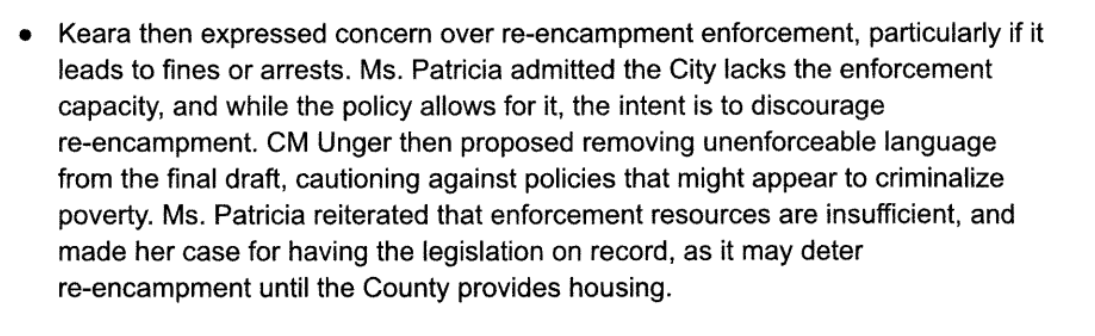
“The other reaction that I had to reading the first iteration of the plan, which came to us a few months ago, was that there were a few red lines in that first iteration that made that plan unacceptable to me. First, I am absolutely unwilling to criminalize and arrest people for the simple act of being homeless. Second, in non-emergency situations, I believe it's critical that we make reasonable offers of shelter before we move people from their encampments. And I want to thank the City Attorney and my colleagues for working to present us today with a version that does not cross either of those red lines,” Unger said.
Fife ultimately abstained from the vote after adding amendments, expressing a sentiment that her amendments were harm reduction for a policy she doesn’t support in spirit*. In prefacing her amendments, Fife recalled the examples of two Black homeless residents who’d died on the streets.
“Both of these Black women died homeless, and the majority of people dying on the streets homeless are Black people. And that is not by accident. This is the history and legacy of a racist country, and I can't support legislation that's going to perpetuate racist policies that impact my people more than anybody…for everyone that's advocating for stricter penalties around what we do with poor people, because this is about poor people, find out where you are in the spectrum of incomes. Because this is coming for us all, because the rents are too damn high and people are too damn poor, and in America, that is our formula, and it's wrong. So we're never going to get out of it, because in an empire where predatory capitalism is the name of the game, then homelessness is a by product, and we're not addressing those root causes,” Fife said.
Brown in her statements and CM Janani Ramachandran, by skipping the meeting altogether, also suggested that they had little support for the original EAP.
Brown thanked stakeholders and speakers who’d shown up for the discussion since the EAP was first introduced—and specifically the East Bay Community Law Center, a consistent critic of the EAP that has sent representatives to lodge opposition to it every time it has come up for scheduling. Brown said she had used the organization’s feedback to inform amendments.
Bridget Nicolleti with East Bay Community Law Ctr: "I attended all council meetings on this policy, & when public is given proper notice that the EAP will be on the agenda, dozens & dozens of Oaklanders have come to speak up against it. I urge you to listen to Oakland residents" pic.twitter.com/RJH7DycGyV
— The Oakland Observer (@Oak_Observer) February 5, 2026
Ramachandran, who several times in her role as Rules committee member declined to schedule the legislation, was notably absent for the meeting, although she was present for the regularly scheduled special meeting later in the day. As a Rules member, she’d had the opportunity to note her unavailability for the day when both the special meeting was scheduled weeks ago, and the legislation for it was scheduled subsequently, but made no comments.
And CM Noel Gallo, often a reliable ally of Houston’s on the dais, refused to vote for the policy. Embedded in a rambling soliloquy that included an uncharacteristic acknowledgement that homelessness is driven by increasing rents and cost of living, was Gallo’s contradictory implication also that the powers to evict RVs and vehicles are already held by OPD and OakDOT.
“Whether it's law enforcement, [Department of] Transportation, the Administration, they're not delivering on the quality of the program that we're asking for them to do,...I'm not in support of this policy, but I am in support of making sure administration does the the job that they were paid to do, and don't go around making excuses from Transportation, the police department,” Gallo said.
During public comment, dozens of speakers vehemently opposed the EAP, with some calling it performative given the ramped up evictions over the past year that have exceeded by a legitimate order of magnitude those of previous years. Few speakers supported the EAP—about 14 of the 80 who signed up to speak. You can see some the comments in the live reporting thread here.
Fife, Unger, Wang, Jenkins and Brown Amendments also Change Scope and Implementation of EAP
Fife's Amendments: Perhaps one of the more important amendments in the short term, one of Fife’s amendments will delay implementation of the EAP for potentially up to 90 days. A provision added into the EAP since last September requires a 90 timeline for the City to provide a report about the use of city land to provide resources and housing sites. Fife's amendment would put the EAP on hold until the report is provided to Council, or 90 days have passed since authorization. Fife’s changes would also require the City to provide additional time, transport and/or accommodations for any disabled residents facing a closure.
Brown and Fife both added data collection requirements at the time of a closure or partial closure, detailing demographics, numbers of residents accepting shelter and their migration through the system, repeated closures, and, importantly, resources and costs expended. For Fife, these also included tracking where residents eventually moved if they didn’t accept shelter or no shelter is offered.
Unger's Amendments: Unger’s amendment now requires that before initiating a tow of an inhabited vehicle, OPD or OakDOT must contact the Encampment Management and Abatement Team [EMAT] in writing and potentially coordinate outreach and offers of shelter. Unger’s changes may add on paper a more lengthy process to tow and evict vehicular shelters than the current one [which follows no policy in effect]. How the connection between OPD, OakDOT and the EMAT would work, given the supposed intention of the EAP to allow OPD a freer hand to tow, is left to the wording of the CAO's Standard Operating Procedures [SOP's]
Brown's Amendments: Brown's amendments expand the requirements of the 90 day report to include city-owned parking areas where residents who have accepted shelter can park their vehicles—she attributed this policy to suggestions from the East Bay Community Law Center. Brown also added data collection requirements as noted above.
Wang's Amendments: CM Charlene Wang’s amendments included directing the City to include in its SOPs processes around families with children living in vehicles. Wang’s amendments also direct staff to continue to track homeless residents after a closure if no shelter was available in order to provide shelter if it comes on line.
Jenkins' Amendments**: in Jenkins changes, the CAO may choose to expedite closures of certain areas in a documented process of findings. That authority would be shared with the CM whose district includes the area. The criteria for closure is so broad as to create almost any rationale to close an encampment chosen by the CAO, a district CM or both.
Only Time Will Tell What the EAP Becomes in Practice as CAO Will Have Significant Discretion Over Its Definitions and Practices
Likely the most important factor in how the EAP will play out in practice will be in the CAO’s new powers to write SOP's and modify the definitions of individual High and Low Sensitivity zone areas—new powers added almost certainly by the CAO to the legislation after it was last seen in November. The CMs amendments also add new variables to the mix that will be especially dependent on those SOP's.
The SOP's will give the city government broad and potentially unprecedented discretion in how to enforce the City's homelessness policy. While the newer language requires an “attempt” at providing housing, for example, it’s not clear what will satisfy the requirement. Portions of the EAP suggest that the City should decline to carry out a non-emergency closure until there is sufficient shelter to offer residents, as well—that will be up to the discretion of the City. And in the end, many of the amendments added by both City and CMs could clash with the City's pronounced staffing, capacity and budget issues, regardless of SOP's.
The policy expansion of high sensitivity zones to include ALL parks and areas adjacent to BART will probably leave little room for interpretation, however, and that will likely be one of the primary new areas—outside of vehicular tows which ramped up regardless of the policy currently in effect—where the new policy will be felt once enacted.
Houston Posts Sour Grapes on Wednesday
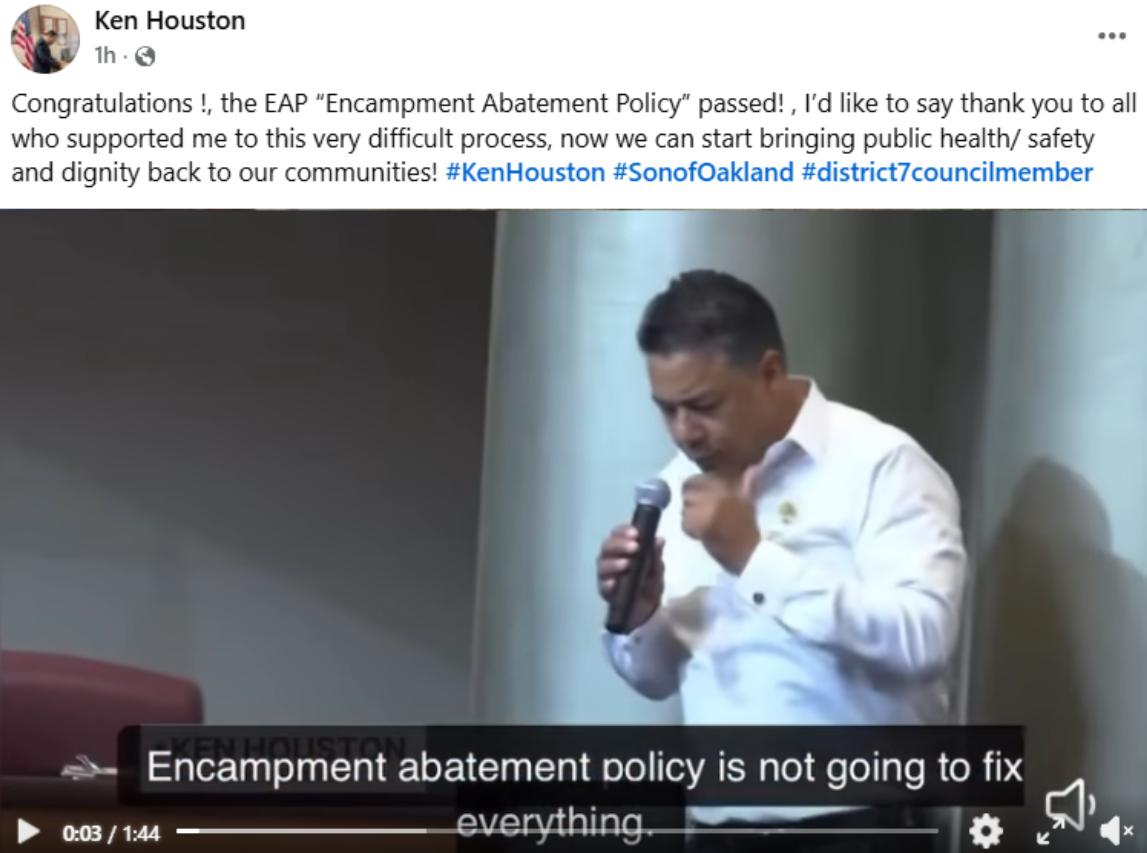
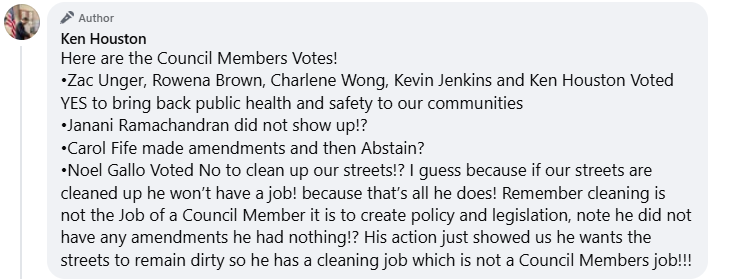
The EAP that finally passed Council with a narrow 5 vote majority was visibly different from both Houston’s vision and the legislation he introduced almost a year ago, but on Wednesday Houston turned to Facebook to boast of the success, regardless. But that was followed by a surprisingly bitter reprise in the same thread that aired a familiar dynamic of grievances. In a subsequent post, Houston attacked fellow CMs he did not view as loyal to his vision. His focus on Gallo reveals he still stands by his original claims that the EAP would by itself significantly reduce homelessness, an idea none of the CMs who voted for his policy appeared to believe.
*Fife also said she had not supported the current EMP, because neither policy attempts to solve homelessness by addressing root causes
**an editing error left Jenkins' amendments off the initial publication. They've now been restored.
Comments ()