
1) Second Highest OPD Attrition Report in 5 Years as Public Safety Committee Continues to Focus on Marketing to Dwindling Applicant Pool
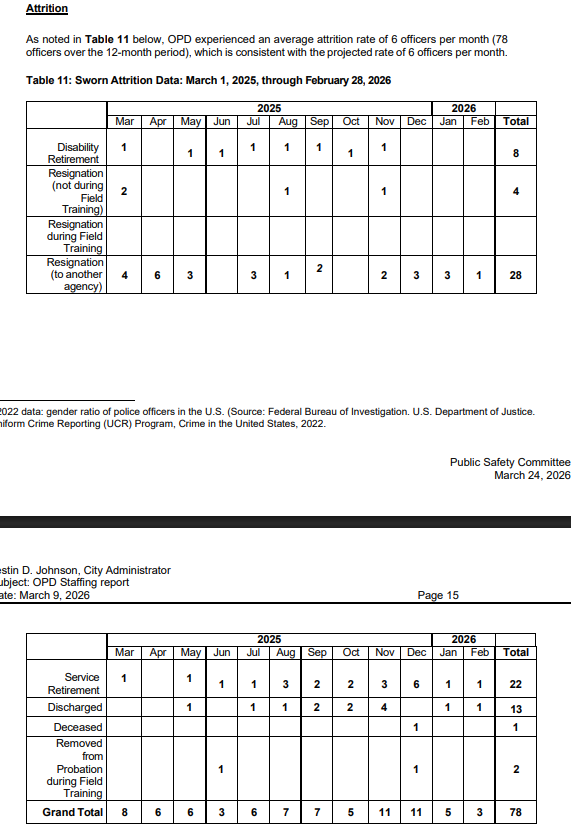
Faced with an unusually dire report on police staffing on Tuesday, the Public Safety Committee largely stressed redoubled recruiting and personnel marketing as a solution, despite clear evidence that recruitment has declined, and OPD officers are being aggressively lured to other agencies amid a visible shrinking applicant pool. The report’s total attrition of 78 officers over a 12 month period is the second highest of any 12 month-period staffing report of the last 5 years*, according to the City’s legislative archive. At one point, CMs at the meeting were told by the OPD’s recruitment supervisor that OPD has tapped the local recruiting pool to its limits.
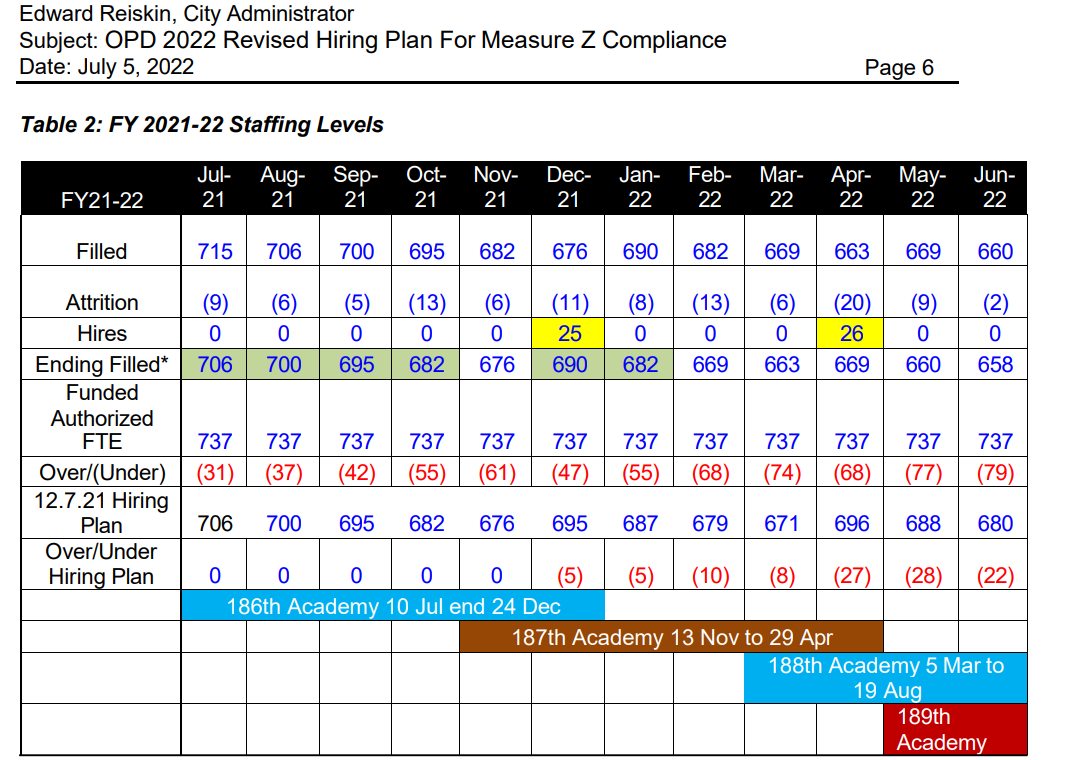
The report nearly reaches the catastrophic attrition of the Covid years between 2021 and 2022, when a combination 0f resignations and terminations resulted in 98 officers leaving the force in a 12 month period, about 14% of OPD sworn personnel at the beginning of that period. During that period, as well, however, a significant number of officers were terminated for refusing to follow city rules on vaccination.
High Attrition, Terminations, Retirements Amid Headhunting and Low Recruitment
The report revealed two alarming trends. One, OPD officers left in greater numbers over the 12 months from March to March than previous recent reports have represented. OPD had its highest resignations of any report from the last five years, 32. But a staggering 28 of those 32 officers left for another agency, according to the report. 22 officers retired during that same period, likely resulting in the back to back monthly attrition rate of 11 officers in November and December, the highest consecutive monthly attrition of any of the periods as well, and a number that all by itself erased the gains of the academy that graduated in January.
But to make matters worse, 13 officers were also terminated during this same period, an unusually high number, and the highest since a mass firing that resulted from wide-spread violation of Oakland’s vaccination policy in the police department. In all, OPD lost close to 12% of its sworn personnel since last March.
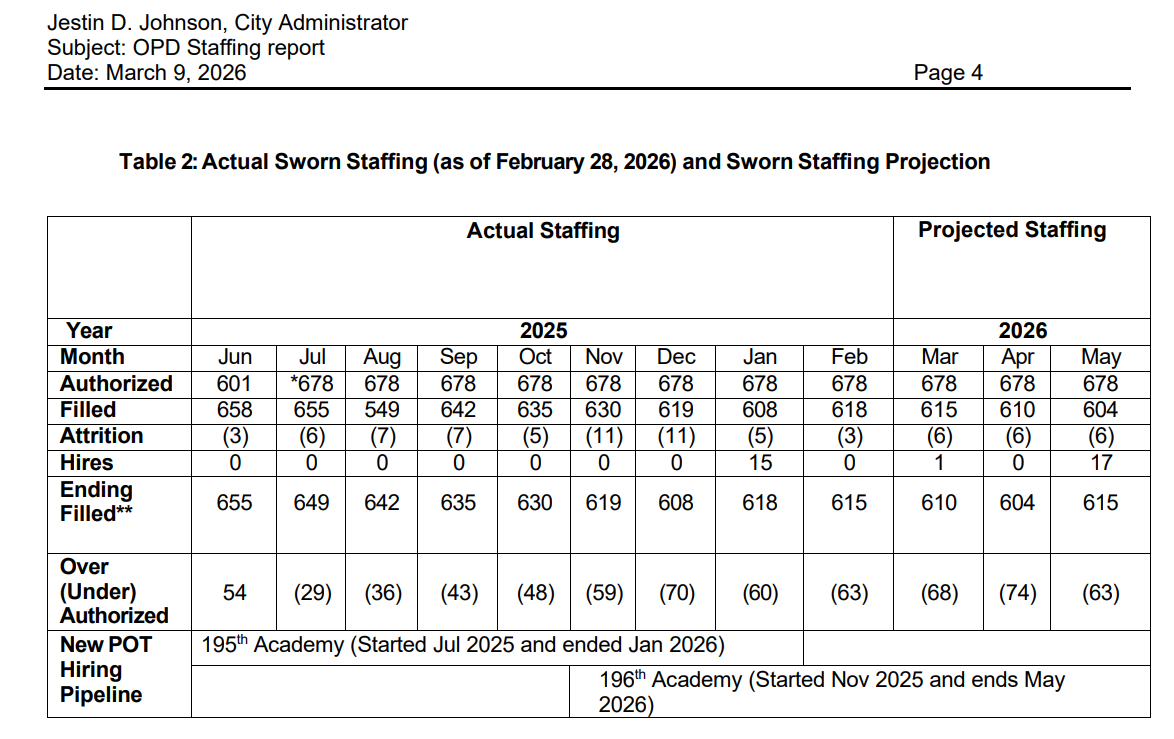
Meanwhile, OPD’s academies continued the low graduation rate that has marked academy production for around half a decade. Only 15 police trainees graduated from the academy that began last July and graduated in January. The current 196th academy graduates in May—the report’s projection is 17 graduates, but a graduating class could still end lower.
Questions to OPD representatives from CM Carroll Fife during the meeting revealed that officers who resigned to another agency likely did so pursuing eye-brow raising signing bonuses, along with higher wages. Alameda’s police department, run by a former OPD officer, offers a $70K signing bonus, according to Sgt Michael Romans-Rowe, an OPD recruitment officer who helped give the presentation. According to a supplemental report, the fact that OPD’s largely non-Oakland residing police force live closer to other cities may be creating an extra incentive atop bonuses and higher pay to leave the force and live closer to their geographic area.
While the main staffing report notes that the most consistent response in exit interviews was conditions of discipline at OPD, the OPD focuses on data other than exit interviews to determine an officer’s reason for leaving. Other agencies must contact OPD when an officer is applying for work to confirm their employment, for example. OPD Deputy Director of Bureau Services Kiona Suttle acknowledged the discrepancy and the more likely indicator in a back and forth with CM Carroll Fife, the only CM who appeared to be ready to grapple with the systemic dynamic in declining police staffing.
“I want this on the record to be clear, people are leaving primarily for compensation…compensation, commute and benefits?” Fife asked.
Suttle confirmed this was the more likely rationale for the departure, and that officers were probably declining to state as such during exit interviews.
“In the actual exit interview, the person separating does not always say I'm leaving to go to another agency…we analyze other data to try to determine why they're leaving, so we know that they were in the background process with another agency, and that agency has let us know that that person is being hired. If we know they’re in the background process with another agency, even if they don’t tell us in the interview, I’m leaving to go to Richmond, or Albany PD, we do have other data to be able to determine reasons for leaving,” Suttle said.
Suttle also noted that cross-referencing against the other agencies reveals the high signing bonuses officers are receiving at those agencies.
“We just did a kind of a spot check on some of those agencies that they may be going to, and just seeing that they may be offering a higher bonus or beginning salary,” Suttle said.
“I don’t know how Oakland can even be in an environment to compete with that with our budget challenges,” Fife responded, referring to the high signing bonuses.
High Training Repayments for Leaving OPD Early Insufficient Against Signing Bonus Attraction
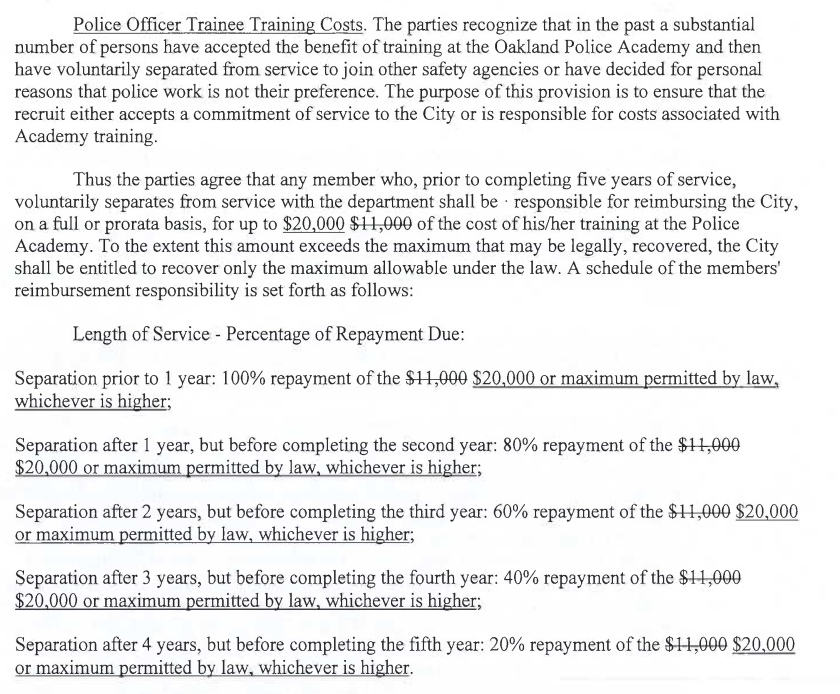
Oakland has previously instituted measures to create disincentives for new officers who may plan on trading OPD’s well-regarded paid training to another agency once received. The Oakland Police Officer’s Association’s last contract in 2022 increased the incremental amount officers have to pay back to the City of Oakland if they leave employment during any in the immediate five years after graduating from the academy in order to staunch the 2021-22 hemorrhage of officers. The fee prior to 2022 was $11K, declining by a percentage increment every year after the first. But Romans-Rowe revealed during the meeting that it was precisely officers who’d been with the department 2 years or less who comprised most of those switching to other agencies.
"When we did our research, our officers that usually leave the department, they were in that 14 to 24 month [period]", Romans-Rowe said.
The maximum amount an officer must pay back if leaving during this period is between $20K and $12K, however, and clearly not a disincentive with signing bonuses of up to $70K at other agencies.
Though Fife kept returning to what appears to be a crisis in policing according to the data, the other members of the committee were largely ambivalent to the alarming figures, and focused on spending more money on recruiting, led by Chair Charlene Wang. Wang admitted, however, that recruiting was well below expectations.
“I know that we have funded, in the last budget cycle, five police academies, and one of our aims was that we were going to fill up those seats.” Wang said.
Academies Produce New Baseline Well Under 20 Graduates as Pool Shrinks Nationally, Despite 2025 Attempts to Sharpen Marketing Efforts
CM Janani Ramachandran, who led the Council budget process in July 2025, said she was comfortable budgeting one less academy in the first year of the biennial budget because a $120K additional marketing line item for the OPD in 2025-26 [and $100K in 2026-27]would mean that each academy would be filled to maximum of about 35 trainees—and at one point, Ramachandran mused that she imagined the classes would be even larger, at 42 trainees. But as the staffing report shows, both the first and second academies of 2025-26 graduated at the new historically low baselines.
Suttle also confirmed that other area agencies are experiencing the same dearth of recruits, in what has been called a nation-wide slump in police hiring visible over the past near-decade**.
“The challenges that the Oakland Police Department is experiencing when it comes to recruitment, they’re not unique to OPD. We’ve coordinated with other agencies to find out what challenges they’re experiencing.”
Nation and statewide studies show the decline is uniform, but especially prevalent in California.
Nevertheless, Suttle argued for higher recruiting budgets during the meeting to match those of SFPD, which she claimed has a much higher recruitment budget. But SFPD, with over twice as many sworn officers, has also been graduating small academies, both relative and in direct contrast to Oakland. A late 2024 and early 2025 graduating class numbered only 12 each. Two current 2025 classes did better, but barely broke 30 for a PD of 1600 officers—and it's worth noting that this increase happened as Oakland cancelled an academy. No class between January 2024 and January 2025 broke 20.
OPD Admits Local Pool is Largely Tapped Out
Romans-Rowe at one point noted that Oakland had tapped out local recruiting pools and would have to target a national market, where he said other police departments were having more success.
“Right now, we’re focused on community first within Oakland…we depend heavily on a referral base…but we also know that we’re really scraping locally,” Romans-Rowe said.
Fife struggled to return the committee back to the visible problem of a shrinking applicant pool and greater competition between agencies, but without luck.
“I’m concerned with the way this conversation is going, like marketing is somehow going to bring people to the police departments…I think having this conversation is essential, but in isolation it doesn’t give us the total picture of what’s happening in this country around how young people see policing…young people are not seeing policing as the same type of career as they did in the 50s, 60s, 70s.”
Fife said the City should focus on a professional analysis about the conditions and competition in the region as well as attitudes towards policing and think of alternatives, given the realities.
“I think we’re going to have to rethink policing altogether over the next five to ten years, unfortunately and lean on some other things,” Fife said. “I think this deserves a more robust conversation than say let’s just throw money at it…that’s not always the answer, especially when our academies don’t necessarily yield the number of cadets that justify the expense.”
Despite Fife’s concerns and Romans-Rowe’s statement about “scraping" the local pool, Chair Wang brought the conversation back to marketing, suggesting that OPD could replicate a previous pro-Army marketing campaign that focused on convincing mothers to encourage their children to join the military.
“I know that Carol Williams was able to create a new light in terms of reaching out to mothers, convincing them that, you know, a job in the Army was going to be a new opportunity. It's got to be something that is not just a standard campaign.” Wang said.
2) Strong Mayor Proposal Receives Little Support from Public or Committee Members During Preliminary Review of Recommendations
A first blush look at the Mayor’s working group recommendations on possible charter amendments to restructure Oakland’s government yielded little Council member opinion, but quite a bit of public opposition at the Rules Committee on Thursday. The Rules Committee generally schedules items without consideration of their content to various committees and council meetings—but it is the subject area committee for ballot measure legislation and proposals, and those issues can be discussed subjectively by the body. CMs Janani Ramachandran, and the Rules Chair, Kevin Jenkins, scheduled the report, which was given by one of the facilitators of the working group, the League of Women Voters [LWV]. The discourse on charter changes has been elevated over the past several years, but there is no requirement to change the charter and it was a minor part of Lee's platform. Amid all of the claims and attention, there is still nothing to suggest Council will create a ballot measure to do so this year.
The LWV and group recommends a strong Mayoral restructuring, where the Mayor would have a veto over Council legislation and direct control over city agencies. Another option the group weighed would invest the City Council with more power, folding the Mayor into the body as an internally elected position with fewer individual powers. Overall the LWV recommended either change as preferable to the current status quo. The working group also commissioned a citywide poll on public preferences on the proposed change, but its methodology could not be independently verified by this publication, and thus is not mentioned here.
About thirty people signed up to speak on the issue, the vast majority opposing the strong mayor system, including high-ranking several veterans of Oakland’s City Administrator’s office and other local jurisdictions.
Speaker has been a city attorney in various districts for 4 decades pic.twitter.com/GJja5QVSkX
— The Oakland Observer (@Oak_Observer) March 26, 2026
From my observation, almost everyone who has worked for the City in a fundamental role vehemently opposed strong mayor system [minus, Schaaf, who publicly admitted to corruption and campaign finance violations]. Former City of Oakland HR director pic.twitter.com/XYElugMY21
— The Oakland Observer (@Oak_Observer) March 26, 2026
Only a handful of speakers supported the strong Mayor’s system, led most notably by former Mayor Libby Schaaf who was given unlimited time to speak on the issue by CM Kevin Jenkins. Schaaf, who recently admitted to a wide-ranging scheme fraudulently running independent finance committees to harm her political foes, support her pet projects and earn monied patronage, argues for an even stronger Mayoral system than the one she enjoyed.
One speaker, Pamela Drake, a former Council constituent liaison, confronted Jenkins' decision to give Schaaf unlimited time, while limiting all others, including Drake, who took some of her time to alert Council of ADA issues in the parking garage, to one minute and 30 seconds.
Many of the speakers were aligned with an independent group led by former interim City Administrator Steven Falk who twice worked for the City of Oakland during interim periods between permanent hires, in 2020 f0r Schaaf and in 2023 for Sheng Thao. Falk’s group proposes a “third option” that would be a hybrid of the stronger Council system, where the “Mayor”, essentially the Council President elected internally within the body, would still have a form of veto, and the city would be run by a manager that answers directly to the body. The group argues that many cities are also hybrid systems closer to the third option than either strong council or mayor. Falk expressed those views at the meeting as well, arguing that most California systems have rejected strong Mayor structures, due to the higher potential for corruption and non-transparency.
"I urge you not to adopt the strong mayor recommendation...97% of California cities have rejected the strong mayor system. With the exception of San Francisco, which is both a city and a county, every single city in the Bay Area, large and small, has rejected the strong Mayor model. No California city has transitioned to a strong mayor system in the last 20 years, not one...because, as study after study after study has proven, professionally managed cities with a powerful city council are more transparent, more responsive, more effective and more efficient and far less corrupt," Falk said.
Falk was not the only former director under Schaaf who opposes a strong Mayor form of government. Mark Sawicki, who worked under Schaaf as Oakland's Director of Economic Development, said he opposes the strong Mayor form of government and criticized the working group's arguments for it and findings.
Mark Sawicki, who worked under Schaaf for five years as Director of Economic Development does not actually support a strong Mayor of form of government, quite a contrast with Schaaf's statements on Thursday. He was the second former high level director under Schaaf to say so pic.twitter.com/prK3F31OQc
— The Oakland Observer (@Oak_Observer) March 29, 2026
When it came time for Rules Committee CMs to weigh in, only At Large CM Rowena Brown spoke at any length or specificity on the issue. Brown noted that she ran for the office in the first place because of how unrepresented East and West Oakland are, which would only be worsened by concentrating power in the Mayor's office. CM Houston, who is not a member of the committee, but was allowed to speak with no limitations, said he also favored Brown’s view.
Brown noted at the end of her comments that she had met with the working group, but was surprised and disappointed to find that none of her recommendations were mentioned in the final report.
CM Brown's comments on proposed charter changes: against strong mayor option, supports the hybrid "3rd option". Brown also said she met with the Mayor's working group, offered several recommendations, but was disappointed to find none appeared in the final report. pic.twitter.com/sjUDd6J2Ok
— The Oakland Observer (@Oak_Observer) March 29, 2026
The Mayor's working group itself falls out of the normal system of transparent government, ironically, as another speaker, Ralph Kanz, a former Ethics Commissioner and Chair of the Ethics Committee, noted. He said he has been waiting for four months for public records requests for the minutes and agendas of the working group meetings. Kanz noted that the taskforce should have been created by Council resolution and operated under Brown Act requirements of participation.
Former Ethics Commission Chair Ralph Kanz made some very good points about the lack of transparency for the Mayor's working group, a privately funded, privately run group with no requirement for public transparency pic.twitter.com/GWp9FBYpkV
— The Oakland Observer (@Oak_Observer) March 29, 2026
Some speakers focused beyond the simple question of whether the city structure needs reform. Speaker Millie Cleveland chastised the Council for not exerting the powers it does have, for example, on holding the City and OPD accountable to commitments and requirements, making the question premature and moot.
Notably, as speaker Kevin Dalley, a Commissioner with the Bicycle and Pedestrian Commission, observed, a Mayor embedded in Council as one of its members would be more likely to produce an East Oakland resident as Mayor, given the City’s current very low voter registration in districts 5, 6, and 7. The past three Mayoral terms were D4 council members.
3) City Administrator Pulls Rent Board’s Tenant Protection Legislation as Board Members and Tenants Cry Foul
Just minutes before rent control legislation was to be heard at the CED committee Tuesday, the City Administrator’s office pulled a set of tenant protections from the Community and Economic Development committee agenda—apparently at the behest of landlord advocacy organizations the Bridge Association of Realtors and the East Bay Rental Housing Association among others. In a very brief comment explaining the action, a representative of the City Administrator's Office explained there is “additional information that we'd like to gather before it comes back to Council.”
During a still-required public comment period, members of those organizations thanked the City Administrator’s office for honoring their requests to pull the item.
During the public comment period, several representatives of landlords had broad criticism of tenant protections, and complained about their idiosyncratic problems with tenants, but few if any landlords who spoke identified any issues with the legislation or why they believed it to be problematic. The legislation itself, crafted by the Rent Board, which is composed of stakeholder residents–tenants, landlords, property owners–is limited to giving more time to tenants to file unfair rent increase petitions and new requirements for landlords who want to petition to raise rents. Landlords would be specifically required to have business licenses, which they are legally required to possess, regardless, and be registered with RAP and up to date on dues, also requirements to be a landlord in Oakland.
Denard Ingram, a Rent Board Commissioner authorized by the body to speak on its behalf, urged the City Council to deny the CAO’s attempt to pull the legislation, arguing that as the legislation comes directly from the rent board and not the CAO, they did not need to honor the request by the CAO. But the body acknowledged the CAO’s request, regardless without comment.
CM Carroll Fife complained about the move, however, in her remarks before the body moved on to other items.
"I came here to actually hear a presentation on this item and engage in active deliberation. I need to get a better understanding of why this item is pulled and why and what is happening next?" Fife asked.
The City Administrator's representative, who never identified himself during the proceedings, and restated his original statement.
"Staff feels that we need to provide more outreach, get more engagement to understand this issue. It's very nuanced, and the basis for pulling it is to get more information so that we can understand all the fiscal impact from the city, obviously, for the landlord and tenants, and do a deeper analysis," the City representative said. There is no current date to hear the item again.
4) City Pulls Parking Administrator Position Crucial to Shift of Parking Dept to Finance and OPD from Salary Ordinance at Last Minute
The City Administrator’s office pulled a new parking administrator position that requires Council approval from a larger salary ordinance creating new positions on Tuesday at the beginning of the meeting. The pause on the position, critical to the transition of parking out of OakDOT, occurred as Council members at the Finance committee have routinely suggested they do not support the transition and find the City’s explanations for it lack credibility. Though the Council has little say over how the CAO chooses to organize itself outside of specific legislation, other actions, like creating new permanent budgeted positions, which the Finance Department has described as necessary for the transition, are exclusively in its purview.
As has become a typical response to legislation about the transition, a score of city workers spoke at the meeting against the transition. No one spoke in its favor.
You can hear some of the comments here:
In comments, Sarah Fine presented a letter from 1k city union staff that absolutely rejects to the Parking Administrator position and the consequent transition of parking out of OakDOT pic.twitter.com/B1d40eUtOs
— The Oakland Observer (@Oak_Observer) March 24, 2026
*OPD has been wildly inconsistent both in issuing the reports and their presentation since 2020. Previously up to 2019, OPD presented quarterly reports to the Council on staffing, followed by a fairly large gap between 2020 and 2023 in which no regular reports were apparently given. The data given for the 2021-22 period comes from a required report on returning OPD staffing to Measure Z levels, which lacked some of the other data typical to the regular staffing reports. In 2024, the reports switched to a "biannual" mode. All of the reports, however, have had year to date tables showing specific attrition data per category—there have been five staffing reports since 2019, and those are the basis for this claim. In several years examined over the past five year period, some of the period’s time spans are incorrectly labeled, but the content is clearly a 12 month period.
**Suttle implied that the cancellation of a 2025 academy impacted recruiting efforts, making old and new candidates hesitant to rely on an OPD guarantee of acceptance. Suttle said up to 40 applicants who were ready to transition into the academy were lost. Suttle’s numbers however clash with claims made at the time by police representatives, including former Police Chief Floyd Mitchell, who told the Police Commission that the academy had not been able to recruit enough police for a full class, regardless.
Comments ()