
1) Skelly Process Delays Reduce OPD Operational Strength—and Could be Systemically Aiding in Exonerating Officers After Salaried “Vacations”
CM Rowena Brown has asked for a report on the OPD and City’s Skelly hearing process—the state mandated due process requirement for discipline cases in government employment. That report, which will discuss challenges and solutions, will be heard Tuesday during the Public Safety Committee. But the process has long been a focal point at Community Policing Review Agency [CPRA] report-backs at the Oakland Police Commission.
What is Skelly
The Skelly process originated in the 70s and seeks to afford government employees a chance to review and respond to allegations behind discipline lodged against them by management before its carried out. While all government employees get a Skelly hearing if they so choose, it’s an especially critical issue with police, whose alleged violations are always more serious given their outsized impact on communities. OPD's Skelly hearings are adjudicated by higher ranking officers in the same department—thus the 18 designated OPD/Skelly officers do their regular jobs as well as the often complicated work of adjudicating Skelly hearings. Not surprisingly, there's a Skelly backlog of 46 cases involving 64 officers, with those officers often on administrative leave or reduced duty, giving OPD a much reduced operational strength.
Delays in Skelly Keep Officer's on Leave
Those disciplinary delays have also made Skelly a recurring issue for the OPD's internal disciplinary process and Internal Affairs Bureau and a regular subject at NSA hearings. Officers can be on leave for years waiting for a Skelly hearing to play out, either off work completely or on modified duty. If Skelly confirms the discipline, that turns out to be an additional set of years an officer who should have been fired for cause draws a paycheck. If Skelly contributes to reversing their discipline, an officer is taken off the job often for years before being reinstated.
OPD's Close Ownership of Skelly Process May Lead to Abuses and Delays
As much as OPD and federal monitor are concerned with Skelly, it’s also a long-standing concern of CPRA and Oakland Police Commission, often responsible for adjudicating discipline alongside the OPD Chief. In his reports to the OPC, CPRA’s director, Antonio Lawson, has pointed out other problems in the Skelly hearing process that could be imperiling the integrity of OPD’s disciplinary process as well as causing delays. According to Lawson, delays in the normative process may be exacerbated by apparent failures built into the OPD system—and those can easily be abused.
During a recent presentation to the OPC on January 22, Lawson said he’s sent back every Skelly adjudication that has come before him as interim CPRA director* due to what he regards as flawed processes that works in the favor of exonerating officers.
“There's been a lot of controversy with Skellies because the Skelly officers have, for the most part, not agreed with the Chief's findings and they come back with other recommendations. I [as CPRA Director] have the right to object. I've objected to basically every Skelly decision that's come to me since I've been Interim Director,” Lawson said.
Lawson told Commissioners that officers facing discipline almost always opt for the Skelly process, and that the Skelly officers almost always come back with a different written opinion on the discipline recommendations from the Chief and CPRA. Lawson said that can contribute to giving the officer an advantage in any final arbitration of the discipline.
“You're going to have the initial Chief's decision, say, sustaining allegation for 10 days suspension. Then you're going to have the [CPRA] decision which was probably likely in agreement. Then you're going to have the Skelly officer saying, ‘No, I don't believe this should be sustained and/or we should reduce the discipline'. Then it comes back to the Chief and I, and we may come out with another opinion, saying, ‘Okay, we'll reduce it to eight days.’ When that all goes to an arbitrator [after Skelly], they are just going to throw out [the discipline]. Because now you have differing opinions coming from one city…you're going to have somebody…on leave for two years being paid, goes to an arbitration, and arbitration is going to reverse, and they're going to come back [to OPD], basically after a vacation with two or three years of being paid.”
Lawson believes that Skelly should be taken out of the hands of OPD and given to trained lawyers in a third party organization—but during his presentation he acknowledged it could be beneficial in the meantime to allow other department senior administrators to serve as Skelly officers instead. In his presentation to the Public Safety Committee, that recommendation mirrors a somewhat less defined alternative proposed in the City report that will come before Council Tuesday.
2) EBALDC's Phoenix Affordable Housing Project is Under Water—the Second [Third] Project in Six Months
EBALDC has long been a go-to affordable housing partner for the City of Oakland—in fact, when a community backlash prompted the City Council to renegotiate a luxury housing deal with Urban Core on public land in 2018, UC, Council and City first turned to EBALDC to add a second affordable tower as a partner to the higher end development. Ultimately, Urban Core failed to meet the benchmarks for the project and its deal with the City was terminated, though not through any fault of EBALDC, which continued with its affordable side of the project.
But in the last two months, the non profit housing builder has found itself very publicly underwater on its own projects in visible ways. In December, City Council approved a loan forgiveness for two EBALDC rental conversion project designed to turn market rate apartment buildings into deed-restricted permanent affordable one—part of the City's Acquisition and Conversion to Affordable Housing [ACAH] program which is funded with Measure KK and U funding. EBALDC, the first affordable housing provider to re-develop existing properties in the ACAH program, from the start found itself underwater on the buildings, jump-started with KK dollars, and now must sell them. To do that, it needs to retire its long-term debt to the City, hence the loan forgiveness bailout, which was authorized by Council last year**.
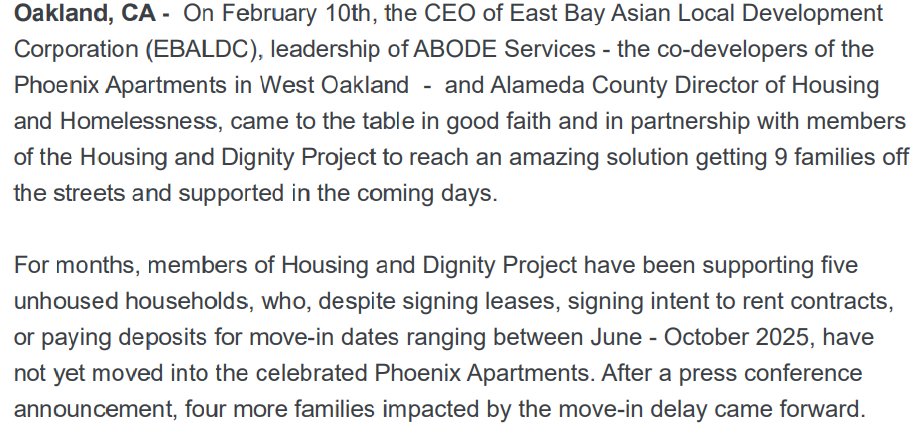
Now, EBALDC's The Phoenix, a Homekey-funded affordable housing project in West Oakland, co-signed and vouched for by the City throughout various stages of pre-development, is still shuttered and surrounded by chain link over a month after its ribbon-cutting ceremony. The Phoenix project had already signed on tenants to occupy the units, many of who are transitioning out of homelessness and others who have been on long affordable housing waiting lists—now those residents are in housing limbo.
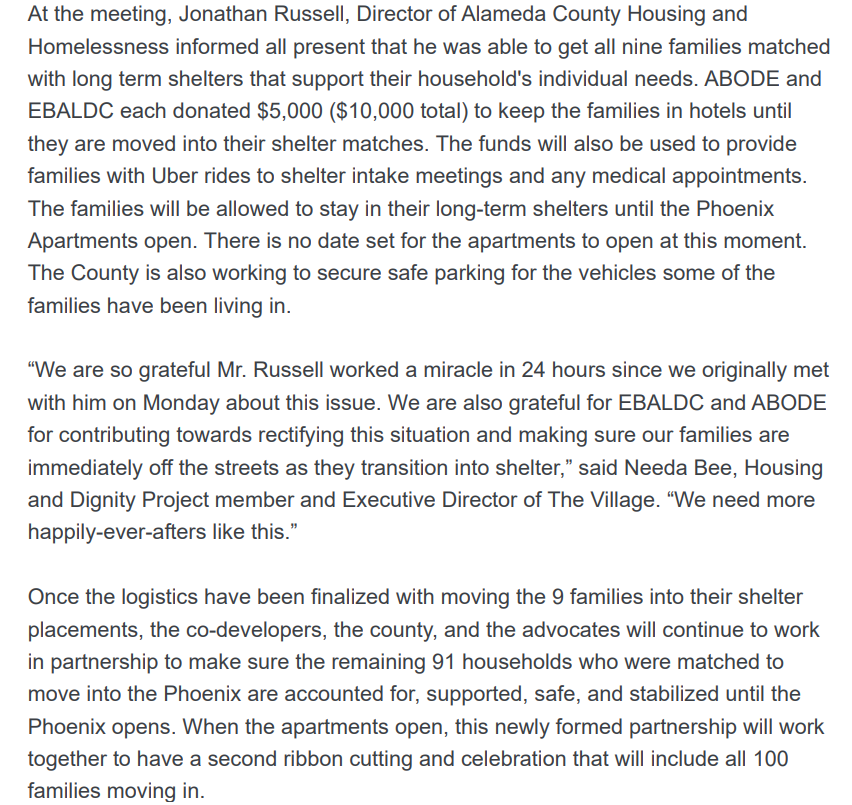
A consortium of housing and homeless advocates–The Housing and Dignity Coalition—helped draw attention to the plight of several homeless families that had been accepted at the site over the past several months, only to have to tread water while the doors remained closed—those prospective tenants also lost their potential to accept other affordable housing opportunities and even homeless services. Once they accepted the offer at the Phoenix, they were marked as housed, and thus not eligible for County and City homeless services.
Through the lobbying of advocates, some of those families were recently able to find alternate accommodations acquired and paid for by EBALDC [and the project partner that will run the complex, Abode] and facilitated by the City and County, but there’s still no word about when the current site will open. Meanwhile, nearly a hundred households that had accepted housing at the Phoenix wait in limbo.
CBS News Bay Area reported that the non-profit owes 2 MM to a contractor this month, and the advocates have also suggested being underwater on payments is the primary cause of the instability.
3) Mayor Commemorates the Life of Rev Jesse Jackson and Honors Oakland-born NBA Slam Dunk Contest Winner, Keshad Johnson, at Council
Mayor Barbara Lee took the podium at Council chambers during announcements to speak on the passing of Reverend Jesse Jackson and to congratulate the NBA Slam Dunk Contest winner, Keshad Johnson. The honorific for Johnson, though not agendized, had been planned to be given during the announcements section of the agenda, but Jackson’s passing that same morning expanded the address. Both had extensive connections to Oakland—Jackson campaigned with Lee in Oakland during his 1980s presidential campaigns and Johnson is an Oakland native. Lee described Johnson's leap over E-40 for the win, which must be seen to be believed.
Here are snippets of Lee’s remarks for both Jackson and Johnson.
a little more on Johnson pic.twitter.com/3EqHPZzpxm
— The Oakland Observer (@Oak_Observer) February 17, 2026
Mayor Lee congratulates Keshad Johnson at the February 17, City Council meeting
— The Oakland Observer (@Oak_Observer) February 18, 2026
Mayor Lee Commemorates Jesse Jackson at February 17 City Council meeting
*The OPC appointed Lawson permanent CPRA Director several weeks after making these comments
**per City report, this forgiveness is basically cost-neutral in anything but the extreme long-run...a reader points out that the loan forgiveness was actually for two EBALDC-owned buildings that were under-water, so some minor edits were added. Technically, this is the third instance of being underwater on a project in six months.
Comments ()