Changes to Homeless Policy Urged by State Body Added to "EAP," But Prohibitions on Vehicular Encampments Remain

The new version of a proposed City of Oakland “Encampment Abatement Plan” [EAP] policy that will be introduced at December 2nd’s Council meeting shifts significantly from the zero-tolerance positioning of the original proposal introduced at the September 9 Public Safety Committee meeting. The changes reflect significant feedback from the Interagency Commission on Homelessness [ICH] and the California Housing and Community Development Department [Cal HCD], the state bodies that review and approve the Homeless Housing, Assistance and Prevention [HHAP] grant worth tens of millions of dollars to Oakland and Alameda County [ALCO].
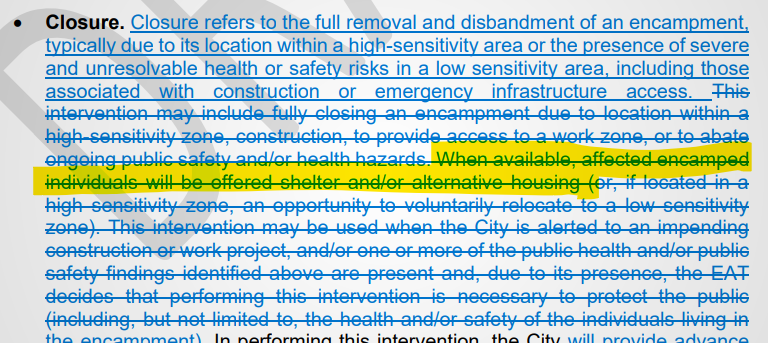
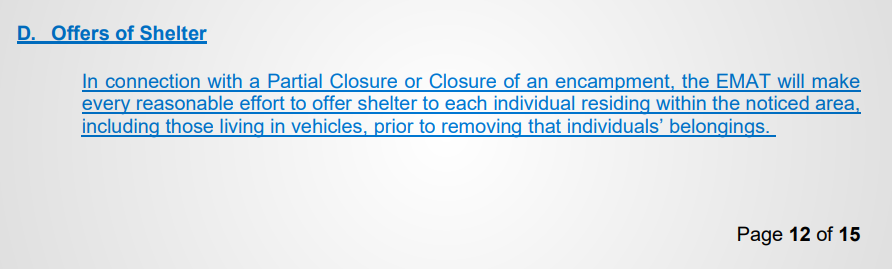
In the original EAP, a focus on homelessness "abatement" emphasized removing encampments with no offers of shelter, a big shift from the current Encampment Management Plan [EMP] it is intended to replace. That policy approach seems to have softened now to conform with ICH criticism of the proposal; for example, the EAP now includes requirements to make "reasonable efforts" to offer shelter and establishes geographic areas in Oakland where homelessness is ostensibly allowed. However, some of the EAP language remains, and the policy, if passed, would still give ample on-paper flexibility for the City to classify encampments as targets for closure—especially for vehicular encampments, which are excluded from any considerations as encampments in the policy.
EAP's Indifference to Shelter Offers Becomes Explicit Requirement to Prepare Shelter Options and “Make Every Reasonable Effort to Offer” Shelter
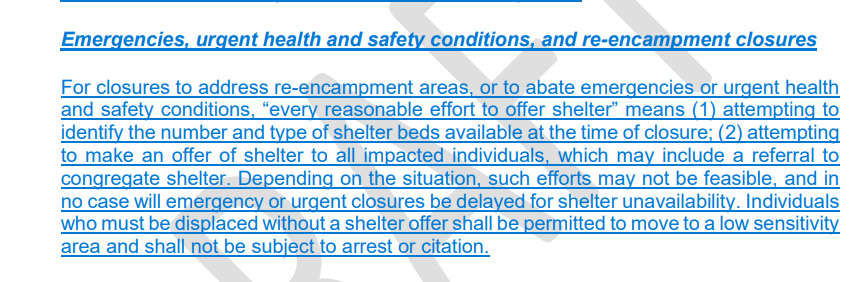
The EAP now includes direction to make “every reasonable effort to offer shelter” in all encampment evictions, including requiring offers in some form to be made even in emergency situations. In the new version of the EAP, the City would keep its procedure of scheduling non-emergency encampment closures around available shelter capacity, instead of treating shelter for displaced individuals as an afterthought in the eviction process. The original EAP proposed that closures would be planned with no regard for shelter capacity, and shelter only offered “when available.”
"Low-Sensitivity Zones" Now Explicitly Areas Where Encampments Are Nominally Allowed
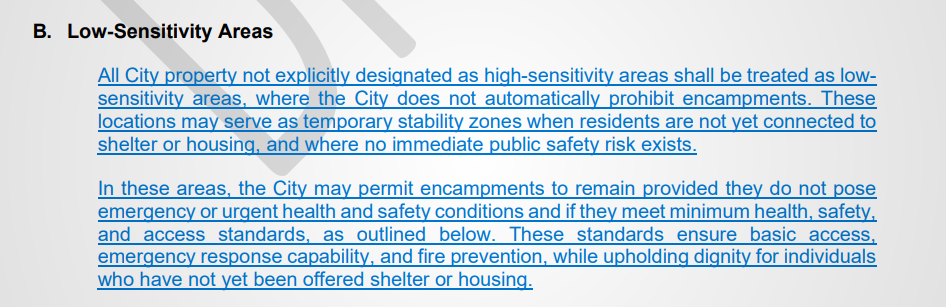
Many changes in the new EAP are almost certainly a reflection of the ICH guidance that require cities to allow geographic areas where homeless residence is nominally allowed. The new policy has pivoted from its approach to high- and low-sensitivity locations, for example. "Low-Sensitivity Areas" are considered to be any area that is not categorized as "High-Sensitivity," but the new text makes it clear the City must designate "Low Sensitivity" areas as locations where the homeless can find respite from encampment closures. The original EAP had described these areas as subject to closure, but with a lower priority, but they are now called “temporary stability zones” in the new text with the assumption that encampments in those areas will not be pursued for closure if they meet criteria in health and safety evaluations.
The EAP's "High-Sensitivity" areas are similar to the list in the EMP rubric that includes parks, critical infrastructure, areas where children play or are educated, but with new EAP additions that are more explicitly defined—a broad set of criteria would require encampments to have a smaller footprint and conform better to ADA requirements, among other restrictions.
Other changes to the EAP:
—the City Administrator would now be required to provide a list of city-owned properties that could be used as shelter, safe parking sites or areas where encampment is allowed in low sensitivity zones
—includes guidance that favors mitigation over closure in low sensitivity encampments that don’t meet health and safety standards
—restores EMP text stating residents will not be cited for simply being homeless. The original EAP text had deleted these passages.
—provides explicit requirements on storing the property of homeless individuals who are being evicted, or experiencing a mitigation; these were missing from both the EAT and EMP and likely reflect the Miralle settlement of 2022.
Some of the EAP Changes to the EMP Remain in New Version
In the revised EAP, as in the original draft, a vehicle used as a dwelling is no longer recognized as an encampment for the purposes of the plan, and is subject to tow under most circumstances if the vehicle lacks registration and/or is parked illegally—a big change from current EMP policy. The state HCD and ICH appear to endorse this view, because the red line edits for the original EAP from ICH did not cross them out.

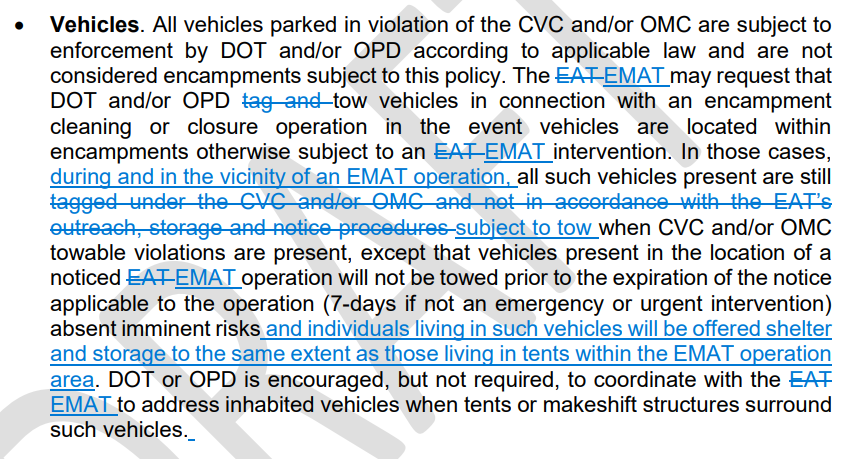
In the new EAP proposal, there is a vague implication that vehicular encampments in “low sensitivity areas” will not be actively pursued for closure, but rather may be a focus of potential mitigations. Other city agencies directing tows based on lack of registration or illegal parking [most likely OPD] are urged to contact the EMAT in an effort to provide alternative shelter or to redirect to a low sensitivity area instead. But those mitigations appear discretionary.
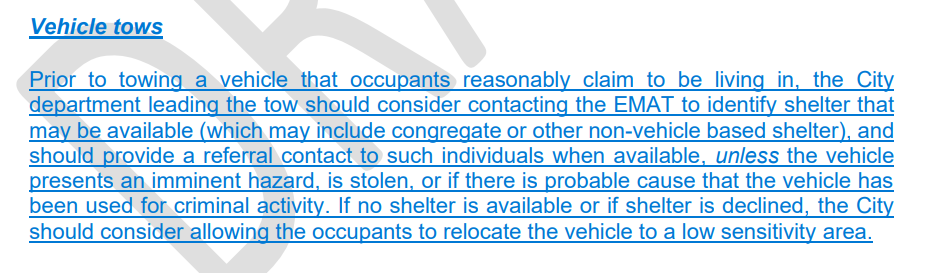
Homeless advocates for over a year have been documenting cases that show that the approach to vehicular encampments is already in effect, regardless, with several large vehicular closures having taken place in 2024 and 2025—this publication has observed at least one as well, with another threatened.
The EAP’s rubric on Emergency and Urgency cleanings and closures also remains in the new EAP, with encampments subject to emergency closure with little notice, and “urgent” closures having between 24-72 hour notice. All other closures would still have the city’s current 7-day notice. This may simply be an issue of incorporating a Mayoral executive order by Mayor Sheng Thao in 2024 that also directs City staff to conduct “emergency closures” with little notice and has been standard procedure since.
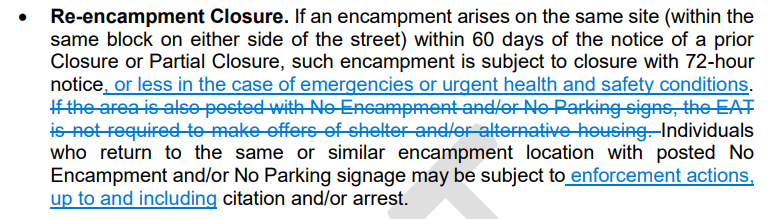
The original introduction of “Re-Encampment” Enforcement remains in the new EAP, but with slight modifications, including citation and arrest as a range of other unspecified “enforcement actions” and a requirement to make "every reasonable effort to offer shelter" during the closure. In notes made public by the City Attorney's Office, EAP co-author Brooks says that the section was added with full knowledge that OPD lacks the capacity to enforce the provision.
Emails Show Rules Committee’s Original ‘Urgent’ Scheduling of EAP Occurred As State Warned Approving the EAP Would Cost City/County Joint HHAP Grant Worth a Combined $44MM
Emails obtained via records request by OO show that state officials had warned the City and County by August that the then-current text of the EAP could cost the City and County their joint HHAP grant if adopted. Both the city and county have relied on the state HHAP funds for nearly a decade to fund homelessness interventions and have never lost a grant opportunity. By August, as the City/County were completing their joint HHAP Round 6 application, the EAP draft had circulated internally in both jurisdictions as well as at the state ICH.
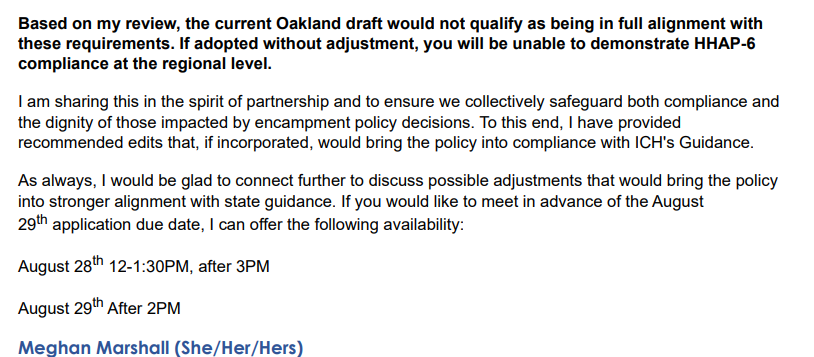
The EAP, sponsored by D7 CM Ken Houston and authored by D6 CM Kevin Jenkins’ Chief of Staff Patricia Brooks, was scheduled by Jenkins in his role as Rules Chair with a claim of urgency beginning in late July, ahead of Council recess. At that time, Jenkins said he would create a Special Public Safety Committee meeting for the EAP with an early return from Summer recess for Council. But emails show that by August, the ICH strongly advised that the City and County were at risk of losing funds in the HHAP 6 round if Oakland's City Council approved the EAP as it was then drafted. The ICH creates state encampment policy guidelines and reviews jurisdictional homelessness policies for the HCD on HHAP to ensure they are in compliance—a prerequisite for winning the grant. Meghan Marshall, the Executive Director of the ICH, wrote to Homelessness policy principals Sasha Hauswald at the City of Oakland and her counterpart at the County, Jonathan Russell, that the EAP, if approved, would likely cost the City and County their HHAP funding, worth a combined total of over $40 MM.
“Based on my review, the current Oakland [EAP] draft would not qualify as being in full alignment with these requirements. If adopted without adjustment, you will be unable to demonstrate HHAP-6 compliance at the regional level,” Marshal wrote in an August 27 email.
Though likely common knowledge to Council members and city officials by September, the precarious position of the City/County HHAP 6 grant application only became public knowledge during a County Board of Supervisor’s meeting the day before the EAP was heard by the Public Safety Committee, when the County’s HCD department warned the BOS during live session about the ICH critique affecting the joint HHAP 6 application.
At the EAP-focused PSC meeting in September, Brooks argued that the ICH’s review would not be the last word on the HHAP application or necessarily affect accessing the grant.
“The recommendations from Cal ICH are just that, recommendations,” Brooks told Public Safety Committee Chair Wang when asked if passing the EAP would be gambling with the HHAP funds. Brooks claimed that CM Houston had spoken with Governor Gavin Newsom, who’d given a favorable reading of the EAP and then argued that “HCD is under the governor,” suggesting that the ICH’s opinion could be waived by the parent agency administering the grant. Eventually, the Committee members at the September meeting tabled the legislation regardless, suggesting that it could return with amendments sometime in October.
But despite Brooks’ claims that the ICH guidelines are considered discretionary by HCD, a later October 14 email to City and County staff from Hauswald confirmed HCD's position that if the EAP was approved it could cost the region its HHAP grant—even if the EAP was passed after the grant was awarded.
“Today we met with folks from CA State, as they requested in the attached letter, to discuss SAFE, HHAP-6, and encampment management policy in Oakland…HCD emphasized that amendments to the encampment management policy or whatever encampment practices we are effectuating on the ground moving forward cannot be in conflict with Cal ICH encampment guidance principles. If that occurs in the future, it will be cause for halting or repealing HHAP-6 funding,” the email reads.

Despite confirmation by HCD that the EAP would put the Oakland and ALCO HHAP application at risk, just two days later, on October 16, Houston again tried to schedule the same version of the EAP he had presented in September with no visible amendments. After some protests from other Rules Committee members over the October 27th date, due to issues of quorum, Rules Chair Jenkins declined to schedule it on the day, saying he'd investigate the options. “I'll do my best to address everybody's concern and to make sure that it gets the urgency it deserves,” Jenkins told other CMs.
An email sent from Jenkins to the Clerk’s office shows that 5 days later, Jenkins scheduled the Special Council meeting for the 27th, again at 9am. At the Rules committee when the EAP was formally introduced by Houston for that special meeting, however, the other CMs on the Rules committee balked at the short lead time, which would have required amendments to the EAP to be submitted within four hours and with one business day thereafter to review. Jenkins chided the CMs for not scheduling the item to the meeting, which he claimed Houston had polled for a quorum of availability, again arguing urgency to schedule the item.
Eventually, Houston gave up on the trajectory of special meetings with short scheduling and agreed for the December 2nd meeting. Despite claims by other CMs that they would add amendments, however, only one CM amendment, from CM Charlene Wang, has been added to the packet. It's unclear if other CMs' amendments were incorporated into the EAP–which, in its changes, reflects a different tone and writing style from the original. Wang’s amendment would direct OPD and OakDOT to develop “SOPs” that would “avoid towing vehicles where children are living, absent imminent risks to health or safety.”
Comments ()