
Finance Committee
Q2 Revenue and Expenditure Report
This year, the City decided to forego the presentation of the first quarter [Q1] revenue and expenditure report, a very preliminary analysis of spending and revenue patterns in a new fiscal year. Q1 from the current year is usually paired in the same report with the Q4 report from the previous fiscal year that ends July 1. It takes time to get these reports together and audited, and Q4 isn’t really done until the calendar year’s end.
Generally, the Q4 report from the previous fiscal year itself is more illustrative of how the coming year will go, especially because the final answer about a carry over of a deficit or surplus is answered, along with spending and revenue patterns from an entire recent year of activity.
After skipping the Q1 usually presented in November or December, the Finance Department gave the Q4 report in February. As this publication reported last month, fiscal year 2024-25 ended with a sizeable budget surplus, which forwards into this year’s budget as the initial fund balance—much of which has to go to required expenses, funds and carry forwards [which are subtracted from the revenue side of the equation].
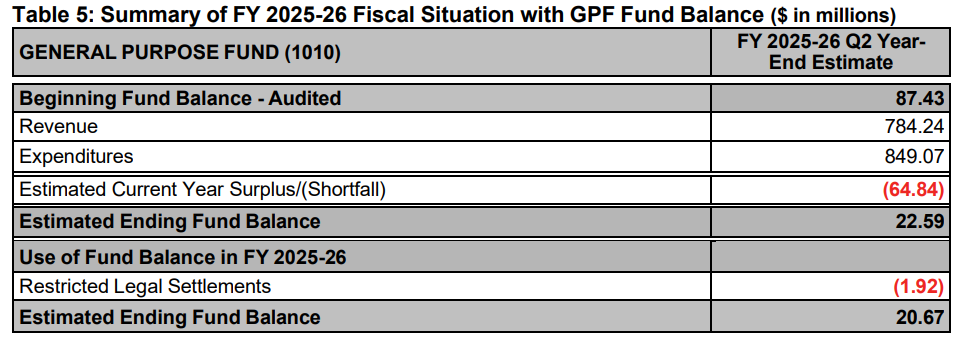
Much of last fiscal year’s surplus was due to historic freezes and cuts and urgency spending from special funds from the “contingency” budget that took effect as the second quarter of the last fiscal year unfolded. The contingency budget featured a historic series of spending controls over OPD, without which, according to Finance Director Bradley Johnson in his Q4 report presentation, balancing to surplus would not have been possible.
That surplus will nullify what would have been a budget shortfall of about $64.8 MM in this current fiscal year and leaves an actual positive projected balance at the end of the FY 25-26, according to the analysis, of about $20 MM. The current projection suggests that the OPD will come in at or even in surplus of their budget. But that's largely due to over budgeting for sworn positions—OPD was budgeted at over 60 positions more than any credible staffing projection would have yielded, and that extra funding will be used to pay off what is certain to be a typically high overtime figure. OPD is usually the driver of expenses in expenditure overages, but this year the expenses are projected to come in at around only $4 MM above projections due to overbudgeting. The problem here is that Oakland did not forecast its revenues nearly well enough to balance the spending, with the biggest outliers in property tax, sales tax and utilities taxes. The outcome again is troubling—the City still has no real rein on its police spending, despite pumping up its personnel budget to create an illusory positive balance, and will have even larger expenditures next fiscal year with only the promise of a new parcel tax and not much cushion otherwise to patch the difference.
Ordinances Amending Salary Schedule/Creation of New Roles
Worth watching out for this one as an alternate battlefield on which the struggle to shift Parking from OakDOT to OPD and Finance may play out. The Parking Administrator position is a crucial part of the plan to bring parking services out of OakDOT, and while Council has no role over the transition, it is required to weigh in on the creation of this job. The legislation also concretizes a new position in the CAO of Constitutional Policing Administrator, currently filled in an interim role by the former Police Commission Inspector General, Michelle Phillips. The City has made this a crucial role in getting out of the Negotiated Settlement Agreement and much of its presentation at the last case management conference, which was positively regarded by NSA Judge Orrick, was based on its continued existence.
There's also a report on city wide staffing
Public Works and Transportation
Ordinance to Strengthen Illegal Dumping Fines
The ordinance brought by Zac Unger would raise the current fines, starting with $1,500 for the first offense and criminalize transporting waste in a vehicle without a license plate. Fines would go through an administrative system which is faster and easier for the city than a criminal one. But though the legislative report mentions the potential for public works’ anti-dumping camera system to be an enforcement vector, its spare on how the law would be enforced.
Unger’s legislation also relies on a state proposed law currently cycling through the process, Arreguin’s SB1218; there is also a symbolic resolution to support that legislation.
BPAC Annual Report
OO will live report the BPAC presentation
Aerbits Drone Camera System Pilot
A quasi-automated aerial drone system is not mentioned in Unger’s new dumping law—the proposed pilot program would use Aerbits' drone, which can fly at about 120 feet over a designated area and uses AI to identify dumping sites for City remediation. An operator and another staff member would operate and supervise the drone, and are the only individuals that would have access to a live stream and monitor output. The two authorized personnel operating the system would be the only human's who can view the raw visual data, thereafter, the system's AI auto-redacts humans, addresses, license plate and other data before dumping permanent images. the retention period would be 6 months. The technology promises only to deliver images that the AI is trained to recognize as trash. The use policy was reviewed and approved by the Privacy Advisory Commission.
Community and Economic Development
RAP adjustments
Housing and Community Development proposes several changes to Oakland’s tenant and landlord rules from a Rent Adjustment Program board recommendation:
1. Allow tenants to file rent adjustment petitions with the Rent Adjustment Program (RAP) at any time during their tenancy instead of during the current 180-day period contesting a rent increase or 90-day period for claiming decreased housing services, while still retaining the three-year limit on restitution awards provided by the Residential Rent Adjustment Ordinance
2. Require that an owner provide evidence of a current city business license and payment of the RAP service fee or exemption from the RAP service fee, and RAP registration among other requirements before filing a rent petition or contesting one.
3. Modify the Rent Adjustment remedies section including increasing the damages remedy in civil actions against owners
4. Remove the restriction in the rent regulations on selection of the Rent Board chair and vice chair being limited to the undesignated Rent Board members so that either owner or tenant representatives could be also selected as chair and vice chair.
There’s also a fine tuning resolution on RAP officer appointments
Life Enrichment Committee
Citywide Purchasing for Human Services, Parks and Rec
Cooperative agreements were found to be a leading vector for contractor discrimination in the City’s recent contracting disparity report, albeit those under $250K that are under the total discretion of the City Administrator. These would normally require Council approval, but this one action would approve them going forward. However, the operative problem, having another jurisdiction choose the City’s contractors, appears to be the same. We’ll see if the LEC has anything to say about this in that regard.
Purchase of Future Hoover Library Building
After many years of resident lobbying for a library branch in the area, the City is set to approve the purchase of a building for it. But funding and other issues would be yet to come. Ironically, the building is the site of the Community Foods supermarket that once held great promise for the area, but shuttered within three years
There’s also a Library Commission report
Public Safety Committee
OPD Staffing Report
OPD’s staffing report, current as of late February, shows an extended high attrition rate and low academy completion rate that combined has led to the plummeting police numbers. 30 officers have left since November, 2025 for example–an astonishing figure that's nearly equal to the total number of academy graduates expected for the fiscal year's worth of academies.
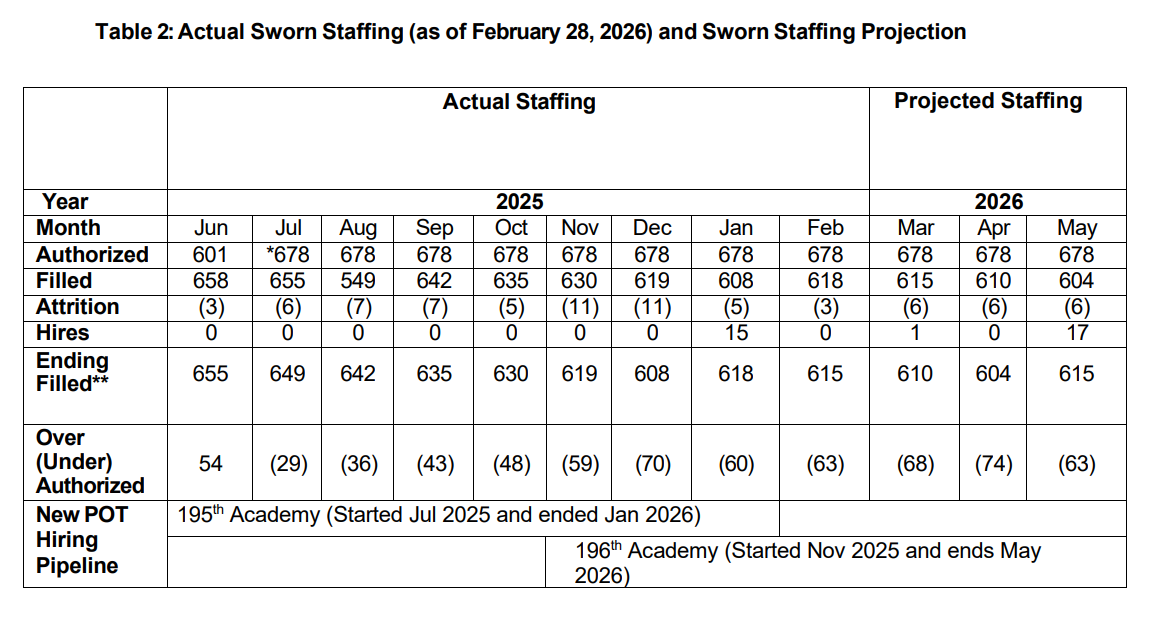
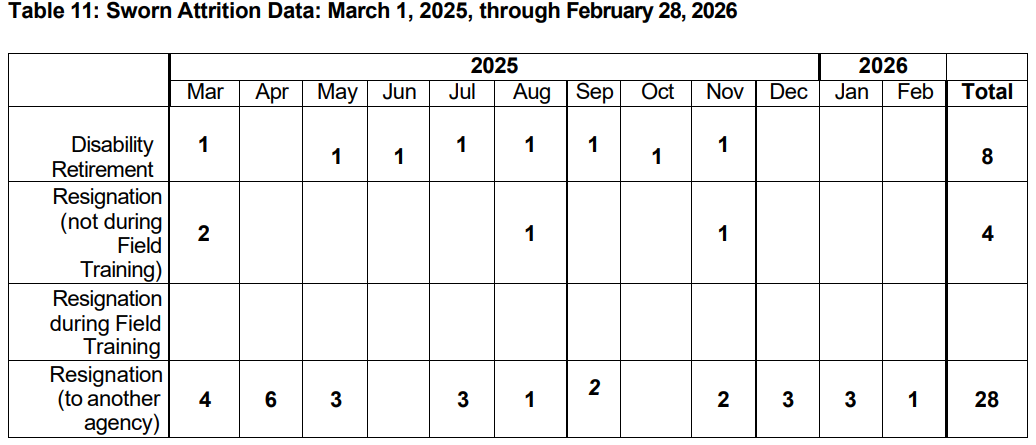
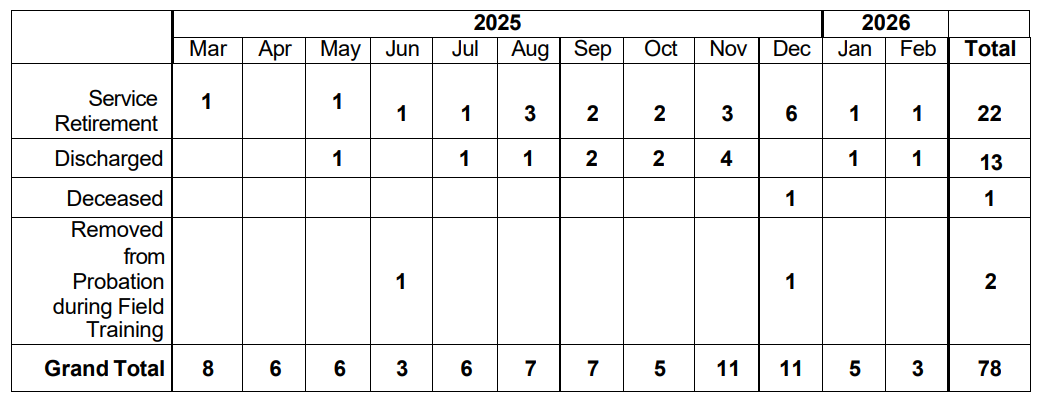
Several factors to note above all others in the exits from OPD. One is the historically high figure for migration to another police agency since last March—at 28 it’s as many as the previous two years combined.
A questionable presentation of data follows the numbers, citing the "top" rationales for leaving, but not actually citing the data. OPD argues then that officers are leaving due to the fear of heavy discipline and the negotiated settlement agreement, but gives no data or description of what "top" means.
13 officers were terminated, per the data since that same date, another high water mark. Retirement remained high with 22 officers retiring during that same period.
GPS Tracker
This initially looked like the OPD’s own GPS system that would allow the City to track individual officer activities and increase 911 response times. But it’s not—that’s been trapped in an OPOA-initiated quagmire called “meet and confer” that can last years, even though the actual use policy was approved by the Privacy Advisory Commission years ago. This use policy is for a GPS surveillance system that is used with a warrant to track a suspect’s car—although OPD can use it in exigent circumstances without a warrant, per the use policy
Comments ()