
--it isn't easy putting this preview together every week without fail, but OO is the only publication even trying to keep you informed about what Council gets up to before the legislation hits the full meetings. In five years of doing this work, it's never been as important.
Finance Committee
Q4 Report Reveals Surprising Positive Budget Balance After Turbulent Years of Spending Imbalances
After years of headline news about Oakland’s struggling General Purpose Fund budget, the City avoided a budget overage in the General Purpose Fund for the first time in at least 5 years and even managed to have a surplus of $16 MM—originally over $70 MM on straight revenue to expenditure math, but whittled down after carry-over and other requirements.
On the revenue side, Oakland benefitted from the Real Estate Transfer Tax from a windfall large property sale; experienced higher than typical business license revenue owing to more stringent collection practices; and increased revenue from parking and other fines. But big indicators of continuing economic trouble were seen in sales tax, transient occupancy tax and parking tax, which all performed under expectations.
On the expenditure side, the City came in under projections as well. A plan to shrink the City’s police budget by a significant amount failed to meet the target, but ultimately limited the chronically over-spending OPD to a lower than typical overage of its adjusted budget. Cost-cutting, budget reductions, and a hiring freeze kept other services costs low, balancing out the overage for OPD and OFD. A cost-cutter for OFD was removed early on in the budget year due to public pressure. Nearly every department spent under its budget, with the exception of OFD and OPD, but the strain on services city wide has been palpable.
Regardless, the City still faces a large budget gap in the upcoming budgeting for the next fiscal year of the biennial FY 25-27 budget, where Council and Mayor are relying on an as yet unwritten and unauthorized parcel tax ballot measure to shore up a $40 MM gap in its budgeting. As usual, the City also faces a structural deficit as its spending requirements are higher than revenue sources, but the parcel tax could help work toward that balance should it pass. The parcel tax ballot measure appears like a gamble, and recent reports suggest it factored into some of Oakland's credit downgrading—but Oakland generally passes such measures by wide margins and it would help stabilize the City's finances going forward should it pass.
The Annual Comprehensive Financial Report compiled by Macias, Ginni, et al, is also on the agenda, the requirement that shows the City’s financial statements are accurate and verified, and is necessary to validate the budget for bond sales and credit ratings.
Public Works and Transportation
Construction Contract Amendment for McGuire And Hester, Inc. Pavement Rehabilitation from 25 to 27.5% of the original $19 MM contract
Oakland’s paving contractor McGuire and Hester is getting an increase to its change order limit on its pavement contract—the additional amount a contractor can charge over the initial contract due to unforeseen complications or additional work. The money appears to have already been allocated, and just requires an approval from Council—the City says that the scope of work was not adequately presented to the contractor, requiring additional work.
Parking Transition Report
The secretive process followed by the City Administration in reorganizing parking enforcement from OakDOT to OPD and the Finance Department will have a public airing after many public complaints from staff and transportation advocates. CMs Rowena Brown and Zac Unger requested the report after advocates and city employees in OakDOT demanded a more transparent process.
The Finance Department argues in its report that its proposed reorganization will keep policy and design in OakDOT while shifting collection and administration of fines to Finance. Finance also argues that OPD already deals with most of the abandoned car calls, and OPD would simply be in charge of the process, while non-sworn employees would handle the day to day activity.
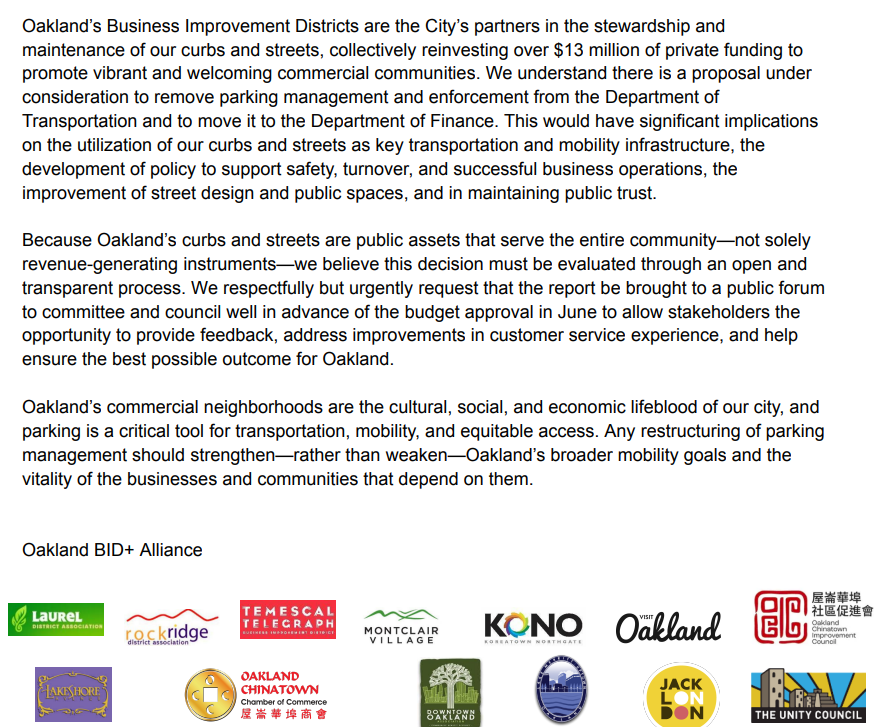
Transportation advocates say that embedding administration in Finance with a focus on generating revenue will shift the impact of OakDOT’s policies and could interfere with keeping up with the City’s current ADA consent agreement. While OakDOT ostensibly focuses on design of public space for the public good, Finance and Revenue would seek instead to maximize the revenue generating aspect of parking design and enforcement. In addition to transportation advocates, the City’s Business Improvement Districts [BID] are also concerned about the move. And affected unions SEIU and IFPTE have complained about potential lost positions.
A parking enforcement manager says that the shift to Finance needs to be more critically examined pic.twitter.com/ZrhJs8GzUe
— The Oakland Observer (@Oak_Observer) January 15, 2026
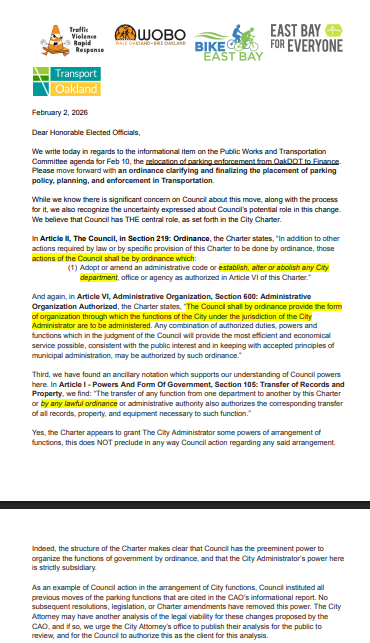
The variously aligned opposition—city labor, transportation advocates and Business Improvement Districts—agree that the process has been rushed and untransparent which is the genesis of the report request from Unger and Brown. But it's unclear if the Council will do anything about the transition even if it's within the scope of its powers.
Measure DD funds for Sogoratea Land Trust
A little less than one million in DD funds would go to Sogoratea Land Trust to purchase a hills-bound house and property adjacent to Sausal Creek to restore and maintain the local watershed.
Community and Economic Development
Impact Fee Report
Outcomes from recent changes to the Impact Fee schedule pushed by CM Jenkins and Wang last year are not included in the report, as they will be in next year’s. More on the report during the meeting.
Code Enforcement Report
More on this during the live reporting.
Life Enrichment
Contracting Disparity Report
This long-awaited city contracting disparity report won’t be a surprise to most who’ve followed the issue over the past several years—the city has a copious and historical deficit in awarding contracts to non-white contractors, especially Black contractors. And the disparity persists in every area of the City’s activity and across contract amounts, including in the one area of municipal contracting most open to non-white contractors, sub-contracting from a prime contracting winner of a city bid.
The report analyzes data in the five year period, from 2016 to 2021, during which Oakland awarded nearly half a billion in contracts for everything from infrastructure construction to goods and services. But only a tiny percentage of that went to Black contractors. As an example, only 8 construction contracts went to Black prime contractors amounting to a negligible amount of the total expenditure—.3% of the total $214 MM. Non minority males received 70% of those contracts, and 84% of the monies. Latino and other groups performed slightly better than Black contractors, splitting the rest. Black contractors got slightly more of other kinds of contracts, like goods and professional services, but still received only a fraction of the contracts.
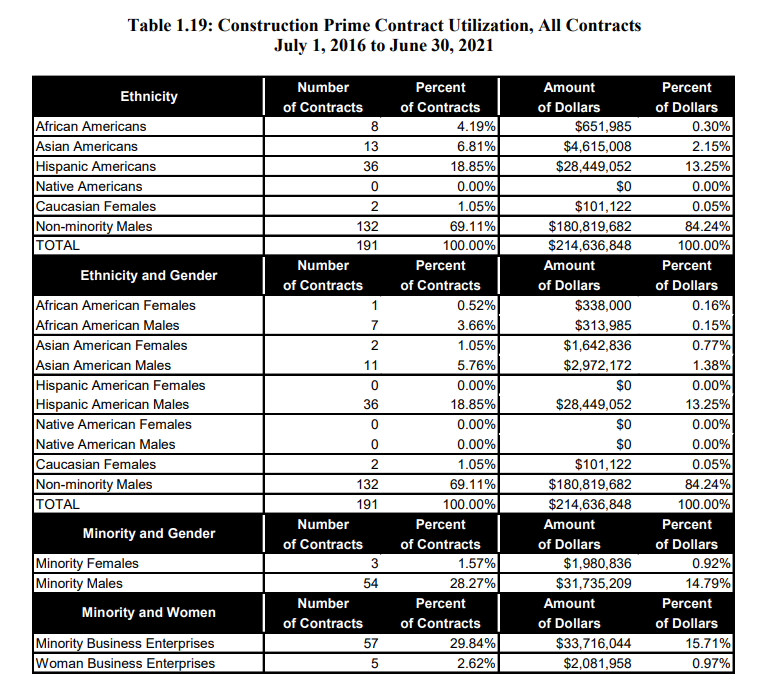
Mason and Tillman compiled the report, and CM Carroll Fife was instrumental in getting the CAO to carry out the study. Here's the study:
Biennial Grant Contracts
Contracts for the grant agreements approved in the 25-27 budget come before Council for authorization.
Public Safety Committee
Public Safety Committee Vice Chairman Appointment from Councilmember Houston
D7 CM Ken Houston appears to be nominating himself to the Vice Chair position of the Public Safety Committee. The position of Vice Chairs is a new one for Oakland's Council committees that was added in recent rules updates approved by Council in December. But the process for deciding if the Committee even requires one or how to nominate an individual is not specified in the new rules. Generally city bodies agendize an open ended vote for the Vice Chair, where no candidate is specified and members nominate and vote from the body. The President of the Council initially appoints the Chairs of each committee with a slate and votes taken during a regular session.
ALCO BOS Will Consider Extending AC Sheriff's "Piggy-Back" Contract with Flock ALPR to Mid-Year
The ALCO Board of Supervisors will consider a contract extension for the Alameda County Sheriff's Office [ACSO] “piggyback” contract with Flock for unincorporated areas of Alameda County. ALCO Sheriff originally piggybacked a contract with Flock for ALPR devices and service for unincorporated county areas. As that amended agreement actually expired last year, the ACSO is seeking to retroactively renew the contract with Flock with an end date of 6/30/2026 to continue using the devices. ACSO’s Flock arsenal also includes Flock drones.
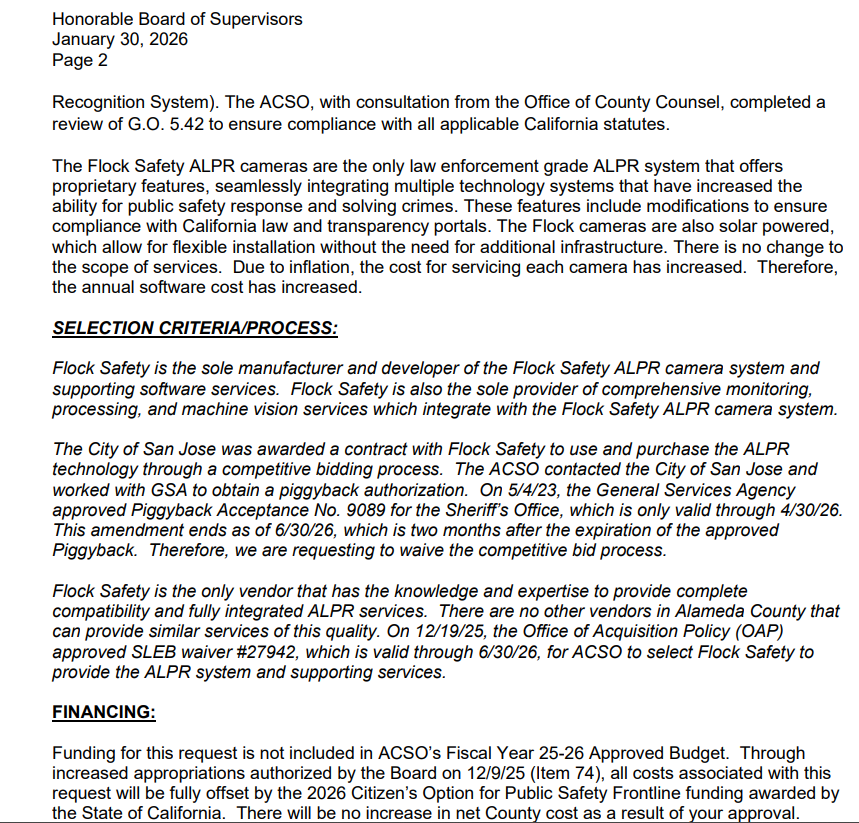
Privacy and surveillance law advocates note that ACSO has violated state laws on the use of ALPR by unlawfully sharing information and are asking the County to pause and shut down the devices to avoid lawsuits and protect residents—surveillance and privacy watchdog organization Secure Justice states in a letter to the BOS that this number is at 2.6 MM and rising. Advocates also point to the growing number of jurisdictions shutting down their Flock camera. You can read the Secure Justice letter to the BOS below, where the organization signals it's ready to sue the County over multiple violations.
Comments ()