
Ken Houston’s Encampment Abatement Policy [EAP] proposal is back on Tuesday—again at an unusual time, 9:30 am. Houston’s attempts to change the policy and polarity of the City’s current Encampment Management Plan[EMP] have been in free fall for months, as his bombastic soliloquies and brusque style seem to have soured some CMs to his efforts—excluding Council President Kevin Jenkins, of course. Jenkins, who loaned his chief of staff to Houston’s office to write the policy, has helped the EAP along in ways visible and less so since last year. In this most recent iteration, Houston scheduled a 9:30 am special meeting ahead of a regularly scheduled special meeting at 3:30pm, just for the EAP, several weeks ago. It’s the second time Jenkins has chosen such an unusually early hour to hear the EAP. Last September, Jenkins scheduled a last-minute special Public Safety Meeting at 11am which ended inconclusively. But this time, it’s a full special council meeting, where the council could vote to pass the EAP as it stands or in some amended form.
It’s unclear what kind of support Houston will have for the EAP on Tuesday. Several CMs have signaled less enthusiasm for Houston’s policy as time has gone on—Rules Committee members Janani Ramachandran and Rowena Brown have declined Houston’s often frenetic attempts to get his EAP scheduled directly to Council more than once since it was first introduced last September. Those CMs seemed far more open to Houston’s rhetoric and policy a year ago, but the shift may be less about the policies themselves than the way Houston has tried to lead on homelessness without including other CMs and attempted to outrun the establishment of a CAO Administrator level “Homelessness Solutions” director which was announced around the same time his policy was first agendized last Summer.
In October, Jenkins scheduled a special meeting to enable the introduction of Houston’s EAP again—and public records requests from this publication reveal he did so and received confirmation from the City clerk via email during a Council meeting, though he did not make the existence known to the public at that time. When Houston subsequently introduced the EAP for scheduling to that meeting, it meant that CMs would have less than a day to add amendments, and the public would have only through the weekend to read new texts. The Rules Committee, and specifically Ramachandran and Brown declined to schedule the EAP to that meeting with those stated reasons, despite vehement protests from Houston [via a phone held to the podium microphone by his staffer].*
In February, those same Rules committee members again balked at Houston's request to schedule Houston’s EAP directly to Council and suggested it go to Life Enrichment Committee. Following that failure, Houston attacked other officials and electeds in Facebook posts, which he later deleted.
Life Enrichment Chair, CM Carroll Fife, declined to accept the scheduling and the EAP was in limbo for some time after, but Houston’s most recent—and least provocative—plea via a staffer at the 3/26 Rules meeting to schedule the EAP to a special meeting was greeted with no discussion. A week or so earlier, Jenkins had scheduled the special 9:30 am Council meeting on top of an already scheduled Council meeting, and it was clearly intended for the EAP. Notably, the final relent on Houston’s efforts appears to have occurred as a permanent director to the Homelessness Solutions department, Cupid Alexander, was hired in late March.
Houston’s EAP prose and policy have shifted since his original presentation last summer and fall. Houston’s original proposal led with a seeming zero tolerance stance, embodied most visibly in his performative replacement of the word “management” with “abatement” in the title. The original EAP removed requirements to offer shelter to residents in encampments targeted for closure; criminalized re-encampment of previously cleared sites; explicitly removed vehicles from consideration as homeless dwellings; dramatically increased the scope of “high sensitivity” areas and suggested encampments in low sensitivity areas would also always be in danger of closure.
A central goal of the legislation appeared to be removing vehicular dwellings completely from the considerations adopted in the EMP, vastly expanding High Sensitivity areas and removing requirements for offers of shelter. In the end, the current EAP maintains those elements, but in a significantly modified form.
Critiques from ICH and Other Pressures Mold EAP Revisions
The tone and stridency of the original proposal triggered immediate concern from the state’s housing and homelessness authorities that emerged even before the legislation became public. The state Interagency Commission on Homelessness [ICH], a key body in the approval of HHAP grants, warned that the original language would risk compliance with terms for the 2025 grant, which both the City and County were counting on to fund ongoing homelessness plans. The ICH’s concerns stemmed exactly from the most visible goal of Houston’s policy, a zero tolerance orientation towards homelessness—ICH argued that to comply with state law and state policy, homeless people must have a place to exist in public where they will not face constant and immediate eviction, something that was not visible in Houston’s plan.
Indeed, the tumult around the policy and back and forth likely delayed the HHAP award until late December and almost certainly caused Houston and whoever else is co-authoring the document [as language and tone have changed considerably since last September] to re-write significant passages, changing tone and modifying some of the more strident proposals. A November proposal, which would have been heard during a regularly scheduled December 2nd Council meeting, had considerable changes to tone and some content. A visible embodiment of the retreat was the shift from "Encampment Abatement Team", to the "Encampment Management and Abatement Team" [EMAT], signifying a desire to have the policy now viewed as having something more to do with homelessness than just eradicating encampments [the EAT]. Houston’s new late 2024 EAP went from the original removal of shelter offers as a component of closure to making “every reasonable effort to offer shelter”, as another example.
But the ICH was still concerned about the “high sensitivity” expansions and an accompanying map from the existing policy which also seemed to show few low sensitivity zones except in the furthest reaches of East Oakland. Based on those concerns and the potential to lose over $20 MM in HHAP grants [and another $20 MM or so in county HHAP grants that would largely benefit Oakland] Council President Kevin Jenkins pulled the legislation at the start of the December meeting*.
In the meantime, the ICH eventually relented in its criticism, likely with the promise from the Lee administration that the critiques would be taken into account in a final policy—Mayor Barbara Lee subsequently made public statements that largely contravened the spirit of Houston’s zero tolerance proposal as well as her own and previous administration's ramped up closures. Lee’s interim Homelessness Solutions Administrator, Sasha Hauswald, also made several claims during a presentation to the City’s Homelessness Commission that seemed to all attendees to be a salvo against Houston’s policies—to the extent that she had to clarify she was not criticizing Houston’s plan. Hauswald told the Commission that with over 1,200 encampment closures over the previous year with no reduction in homelessness, "we need to do something different than the City has been doing in 2025".
New Language Adds More Stability to Low Sensitivity Zones
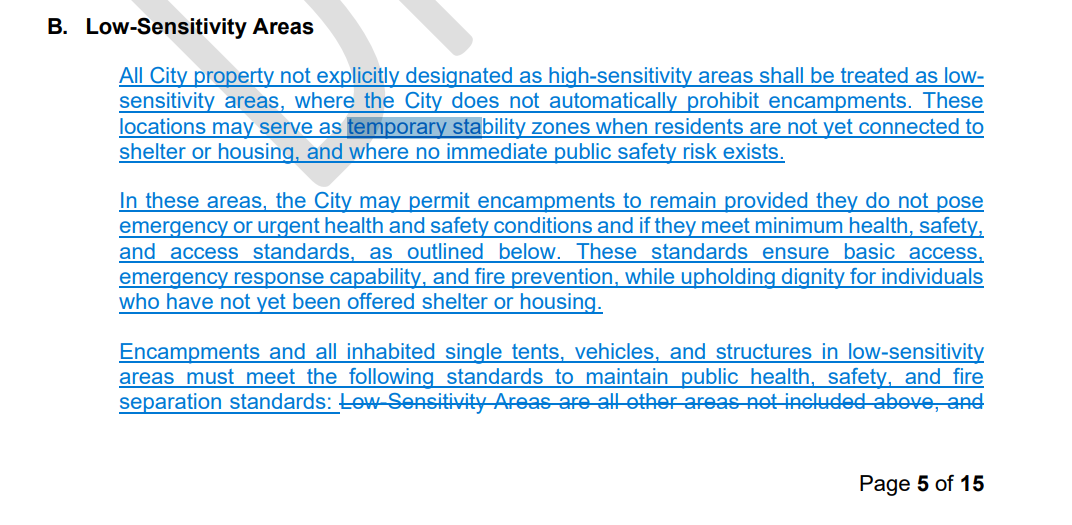
Houston has rewritten much of the “Low Sensitivity” text and definitions since the original presentation last year, likely to satisfy the concerns of the ICH about the lack of a defined area where homeless can be reasonably assured they will not be immediately or arbitrarily evicted. Newer versions since September include language describing the Low Sensitivity areas as “temporary stability zones”, new terminology that indicates a focus on rehousing, not eviction. The policy’s total prohibition on blocking sidewalks has also been removed, leaving ADA considerations only for significant barriers to pedestrians that would require them to enter the roadway to pass.
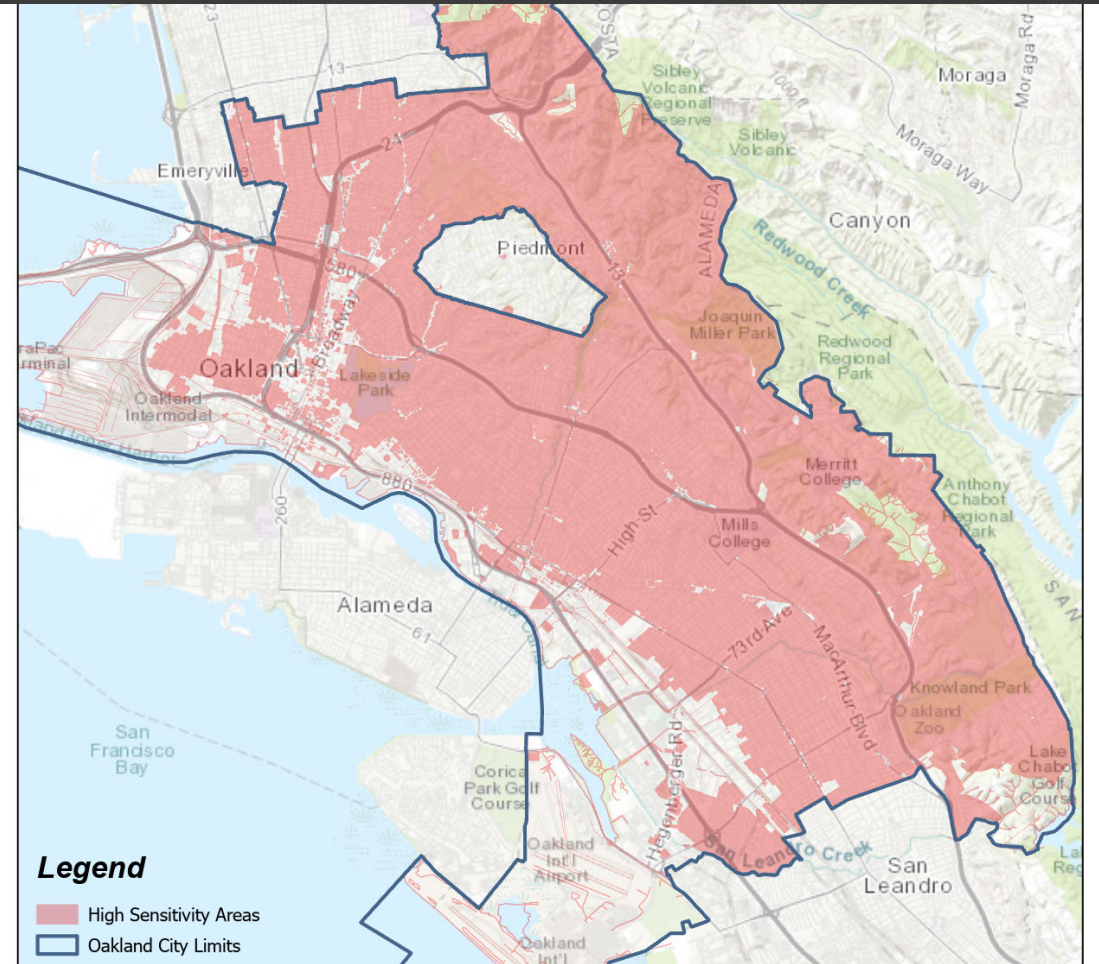
New Map Adds More Low Sensitivity Zones in Other Areas, But is Still Vague, Focused on East Oakland and Subject to Change by CAO
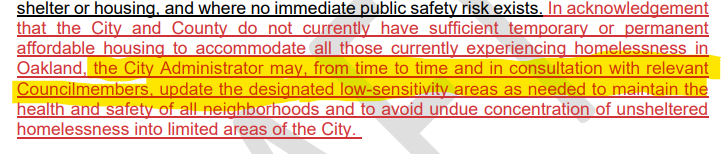
Another feature of the April EAP is a new map that identifies high and low sensitivity areas. The new map suggests areas in downtown, uptown and north Oakland as Low Sensitivity, but the vast majority of the low-sensitivity areas remain in West and especially East Oakland, and, significantly, in the flatlands. Despite recent claims from Houston that his goal is to share the load of low sensitivity sites, East Oakland’s flatlands appears to be the official place for homeless to go by his own design in the new map. Like the old map, the new one is not geolocation-enabled nor can it be enlarged for detail, leaving a blurry mess as general as the last. The policy seems to acknowledge the shortcomings of the map, because it essentially says that the map is not the final word on High and Low sensitivity areas. The newest EAP language would give the CAO the ability to "update" designations of Low Sensitivity areas. That could result in closures of encampments outside of the current guidelines if they lose the Low Sensitivity designation or increase the number and location of High or Low sensitivity areas—but the actual meaning is difficult to discern from the text. Importantly, it seems a City Council person on their own would influence the process outside of any open procedure.

Criminal Penalties for Re-Encampment Removed, Though Now Vague
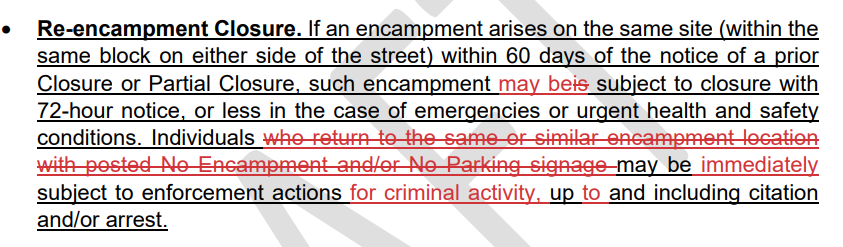
A central feature of Houston’s original EAP, criminal penalties for re-encampment, appears to have been removed as well, though it’s unclear what exactly is meant by the passage—a consistent feature of the new EAP is the creation of vague directives by changing only certain words in a text originally conceived with a different intention.
A new section of the EAP appears to direct the EMAT to "attempt to coordinate" transport for those relocating after displacement during closure.

These are all departures from Houston’s original framing of his proposals, which he often claimed would solve homelessness in Oakland—ostensibly through forcible evictions and denying almost all areas for encampments.
Many of Houston’s Most Impactful Policy Changes Remain, Now with Added Confusion
Since the City received the HHAP award, Houston has publicly claimed that he has been in dialogue with the Mayor’s office and the City Administrator’s office on changes. But though some of Houston's policies are altered and others removed, in apparent acknowledgement of ICH critique, many remain. The resulting policy that will be presented to the City Council early Tuesday morning maintains many of the most potentially impactful policies Houston originally proposed EAP. And, as always, Houston’s changes are built upon the structure that has existed as the Encampment Management Plan passed by Council in 2020, which had several vaguely defined parameters.
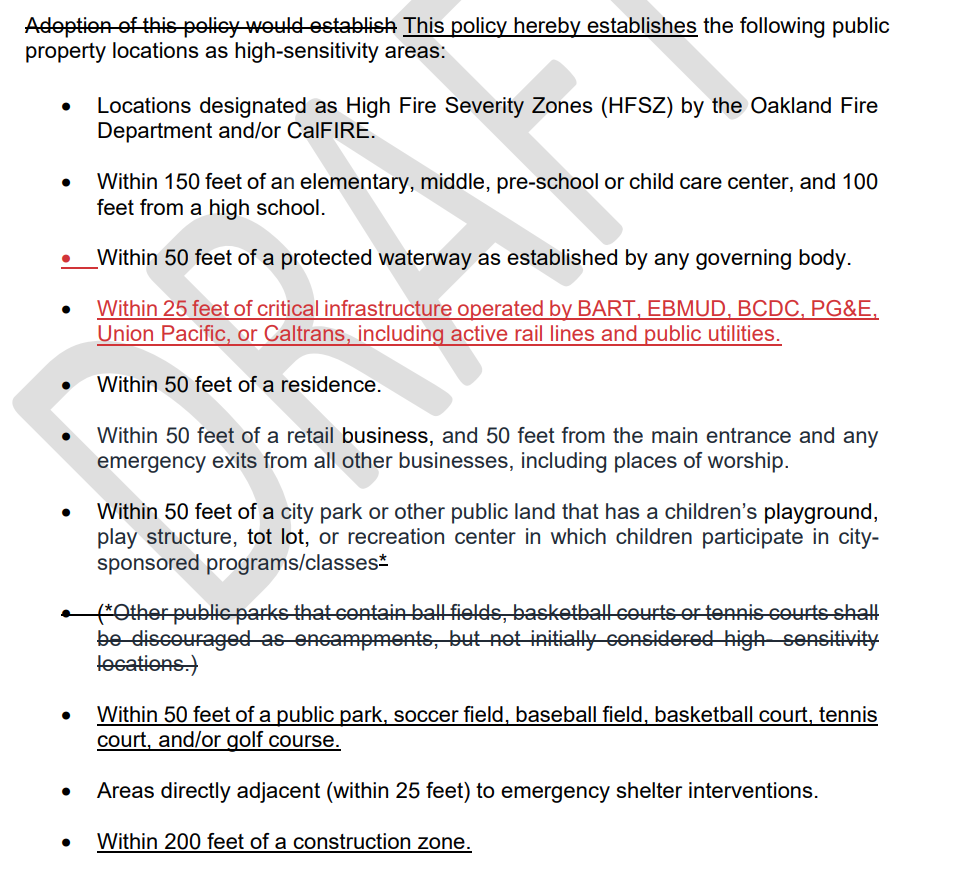
The original and current EAP proposes expansion of high sensitivity zones to include ALL public parks, not just those with playgrounds and youth-focused programming, as well as athletic fields and centers. The newer version of the EAP adds new prohibitions on proximity to BART and other utility installations—ironically an issue that has once again emerged as City sweeps have pushed homeless encampments back into those BART adjacent areas that were cleared years ago.
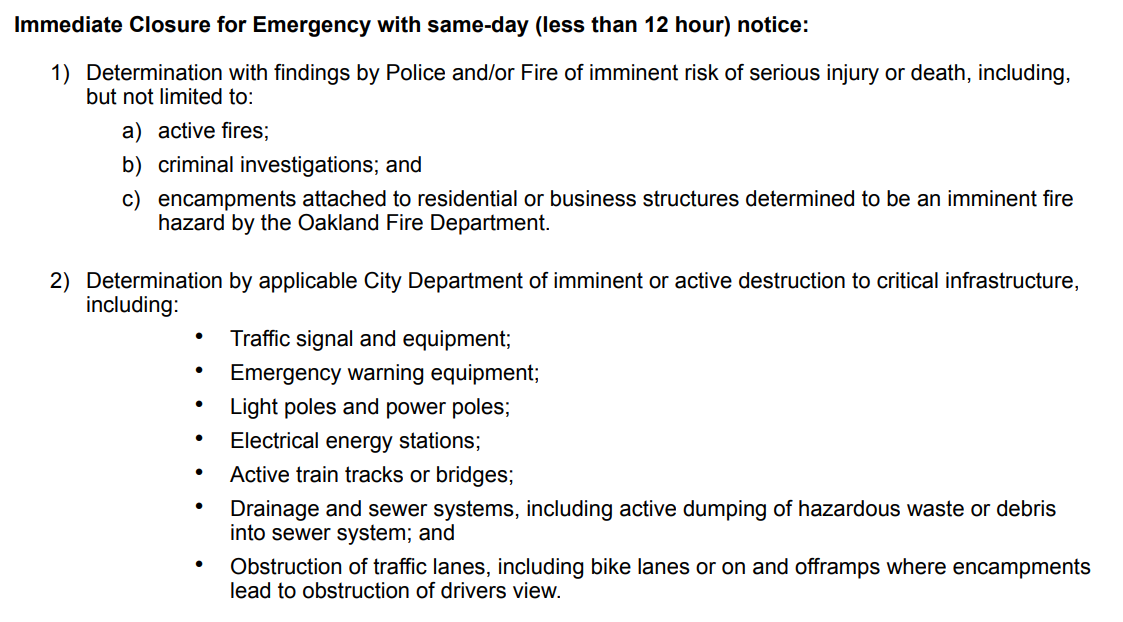
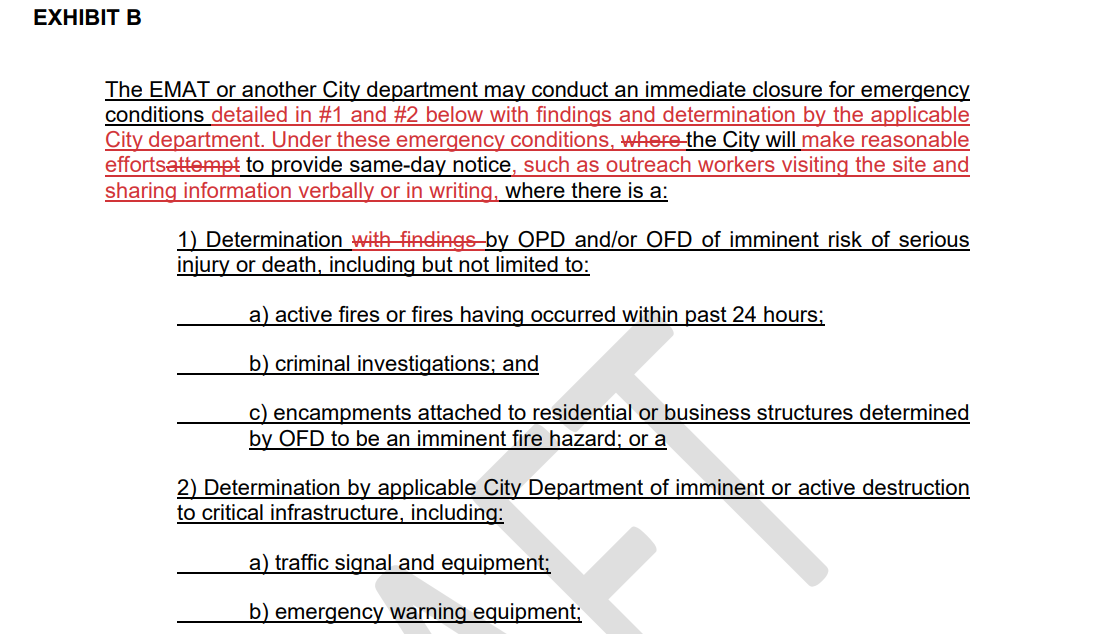
The EAP in its original and current form adds a policy for “emergency closures”, which is essentially former Mayor Sheng Thao’s executive order that sought to more fully flesh out very limited text on what constitutes an emergency in the original EMP passed in 2020. Emergency closures are divided into urgent and less urgent emergencies—the former allow same day closure, the latter 24-72 hour notice closure.
The EAP's removal of vehicle dwellings from the definition of a homeless encampment in the EAP remains. But after several rewrites, it’s become a source of confusion in the policy. As in the original EAP, tow/eviction of such dwellings would be carried out by the OPD at its own discretion—but that has been softened to some degree by what appear to be suggestions, instead of requirements, for outreach to vehicle occupants with offers of shelter if possible before eviction/tow.
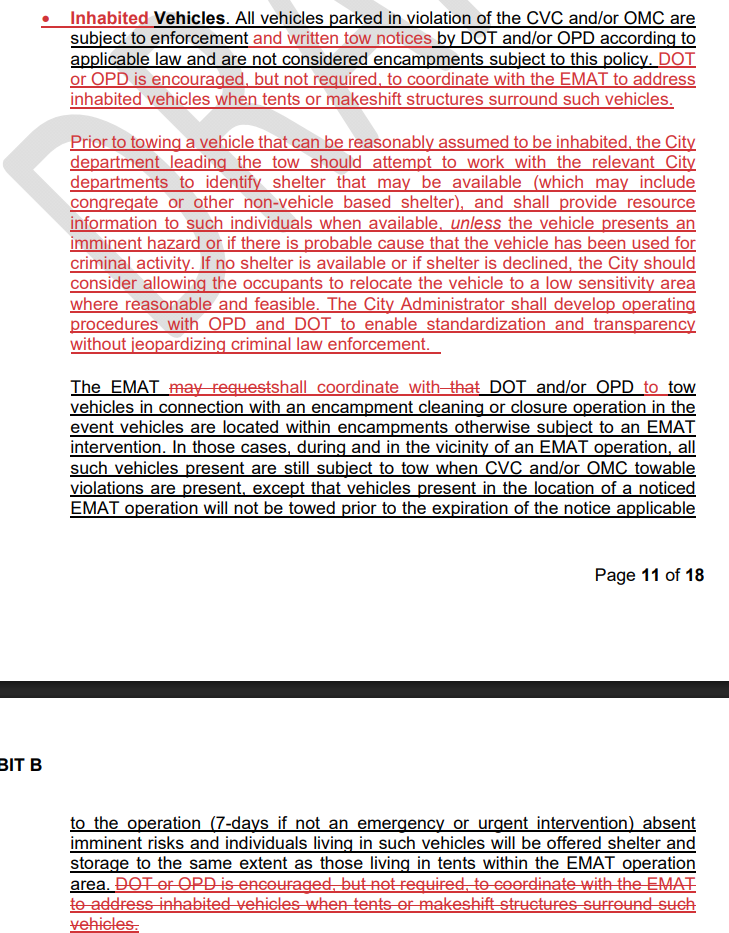
It’s unclear if the EAP envisions that outreach to be conducted by OPD, since the policy gives explicit authority over towing vehicles based on violations of the California Vehicle Code to the OPD or OakDOT–this again is left to the CAO to develop in practice. The policy becomes more inscrutable when such vehicle dwellings are considered to be part of a largely non-vehicle encampment that is being cleaned and/or closed under the EAP with requirements for noticing, outreach and shelter offering—it appears if a vehicle dwelling is part of a larger non-vehicle encampment, it receives the same considerations under the EAP that a non-vehicle dwelling would. The new wording leaves the question of what criteria the City would use to differentiate a vehicle encampment from a non-vehicle encampment subject to the EAP if both types of dwellings exist.
A requirement that vehicles be operable and registered has been removed from the EAP, but it’s not clear why, since the policy still states repeatedly that vehicles are subject to the California Vehicle Code, which requires vehicles parked in public to be both registered and operable, and that OPD has the ultimate determination of those.
Much of the 'Zero Tolerance' Pretense of Houston's Efforts was de facto Practice in 2024 and 2025
Unspoken in much of the Council and news discourse on Houston’s EAP is the fact that a large majority of encampments are vehicular, and that the City has since at least 2024 aggressively expanded displacement operations of those and adjacent non-vehicle encampments, causing what can only be described as havoc on Oakland’s homeless population. During many of these evictions, residents and observers have noted often no outreach has been conducted, no shelter has been offered, nor practices in the EMP followed.
As large scale closures, tow operations and evictions ramped up in 2025, many encampments have returned to areas adjacent to BART due to expanded eviction operations, for example. Some of Oakland’s legacy homeless encampments that the City invested hundreds of thousands of dollars into clearing over the last near-decade, including the city-owned lot under the 23rd street overpass and the area around 77th street and the Coliseum BART station, have also returned. The City’s inscrutable policy of evictions that could only push vehicular encampments deeper into East Oakland continued throughout Houston’s efforts to agendize the EAP, weakening claims it would be the progenitor of a more aggressive and definitive move against homelessness in Oakland.
With over 1,400 encampment closures in 2024 and 2025, it’s not clear what difference the EAP, originally based on a false premise that Oakland does not evict the homeless, will actually make to de facto city policy.
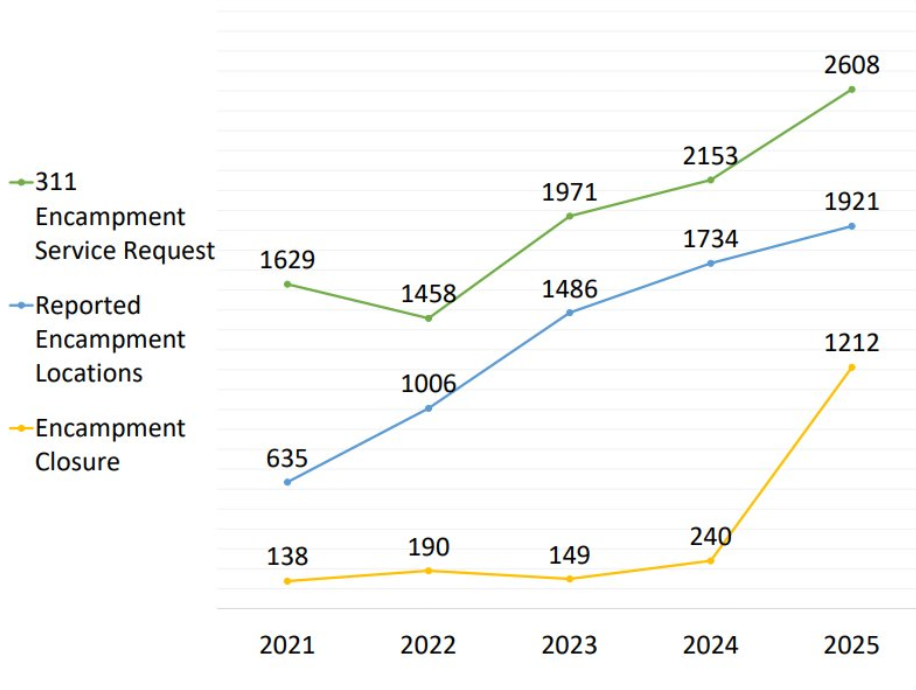
Regardless, in the new EAP proposal, the City Administrator’s office gains wide discretion on how to interpret and carry out the policies, including how to approach tows of inhabited vehicles and even what is considered a Low and High Sensitivity area– with authorization to simply repeal or add High and Low designations without required Council input.
In keeping with this inchoate theme, the CAO would rely on vaguely-sketched programs and processes, such as a “shelter dashboard” and a “written report identifying city properties that could be converted to shelter, low sensitivity areas, and/or safe parking sites” even as the City itself is closing safe/parking and community cabin sites. The policy also suggests outreach practices would offer programs that the City has not now or ever offered to homeless residents consistently, such as “transportation..." and "travel vouchers and vehicle buy-back opportunities”.



A non-exhaustive list of the original major changes to policy, changes to those changes, and new policy proposals that have been added since last November are below.
What Remains From Original EAP Version
—Removal of vehicles from encampment definition
—addition of all parks to high sensitivity encampment areas
—emergency and safety closures that integrate Thao’s executive order
What’s new from the Original EAP Version:
—written findings necessary for low sensitivity zone evictions
—removal of criminal outcomes for re-encampment
—removal of ADA issue designation
—more consistent language regarding requirements to make all attempts to offer shelter
—allowing CAO to make changes to high and low designated areas
—CAO will be responsible for developing practices based on the EAP
—new map with expanded low sensitivity areas
—barring encampments as high sensitivity areas within 25 feet of critical infrastructure operated by BART, EBMUD, BCDC, PG&E, Union Pacific, or Caltrans, including active rail lines and public utilities.
—transportation for individuals in targeted closure or partial closure sites
*following this, Houston's EAP was scheduled to a December 2nd meeting with sufficient notice, but withdrawn again as described later in this article.
**it should be noted that in the redlined recommendation on the policy issued by the ICH, there was not fundamental disagreements on the removal of vehicular encampments from the policy rubric
Comments ()